Sunday, 1 January 2017

Pinterest: Cataloguing the World: the bow loom and the inkle loom

Bow Looms.


Here are some images of bow looms in action.


I love this picture of a class in Taiwan all using bow looms with heddles. They all seem to be enjoying the experience.

A simple bow loom made from a rough branch.


Here is another picture of a bow loom with  heddles


This useful diagram shows how the bow loom works. A long warp can be used, as the extra warp is wound around the forked end of the stick.  The other end has an attached tape which could be used to tie the end around the waist of the weaver.

It is not the only image however. Here is a copy of a photograph of the artist Karin Larsson with one of her daughters.  She is weaving on a large bow loom which appears to be tucked under her left arm.

Carl and Karin Larsson with one of their daughters.  


The photograph is not clear as it is from an illustration in a book.


Bow looms do not have to be used with string heddles.  Here is a very simple bow loom for a tapestry woven friendship band. I bought a lovely little bow loom at Tacoma to use on a weaving open day for the Durham Guild.(see my blog for November 1st 2016 Durham Guild Open Day).

Small bow loom in action


My little bow loom was very popular.  I have warped it with more beads for my next demonstration!.

The complete loom

Close up of weaving with beads.

The beads are threaded onto the warp thread before warping the bow loom.  Half the beads are on one side and half on the other.  The beads are brought down to the fell of the band when needed.

It is very quick and easy to weave and a very good introduction to weaving for beginners.

Here is a link to an introduction to bow loom weaving. Bow Loom weaving preview:

Other simple looms.


Of course, these simple looms do not have to be bow shaped.  The loom can be a variety of shapes. Both these pictures come from Lithuania
a circular branch loom with a circular warp.

.

A forked branch used as a loom 


Weaver tensioned weaving.


It is fascinating to see how resourceful weavers can be.

Look at this picture of an Estonian weaver.  She is weaving a patterned band using a circular warp. The warp is tensioned by fixing one part to a hook on the wall and the other part goes around her left leg.  This means that she can alter the tension on the warp very easily and both hands are free to manipulate the heddle rod and shuttle.


An Estonian weaver in 1912

Here are two weavers in Cusco, Peru weaving in the Centre for Traditional Textiles. I took this picture in 2007. Here the loom is weaver tensioned.  The warp is attached to the fixed post and the other end of the warp is fastened around the waist of the weaver.  It is a backstrap loom.

Even with this simple equipment, patterns of astonishing complexity can be woven.  It was a joy to watch and a pleasure to support the weavers by buying textiles in the shop. I particularly liked the way that every textile for sale had a card with the weavers name on it. So often weavers are anonymous and yet their work should be celebrated.

Centre for Traditional Textiles, Cusco, Peru.


Here is a close up of the weaving.

Close up of the intricate weaving


An Early Inkle Loom?


Now for an update on my post about Pinterest. Click here to read my previous post about Pinterest: cataloging the World.  (July 1st 2016)
Here is the picture that I was trying to identify.  Is it an early illustration or a modern artists impression?


I asked members of the Braid Society and one member, Janis contacted Nancy Spies. Nancy kindly supplied the relevant links to the original illustration.

Here it is.  It is from Le Livre de bonnes moeurs de Jacques Legrand which dates to the 15th century. The probable date is 1490.  I have added the link address if you want to look at the other illustrations from this book.

"Le Livre de Bonnes Moeurs" 15th century, French, Chantilly (Musee Conde) OR Paris (BNF).  The web site is not clear, but apparently 77 pages of the MS are at Chantilly and 4 are in Paris.


It would be wonderful if someone could make a replica.  However, I think that a better quality picture would be required to see the detail. The original artist has depicted the threads and the wooden uprights so I would imagine that in the original picture the relationship between them would be more easily seen.

Pinterest

As I wrote in my previous blog on this subject, it is fascinating to see how ancient looms were depicted.  These images deserve to be examined more closely and compared to modern counterparts. Some surprising similarities and differences may emerge.  I do not yet have an answer to the mysterious depiction of the bow loom used for tablet weaving  illustrated in my previous blog about Pinterest. Here is the illustration again.

bow loom used for tablet weaving.  Where is this image?


If you want to see more images, do check out my Pinterest site.  One image can lead to another one on someone else's pin board. I am sure that you will love the search. Enjoy your own wander through 'a garden of bright images'.

Happy New Year.


Susan J Foulkes  January 2017


Thursday, 1 December 2016

Autumn Colours


Autumn Colours for inspiration


Autumn colours on the River Wear in Durham City

The FutureLearn course on the Power of Colour was very interesting. During the course I decided to take Autumn colours as a theme and design a scarf. I took this picture a couple of years ago.  At the moment the top of the cathedral is shrouded in scaffolding and is not so picturesque but the trees on the riverbank have been as glorious as ever.

On a recent walk I took this picture of autumn leaves on the path.

Autumn leaves
What a variety of colours in the leaves. Green, golden yellow, crimson red, brown, orange. I love autumn colours.

 The horse chestnut tree and its conkers are particularly colourful.


I looked at the yarn I have in my stash and chose colours to represent autumn and the lovely shiny surface of the conker.  I thought that a simple grey weft would be suitable.


Silk yarn for the warp and grey tussah silk for the weft. 
I wanted to try an unusual pattern and I thought of the shape of the conker.  I found a pattern of circles and adapted it. It was time consuming to thread the heddles accurately as you can see from the weave draft.


The Weave Draft.

The pattern uses 16 shafts and I used two shafts for a basket weave selvedge of 4 ends on each side. so 18 shafts in all.  The weave draft gives two full pattern repeats.  I have highlighted the centre and border of each repeat in colour so to make the pattern repeat clearer.

Weave draft for curved circles on 16 shafts.

Each pattern takes 32 warp ends.  I used 12 pattern repeats and 4 ends on each side for the selvedge. A total of 384 warp ends in all.

The weft in the picture is  2/20 Tussah silk in grey. I tried weaving with this yarn but it was too thick for the sett.  I chose a yarn remnant that I had of a fine pale yellow cashmere. This worked much better and the pattern of circles became more prominent. The yellow fits better with the autumn colour theme.

The silk is a 2/60 silk and I used it in threes. This meant that I could gradually shade the colours  across the warp.

I used a 10 dent reed threaded at three warp ends per dent : 30epi.
I think that this sett was rather tight and I could have used a slightly lower sett.

Here is the weaving on the loom. The shaded colours of the warp show up in the sunlight.
weaving on the loom


Here is a close up of the circle pattern whilst on the loom.


The weaving looks loose but the cashmere yarn will swell when washed. 

The finished scarf.

Here is the finished scarf. I found that washing softened the scarf to give a lovely cuddly finish. I was very pleased that the circle shapes are circles.  I tried hard when weaving to keep an even tension and beat but I was not sure whether the circles would remain circular once the scarf was off the loom. Using a different yarn for the weft may have altered the way in which the material set after washing. However, I need not have worried.


The silk warp ends are twisted for the fringe.


Network Drafting.

A few years ago, I wove a large scarf/stole for myself in Autumn colours.  I experimented with network drafting to achieve a swirly pattern.

Here is the weave draft. It is on 16 shafts with two additional shafts for the plain weave selvedge.


The stole is in 2/60 silk used double sett at 36 epi.

It is difficult to photograph.  The pattern seems alive when the scarf is draped and moving.

silk stole in Autumn colours
Silk never goes out of fashion.  I love the way it reacts with light to show up the pattern.


Happy Weaving.

My next blog will be in January when I will be updating my Pinterest blog from July 2016.   One of the mysteries has been solved thanks to a reader who was as intrigued as I was about the medieval pictures. The second post for January will be the four shaft handtowel pattern.

Have a wonderful festive season.

Susan J Foulkes December 2016

Tuesday, 15 November 2016

Traditional Handtowels in 10 shaft satin


Traditional Hand Towels


Swedish design is so crisp.  I love the clean visual effect of these traditional hand towels. They are easy to weave and of course you can vary the colour by changing the weft.  The weave structure is 10 shaft satin.

The satin is in two blocks: one block is on shafts 1 to 5 and the second block is on shafts 6 to 10. The large squares have 100 warp ends and the narrow stripes at each border have 15 warp ends.

Weave Draft.


Here is the weave draft.

draft for 10 shaft satin weave handtowels
The warp is unbleached 16/2 cotton.  The weft is 16/1 linen in green.  The sett is 48 ends per inch. No floating selvedge is required for this pattern.

Weaving the towels. 


close up of satin on the loom.
Here are the finished handtowels.  I wove them as presents for friends.

Three handtowels
I like this type of weave structure where the warp is one colour and the weft another.  It means that one warp can produce towels in different colours.  I wove one with green linen, one with blue linen and one with yellow linen.


Hanging tag


I wove a hanging tag for each of the towels.  Here is the pattern for the green towel.


closeup of hanging tag 


Linen hanging tag for hand towels. 


Linen handtowel tag
The tag was woven in 16/1 linen in natural and green. The number of warp ends is 51. The tag is 1.5 cm in width.


In the bottom of a drawer I have just found an old Swedish towel which was bought many years ago so I thought that I would add the picture to this blog.  I had been looking for it for some time.  It is a similar pattern to these handtowels but woven in much finer thread.  It is a large square and is suitable for drying dishes or drying hands.

Commercially woven towel bought in Sweden. 


  In January,  I will show a pattern suitable for a four shaft loom for a set of handtowels. Again the warp will be in one colour so the coloured weft can be varied.  I am putting the warp onto the loom today.

Happy weaving

Susan J Foulkes    November 2016

Tuesday, 1 November 2016

Durham Guild Open Weaving Day

The Durham Guild of Spinning Weaving and Dyeing had their Open Weaving Day on Saturday 15th October 2016 at St Oswald's Institute on Church Road in Durham City.

Here is a link to the Guild diary for 2016  http://www.durhamguild.com/Diary2015.htm_24.htm

Guild members were weaving using a variety of techniques and visitors encouraged to have a go at any skill they wish to try. Braiding, inkle loom weaving, table loom weaving, Kumihimo - there are so many techniques.

Everything was set up before we opened and there was a lovely display of work: finished work, work in progress and a variety of methods of weaving.
One side of the hall looking very colourful.


I took some ready warped rigid heddles so that visitors could try band weaving using a backstrap.

My Swedish band loom was warped so that visitors could weave a friendship bracelet. I used 16/2 cotton used double so that the band is 1.6 cm in width. The weft is black cottolin. I put on a very long warp so that anyone who  wove could cut off their piece to take home.  This proved very popular and all the warp was used.

My Swedish band loom set up with a long warp
I was pleased that we did have so many visitors who were interested and the warp was nearly finished by the end of the day.  One surprising visitor was the photographer from the local newspaper the Northern Echo. We had all just stopped for lunch but I was posed for a photograph with my loom.


I bought a lovely little bow loom at Tacoma to use on this weaving open day for the Durham Guild. Someone immediately wanted to try and became very proficient in weaving with the little beads as embellishment.  I am going to warp it up and take it along to the next Guild meeting as it is such a draw, easy to make and so easy to use.


The weaving is finished. 
A friendship bracelet.

Many Guild members had brought work to do and looms for visitors to try.

Sue is weaving an interesting tapestry.

The lettering is lovely.
She is using a Roman inscription.

There is a  subtle use of natural colours.


Douglas brought his trusty table loom and is in the process of warping it with lovely colours to make another tartan.
A tartan warp.
The wonderful Ashford Knitters loom was also being used and showing how very versatile this simple loom can be. It is such a comfortable weaving position.
lacy weaving on the Knitters Loom.

The Louet table loom was there with some experimental weaving by Norma.

Eight shaft table loom 
There was a small display of bookmarks from the National Exhibition.  Every Guild could submit bookmarks and it is a great opportunity for a variety of crafts to display their skills in miniature.


Inkle looms were ready warped for hands on experience of weaving.  Ann brought along two inkle looms and some portable kumihimo equipment. All fueled by mugs of tea!

Inkle looms ready to try and simple portable kumihimo equipment brought by Ann.


There were lots of examples of finished pieces of weaving for visitors to handle.

Note the Navajo spindle and expertly made inkle loom.

And of course, for those members who do not weave, there was the spinners corner.

Busy bee corner.

My display of Woven Bands from around the Baltic.


I brought along my display which shows the different woven bands from around the Baltic.  The stunning wooden heddle which I am using at the moment was made by Gunnar Karro from Estonia. I asked him to make a motif from the White Horse in Uffington. He sells his wares on Etsy and I can recommend the quality of his products.


The curved shuttle has a matching motif to the heddle and there is an elegant stand for them both. I wove a patterned band in cotton and made it into a guitar strap which is shown next to the heddle. It has nine pattern threads.

It was a very busy day and we did have some people who have joined the Guild as a result.

Susan J Foulkes November 2017

Saturday, 15 October 2016

Handwoven in Ireland


In September we spent a month travelling around Ireland.  It was a wonderful journey taking in prehistoric sites, the islands and the towns of Kilkenny, Cork, Galway, Dublin and Youghal where my husbands family came from,  Youghal came to international fame in the early 1950's as the setting of the John Huston film, Moby Dick which was produced in 1954. A public house overlooking the harbour was used in the shooting of the film. It has a display of  photographs taken of the cast and crew during the making of the film. John Huston used the bar as his headquarters to plan each day's filming. Youghal's nineteenth century lighthouse is also shown in the film.

Youghal harbour


As a handweaver, I am always on the lookout for outlets selling handwoven products. I love seeing what other weavers are producing.  I would like to share one of these outlets with you this month - others will follow in future posts.

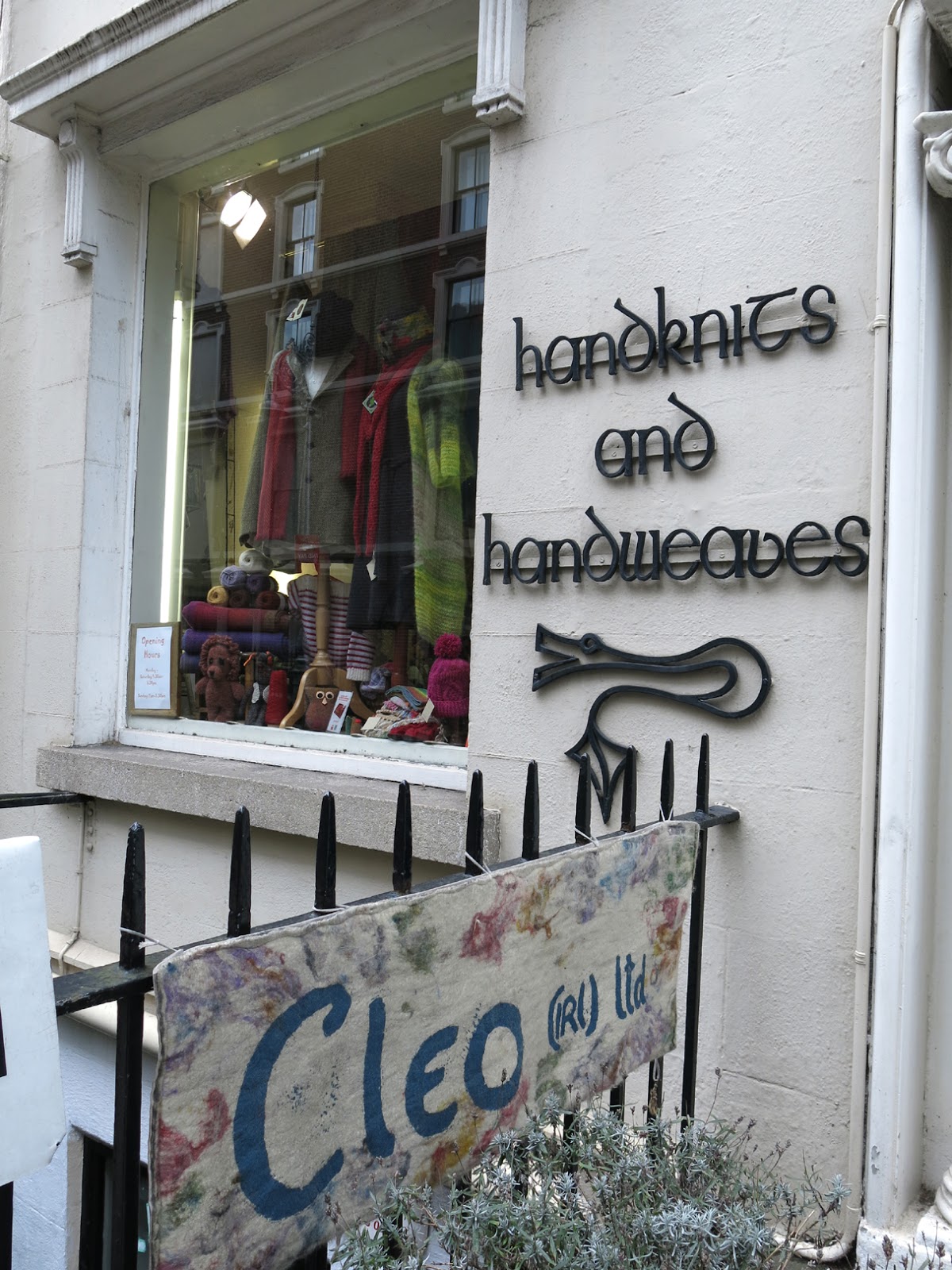
In Dublin near the National Museum and just around the corner from St Stephen's Green is Cleo.


The large sign on the wall proclaimed handknits and handweavers so I had to explore.


In Ireland, the interest in handcrafted Irish goods was stimulated by the opening of The Country Shop in St Stephen's Green in December 1930 by Muriel Gahan.  This was the start of a revival of traditional Irish crafts and brought the variety of Irish handmade wares to the capital.  It was not the first shop to sell Irish craft but it was a non-profit making venture to support the traditional craft workers in rural Ireland. Unfortunately this closed in 1978.

Cleo has been around for 70 years.  It is a family business that the grandmother of Sarah Joyce the current owner, established in 1936. Initially Cleo's sold children’s clothes but in the post-war years Sarah’s grandmother realized there was an increasing number of tourists, especially Americans, visiting Dublin and she started to stock hand-knitted sweaters from the Aran Islands for the new influx of visitors to buy as souvenirs of their visits to Ireland.

Look at the beautiful railings.

Railings outside the shop


The present shop is a riot of colour as you can see from the window display.


Here is a close up of a shawl displayed outside - just the thing for the colder weather.

The lovely shawl - so beautiful to touch.

The shop has a number of handweavers who supply items for sale. Beth Moran (Ballytoughey Loom) is based on Clare Island and makes naturally dyed rugs from her own sheep, and a wide range of shawls, blankets and silk scarves and ties. Also Liz Christie, Co. Monoghan, Deirdre Duffy (Wild Cocoon), Máire Ní Taigh, Galway and Helena Ruuth who is sadly no longer weaving.
The shop is a treasure trove and piled high with interesting items, including wool. The colours glow like jewels and there are some fascinating items to be found.

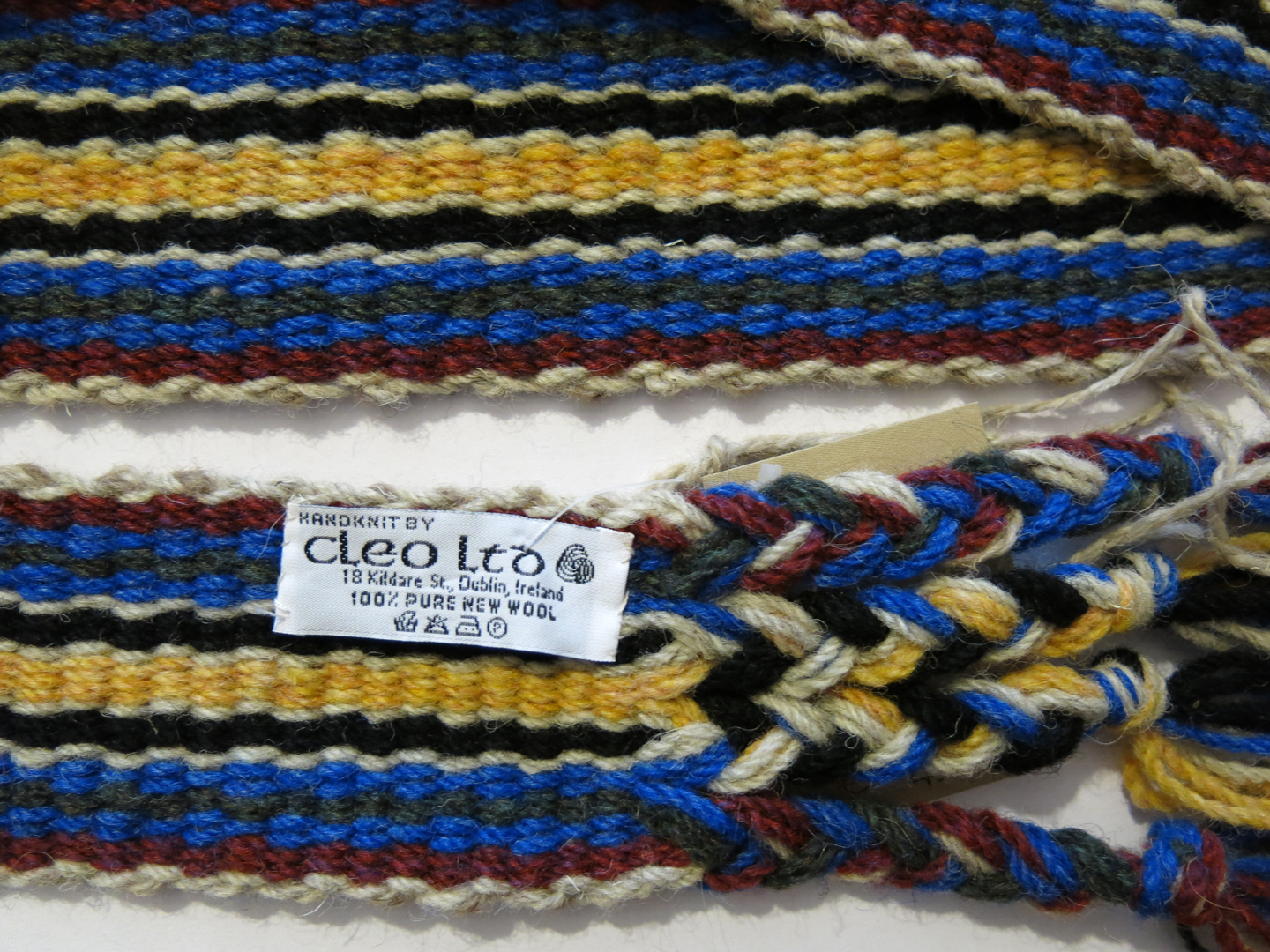
My interest, as you know, is for handwoven belts and I was delighted to find a display of handwoven Crios.


The Crios that I bought in Dublin

This was woven by John McAtasney who is in his 80's. He started weaving in 1948 at the age of 14.

This is a sturdy strap and is woven using Irish wool from Donegal and Kerry woollen mills with the coarse quality of Irish wool.  It is 6 cm (2.5 inches) in width and  190.5 cm (75 inches) in length. There are four plaits on each end about 12.5 cm  (5 inches) in length. It is a plain weave, warp faced band.

Of course it does not need to be used as a belt. Here is another of his Crios used as a guitar strap.


Here is one of John's crios used as a guitar strap.

I wanted to find out more about John who specializes in handwoven blankets, damask linen and criosanna.

I found a short YouTube video of John McAtasney weaving on a loom in the Ballydugan weaver's house in the Ulster Folk Museum.

https://youtu.be/D1mKWyRCnXE

He even has a dedicated poem!  See it at  http://www.craigavonhistoricalsociety.org.uk/rev/mcelroykscutchmill.html

I feel very privileged to own a Crios handwoven by a such a fascinating master weaver.

I found this shop by accident as I was leaving the National Museum.  If you are in Dublin, do go to 18 Kildare Street for a refreshing and colourful encounter with genuine Irish crafts.

I will be visiting Ireland again in future blogs to tell you about my textile adventures.

Susan J Foulkes