Showing posts with label inkle loom. Show all posts

Monday, 1 May 2023

Weaving a tubular cord on an inkle loom and with a weaving disc.

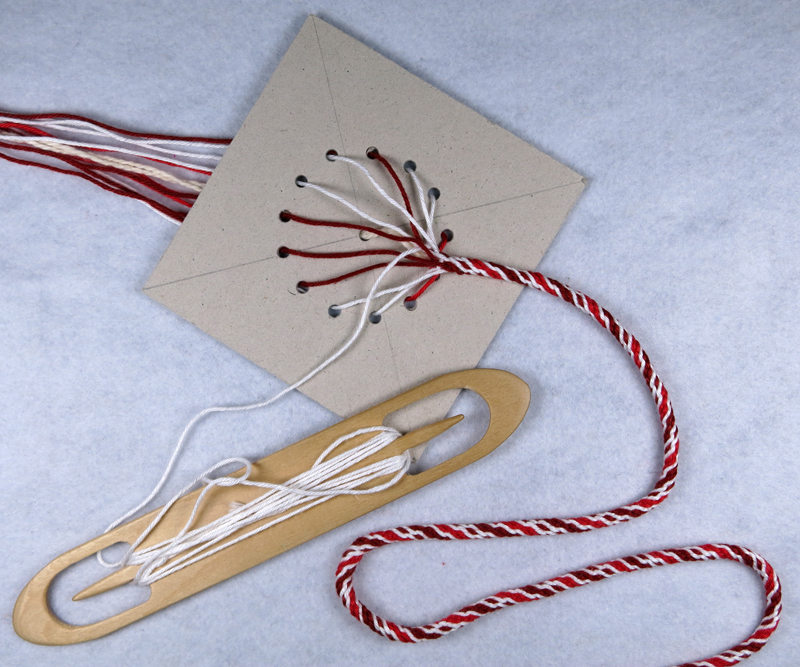
Weaving a filled tubular cord with a weaving disc. 


 This blog accompanies two articles in the Journal for Weavers, Spinners and Dyers.   https://journalwsd.org.uk/

Journal for Weavers, Spinners and Dyers, 285 Spring 2023  A Weaving Disc - an exploration of history and uses. Part 1,  and 285 2023, Summer, A Weaving Disc - part 2. 

What is disc weaving?

I have been exploring a little known weaving implement: a weaving disc. The disc seems to have originated in Indonesia but also appears in Lithuania and Russia.  

These weaving discs are be made with a odd number of holes around the edge and a central hole for the filling material. I have used discs with 13, 15, 19, 21 and 25 holes.

A filled tubular cord can be woven using a disc with a circular arrangement of holes and a central hole for the core thread. It produces a cord with a firm structure and the angle of twist can be altered whilst weaving. 
 
However a tubular cord can also be woven on an inkle loom. It is useful to examine this type tubular cord before examining the filled tubular cord. 


Weaving a tubular cord on an inkle loom


 Inkle Loom.

Weave drawdown for 13 threads

There are thirteen warp ends alternately threaded across the loom either through a heddle or over the top of the bar. There are two sheds so the weave structure is plain weave. The weft pulls the warp threads close together so the band itself is warp faced plain weave. The warp threads are in a single horizontal layer across the inkle loom. 

Weaving a flat band

The band loom cord was first woven as a flat band. The shuttle was entered first from one side then the shed was changed and the shuttle entered from the other side. 


Weaving a tubular band

To weave a tubular cord the weft was continually entered from the same side and pulled tight. This pulls the flat band around on itself so that the tube is formed. 

The twist in the pattern occurs because the weft spirals whilst weaving even though the warp threads are in a horizontal line. This twist is permanent and cannot be varied.


Weaving a filled tubular cord with a weaving disc. 

What is disc weaving?

With the warp ends arranged in a circle and a central core thread, a patterned cord can be woven in warp-faced plain weave. The weft is not visible as the warp ends are pulled tightly together. The central core thread makes the cord strong. 

The weft is entered from the same side for the whole of the weaving. The disc is rotated. This means that unlike other weaving methods, the warp is not in a static horizontal plane but moves around as the weft is entered. 

As there are no books about this technique I had to experiment to find out the most efficient and effective way of weaving.  I discovered that the disc itself does not need to be circular. It is the pattern of holes that need to be arranged in a circle. 
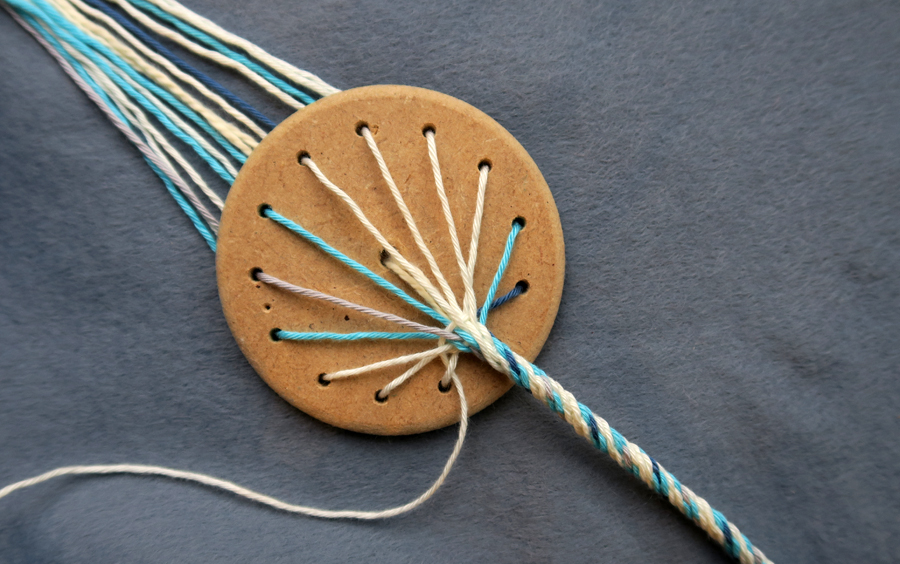


A disc with 13 holes and a central hole


A cardboard square with 13 warp holes
 

Visualising the spiral pattern. 

The  SeiZenn - Band Weaving Pattern Editor. This is an amazing resource. This can be found at: 

  https://www.raktres.net/seizenn/#/

The software now includes a disc option which you can access from the home page. Here is a quick link. 

https://www.raktres.net/seizenn/#/disk  This means that you can design a pattern for your tubular cord using this software.  It is a great addition to a weavers box of tools.

Here is a 13 thread pattern using this software. 


Here is the same 13 warp thread pattern as shown in the drawdown for the inkle loom but here you can see it as a spiral woven tube. 


close up of the filled tubular cord.

I also made a YouTube video to accompany the two articles :  Disc Weaving: making a tubular filled cord 

  https://youtu.be/W7miDg2bix4

The video demonstrates how to start weaving; how to find the point of weaving and how to weave. The thickness of the core threads alters the feel and flexibility of the cord. 

These  cords are flexible and have many uses. They can be made in a variety of threads: cotton, silk, wool and with a variety of core materials.  I have woven cotton cords with raffia, jute and rattan as the core thread.


Susan J Foulkes May 2023


Monday, 1 January 2018

Cataloguing the World 3: The Inkle Loom.


Do you remember this image from my previous bog about inkle looms from January 2017 .  Whilst on holiday in Finland in September we visited Turku, the old capital of Finland.
Turku castle was restored after the war and is a must see sight for anyone visiting the town. 


Turku Castle, Finland

The dining tableau.

In one room, the displays were captivating. The centre of the room had a tableau of mannequins in period costume. The information was extensive. Displays around the room had various artefacts relating to costume. One had this picture as a backdrop.
I did not expect to see an enlarged picture of the inkle loom.


It is from Le Livre de bonnes moeurs de Jacques Legrand which dates to the 15th century. The probable date is 1490.

The close up gives the detail of how the weaving is threaded around the posts.  Unfortunately as the weaving has not started, the process is unclear. 

Inkle looms now come in various shapes and sizes.  There is a wonderful variety available, particularly in the USA.


In this upright model the weaver has a good view of the woven band. 


Double sided looms are also popular.  The pegs will not bend in use and the whole loom is very stable.


This one is illustrated in the Estonian band weaving book. Again with a removable side, the pegs will stay level and will not warp.


This crescent shape is so elegant.


You can even make one out of a cardboard box!


Another home made loom. 


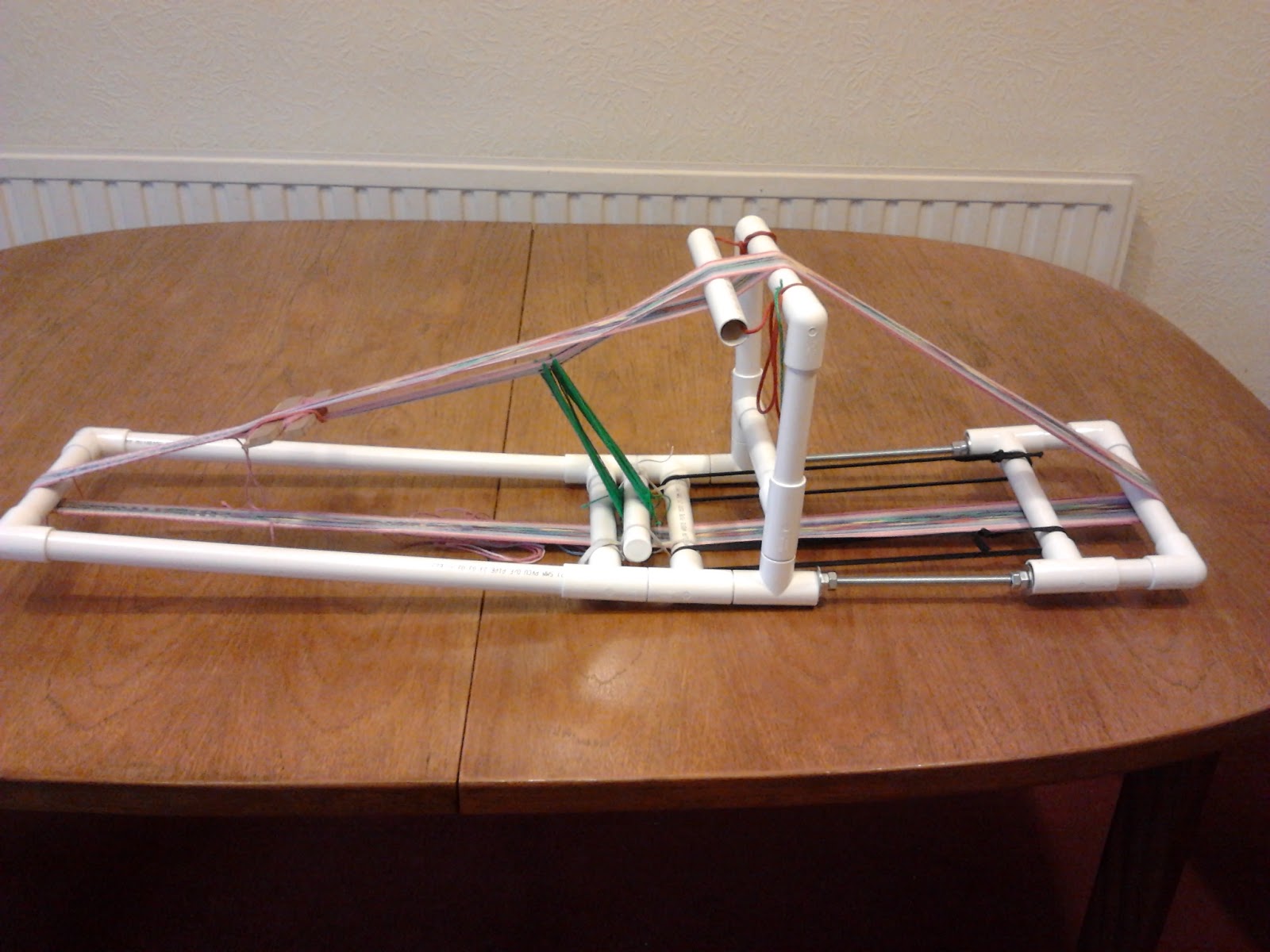
This loom was made by Margaret Parker and her husband out of waste water pipes.

They made it following the instructions in the link to an Interweave Press booklet on band weaving, but it was difficult to understand how to get the two sheds. The geometry of the loom, the path taken by the warp and the position of the heddle and shed sticks seemed to make this impossible. They made some modifications: .

- made the heddles at least twice as long which means there is  nowhere on the loom which can be used as a former for  making them.
- tied the shed rod firmly once we had got it in place.
- use hand manipulation to get the two sheds

Although it seems bow shaped it works well. As it is not as rigid as a wooden inkle loom it can become a bit skew whiff (or wonky!) with use but it is easy to straighten it all out again from time to time and make it all the angles sit at 90 degrees. This does not seem to affect the tension across the width of the weaving.
Inkle looms are expensive, so this cheap alternative is ideal for someone who would like to try this craft. York and District Guild of Weavers Spinners and Dyers have planned an informal workshop for people interested to make their own from this plan.

Floor inkle looms


I have a floor inkle loom given to me by a friend.  It is not in the best of conditions but it works. The earliest floor inkle I have found is from Scotland.  It is dated 1688. My floor inkle loom has a sliding peg in the centre collumn so that the tension can be altered.


A Scottish floor inkle loom dated 1688

Floor inkles also come in a variety of shapes. Some give the opportunity to make very long band indeed. This is being used for tablet weaving but is also designed for inkle weaving.

This lovely floor Cendrel inkle by Leclerc looms is an updated and very practical design  What I particularly like is the fact that it can be used as a warping frame as well.

http://www.leclerclooms.com/ind_eng.htm

The Cendrel floor inkle loom and warping frame


These two versions are very attractive and allow for a very long warp. They look very stable and there is plenty of room for the weaver's legs. 


Here are two Swedish band looms which give the weaver the choice to weave as an inkle loom with heddles or with two shafts to make the sheds. 


This is my Swedish band loom with my own handy brackets for warping.


Finally, I found a picture of this tape loom.  It is not an inkle loom but has two rigid heddles operated by foot treadles.


It is a fascinating version of a tape loom from the Landis Valley Farm Museum, a museum that documents Pennsylvania German culture and history. This museum looks wonderful and I would love to visit it.

I was particularly interested in this unusual design because of the picture in the frontispiece of a book from 1524.


This is a page from the  Ein new Modelbuch by Johann Schönsperger the Younger (German, active 1510–30) and dates to 1524. You can see the large loom on the bottom left of the engraving which shows a woman weaving a narrow band using a rigid heddle. Examine the original image here:

https://www.metmuseum.org/art/collection/search/354660

She appears to have two pedals to use but there is no connection between the pedals and the rigid heddle. 


Tablet weaving

Of course there are also some very creative designs for tablet weaving.

A table tablet loom with a very long warp.

An elegant design for a short warp.


This looks very stable and ornate with the horses head carving.


A magnificent tablet loom which looks as though it should have been used by the Vikings.


This is a very interesting variation.  This design allows for the warp ends to be untwisted when weaving with tablets.  The warp can be as long as will pack onto the warp beam at the front.


A big thank you all the Museums, Universities and Galleries who are taking the time to digitise their collections and to Pinterest for providing a way for people with similar interests to share their finds.

Happy New Year to everyone.  Enjoy your weaving.
Susan J Foulkes January 2018

Sunday, 1 January 2017

Pinterest: Cataloguing the World: the bow loom and the inkle loom

Bow Looms.


Here are some images of bow looms in action.


I love this picture of a class in Taiwan all using bow looms with heddles. They all seem to be enjoying the experience.

A simple bow loom made from a rough branch.


Here is another picture of a bow loom with  heddles


This useful diagram shows how the bow loom works. A long warp can be used, as the extra warp is wound around the forked end of the stick.  The other end has an attached tape which could be used to tie the end around the waist of the weaver.

It is not the only image however. Here is a copy of a photograph of the artist Karin Larsson with one of her daughters.  She is weaving on a large bow loom which appears to be tucked under her left arm.

Carl and Karin Larsson with one of their daughters.  


The photograph is not clear as it is from an illustration in a book.


Bow looms do not have to be used with string heddles.  Here is a very simple bow loom for a tapestry woven friendship band. I bought a lovely little bow loom at Tacoma to use on a weaving open day for the Durham Guild.(see my blog for November 1st 2016 Durham Guild Open Day).

Small bow loom in action


My little bow loom was very popular.  I have warped it with more beads for my next demonstration!.

The complete loom

Close up of weaving with beads.

The beads are threaded onto the warp thread before warping the bow loom.  Half the beads are on one side and half on the other.  The beads are brought down to the fell of the band when needed.

It is very quick and easy to weave and a very good introduction to weaving for beginners.

Here is a link to an introduction to bow loom weaving. Bow Loom weaving preview:

Other simple looms.


Of course, these simple looms do not have to be bow shaped.  The loom can be a variety of shapes. Both these pictures come from Lithuania
a circular branch loom with a circular warp.

.

A forked branch used as a loom 


Weaver tensioned weaving.


It is fascinating to see how resourceful weavers can be.

Look at this picture of an Estonian weaver.  She is weaving a patterned band using a circular warp. The warp is tensioned by fixing one part to a hook on the wall and the other part goes around her left leg.  This means that she can alter the tension on the warp very easily and both hands are free to manipulate the heddle rod and shuttle.


An Estonian weaver in 1912

Here are two weavers in Cusco, Peru weaving in the Centre for Traditional Textiles. I took this picture in 2007. Here the loom is weaver tensioned.  The warp is attached to the fixed post and the other end of the warp is fastened around the waist of the weaver.  It is a backstrap loom.

Even with this simple equipment, patterns of astonishing complexity can be woven.  It was a joy to watch and a pleasure to support the weavers by buying textiles in the shop. I particularly liked the way that every textile for sale had a card with the weavers name on it. So often weavers are anonymous and yet their work should be celebrated.

Centre for Traditional Textiles, Cusco, Peru.


Here is a close up of the weaving.

Close up of the intricate weaving


An Early Inkle Loom?


Now for an update on my post about Pinterest. Click here to read my previous post about Pinterest: cataloging the World.  (July 1st 2016)
Here is the picture that I was trying to identify.  Is it an early illustration or a modern artists impression?


I asked members of the Braid Society and one member, Janis contacted Nancy Spies. Nancy kindly supplied the relevant links to the original illustration.

Here it is.  It is from Le Livre de bonnes moeurs de Jacques Legrand which dates to the 15th century. The probable date is 1490.  I have added the link address if you want to look at the other illustrations from this book.

"Le Livre de Bonnes Moeurs" 15th century, French, Chantilly (Musee Conde) OR Paris (BNF).  The web site is not clear, but apparently 77 pages of the MS are at Chantilly and 4 are in Paris.


It would be wonderful if someone could make a replica.  However, I think that a better quality picture would be required to see the detail. The original artist has depicted the threads and the wooden uprights so I would imagine that in the original picture the relationship between them would be more easily seen.

Pinterest

As I wrote in my previous blog on this subject, it is fascinating to see how ancient looms were depicted.  These images deserve to be examined more closely and compared to modern counterparts. Some surprising similarities and differences may emerge.  I do not yet have an answer to the mysterious depiction of the bow loom used for tablet weaving  illustrated in my previous blog about Pinterest. Here is the illustration again.

bow loom used for tablet weaving.  Where is this image?


If you want to see more images, do check out my Pinterest site.  One image can lead to another one on someone else's pin board. I am sure that you will love the search. Enjoy your own wander through 'a garden of bright images'.

Happy New Year.


Susan J Foulkes  January 2017