Showing posts with label Crios. Show all posts

Friday, 1 December 2017

Inspiration Ireland

I enjoyed a fantastic holiday in Ireland in 2016 and we will be returning for another holiday next year. Researching ancestors and visiting new places is always exciting. We take lots of photographs which are also useful as inspiration for weaving.

The Aran Islands are amazing. The scenery is so different from the type of farmland that I am used to.  A small island means that every space is utilised.

Look at these pictures of the fields and stone walls from Inis Oirr.  The weather was misty which added a lovely feel to the scene.  When the clouds parted the green fields seemed to sparkle.

irregular walls


an evocative landscape


I loved the way the colours of the stonework and the fields changed as the clouds, sun and mist altered the light.  They reflected the mood of the weather.  Looking at the images afterwards I was stuck with the irregular pattern of the walls and the many shades of green.  I wondered whether I could capture this in a weaving design.

A few years ago I spent many happy months experimenting with deflected weave structures. I examined my too large yarn stash and wondered what I could use to give a feel for this wonderful landscape.

I thought of a pattern with grey silks for the borders.  It is an eight shaft design with two further shafts for plain weave selvedges. The weave is a two shuttle weave.


Drawdown.


I used two qualities of silk, a light grey tussah silk and four strands of dark grey 2/60 spun silk to represent the walls. These outlined the green areas.  I had three shades of green silk for the grass areas and a lighter shade for the weft.


Warp: 2/20 light grey tussah silk sett at 20 epi.       2 ends per dent in a 10 dent reed.
2/60 silk used double in shades of green sett at 30 epi.       3 doubled ends per dent in a 10 dent reed. I shaded the green colours across the width of the scarf.

Weft: I used a lighter shade of green silk for the grass areas which I thought would help to meld the other greens together. This was 2 strands of 2/60 silk. For the walls, I used a grey 2/60 silk with four strands. I used two colours of grey silk hoping to provide a contrast and to reflect the changing greys of walls in the photograph.  There are 50 groups of cells.

Total number of warp ends:   500 plus and extra 8 tussah silk to balance the pattern.  508  ends in all.

Width of scarf: 18.5 inches.


close up of the scarf showing the structure


The finished scarf

Although I enjoyed the designing and weaving of this scarf I am not happy with the final look. The green silk across the warp is not shaded sufficiently and the green colours needed to be brighter.


We will be going back to Ireland and the Aran Islands next year. I loved the country and the people I met.

The ferry to the Aran Islands


The Handwoven Belt of the Aran Islands. 


The crios is part of the heritage of the Aran Islands and demonstrates the creativity of the women who devised and wove them. 

Cleas Crafts on Inis Oirr was a delight and I am looking forward to another boisterous boat ride to the island. They were very  helpful when I was researching crios weaving. I was particularly thrilled to buy a crios that had been handwoven on the island. Cathleen, the outlet manager,  showed me how to tie the crios how the crios was traditionally tied around the waist

Here is the short YouTube video:
How to tie the crios.    https://youtu.be/Z5jfQJGD5eE


My latest article has appeared in the Journal for Weavers, Spinners and Dyers.  http://www.thejournalforwsd.org.uk/home


My article is called: The Crios: A Weaver's Quest.  It describes my research journey to Ireland and the Aran Islands to find out more about the crios.  For the article I made a YouTube video showing the different ways in which a crios can be woven. 

Here is link to my Youtube video Six Ways to Weave a Crios.


My next blog will be in the New Year.  

A Happy Christmas and a delightful festive season to everyone. 

Susan J Foulkes (December 2017)


Wednesday, 1 February 2017

Weaving in Ireland

I promised that I would do another blog about my trip to Ireland. My previous blog showed the start of my journey. Click here to read it. https://durhamweaver64.blogspot.co.uk/2016/10/handwoven-in-ireland.html

We stayed in Galway, an attractive and interesting city. It will be the European Capital of Culture in 2020. Having been to Liverpool in the UK  and Umea in Sweden when they were Capitals of Culture, I can recommend a visit in 2020 to Galway.  We hope to visit Aarhus in Denmark this year as they are the Capital of Culture in 2017.

The camp site site was in an idyllic spot overlooking Galway Bay.  We stayed for 6 days and the weather was mostly fine. One night there was a storm with 60 -70 mph winds coming straight towards us.  Fortunately our motor home is sturdy and so the movement in the wind was not too violent.

Overlooking Galway Bay - an idyllic view. 

We took a second trip to Inishmore from  Ros a' Mhíl.  The bus journey to the harbour was a good way to see the countryside and takes nearly an hour.  On the way we passed the entrance to Spiddel Craft Village.  Unfortunately the bus did not stop but it looks like a place to visit next time we go to Ireland.

Spiddel Craft Village from the bus.

Inishmore


The ferry to Inishmore was very efficient and it was a smooth journey.  I wanted to visit the craft shops to see if there were any criosanna for sale.  Kilmurvey Craft Village is another popular tourist stop. We cycled out to Kilmurvey and I visited every craft centre there but no-one had any crios for sale. There were only two outlets that said they would normally stock them but as it was the end of the season, they had none left.


Kilmurvey craft Village
The cycle ride was exciting and the leisurely pace meant that we could appreciate the beauty and the scenery of the island.

At Kilronen, there were a few craft shops but no-one here sold crios. However, there was a lovely selection of wool and of course plenty of Aran sweaters. We went for a long walk up to the black fort.

The famous Aran Sweater Market in Kilronen.


A colourful wall of wool.


Galway

However, Galway was lovely to explore and here I  found O'Maille on the High Street.  This is an absolute must to visit if you like traditional crafts of knitting, weaving and spinning.
Here is the web site.  https://www.omaille.com/

'Slow is Good'.

I had a long conversation with Anne Ó Máille, seen in my photograph.  Everything for sale in the shop is made in the traditional way. Yes, she did have some criosanna for sale which had been hand woven on Inis Oirr.

Anne Ó Máille holding the crios I bought.

She was a fountain of information and stories.  The Aran sweaters for sale in the shop are woven in a traditional way without a pattern.  Her supply of knitters who are skilled enough to weave like this is dwindling but their work is superb.

The shop has been established for some time.  This link gives further details about her knitters.
https://www.omaille.com/wild-geese-interview/

The photograph on the wall shows some of the cast and director of The Quiet Man, a film made on location at Ashford castle in 1951.  All the costumes were made of tweed supplied and tailored by the shop. (see the web site for further details).


close up of the photograph showing John Wayne
I bought a crios but also some lovely delicately coloured sock yarn  This was a relatively new line for the shop but she was keen to encourage quality Irish yarn. As Anne emphasized 'Slow is good'. She wanted to encourage quality goods made with care.

I bought a pack of four colours of sock weight yarn from mixed mountain fleece.   http://www.stwistwool.com/

I contacted the spinner about his wool as I wondered whether it would be suitable for weaving.

Diamuid was most helpful and told me a bit about the background to his company, S Twist Wool.

His introduction to the world of yarn started when he first learnt to weave after leaving school.  He spent a year in Stroud, Gloucestershire learning under a weaver there. His company,  S Twist Wool produces yarn for knitters.

The wool is collected from local farmers in the Kilkenny / Tipperary region and is washed using a natural fermentation method. This ensures that no harmful chemicals are used. All the washing is done by hand and the wool is dried in the open air.
Mindful of a carbon footprint, all of the natural dyes are gathered locally.  Making a decision about which dyes to use was made after extensive testing and hundreds of samples.  Finally, three local dyes were found which are fast enough to be offered. A lot of the experimentation centred around low-energy dyeing methods, such as solar and fermentation dyeing.

The colours of the sock yarn I bought are lovely and delicate. It was difficult to choose which colour pack to buy. I also bought a crios in the shop. When I got home I decided to weave my own design using this lovely coloured wool.


One skein has been wound ready for warp making.
It has been a long time since I wound yarn into balls from skeins.

The yarn is now ready for making the warp. 

I needed to weave a sample and make a warp long enough for a belt.  I was not sure how much yarn I would need, particularly as the white is used both for the warp and weft. Fortunately I had enough white to finish the belt.

Weave Chart


weave chart for the crios using four colours of wool.

The weave chart shows the colour order for threading. This chart is set up for two shafts and plain weave. I used 6 shafts to weave plain weave so that I could spread the warp to reduce the amount of friction on the warp ends.

There are 54 warp ends. I wove a short sample at 16 epi but the weave structure was too open.  The crios I bought is warp dominant.  I increased the sett to 20 epi and this made the woven fabric similar to the belt that I had purchased.

I wove the belt on my Louet table loom using six shafts.

weaving on the table loom.
The shuttle is on of my favourites and was hand made by Gunnar Karro. His shuttles and heddles are a real delight to handle.

close up of shuttle and fabric. 

Here is a picture of the finished belt.


It is 185 cm in length. The width is 6 cm  The crios that I bought in Galway is 175 cm in length and the width is 4.5 cm.
The wool is lovely to handle and I enjoyed the challenge of designing and weaving a belt.

There will be a further blog about Ireland in the future. There was so much to see, do and enjoy.


I have just finished a lovely book about the Aran Islands - it covers geology, archaeology, history, folklore, cartography, flora and fauna and history and more! It is Stones of Aran, Pilgrimage by Tim Robinson. He uses place names to recover stories of Aran in a discursive ramble around the perimeter of the island. It was first published in 1976 and I bought a second hand copy.


Happy weaving and happy reading.

Susan J Foulkes February 2017

Saturday, 15 October 2016

Handwoven in Ireland


In September we spent a month travelling around Ireland.  It was a wonderful journey taking in prehistoric sites, the islands and the towns of Kilkenny, Cork, Galway, Dublin and Youghal where my husbands family came from,  Youghal came to international fame in the early 1950's as the setting of the John Huston film, Moby Dick which was produced in 1954. A public house overlooking the harbour was used in the shooting of the film. It has a display of  photographs taken of the cast and crew during the making of the film. John Huston used the bar as his headquarters to plan each day's filming. Youghal's nineteenth century lighthouse is also shown in the film.

Youghal harbour


As a handweaver, I am always on the lookout for outlets selling handwoven products. I love seeing what other weavers are producing.  I would like to share one of these outlets with you this month - others will follow in future posts.

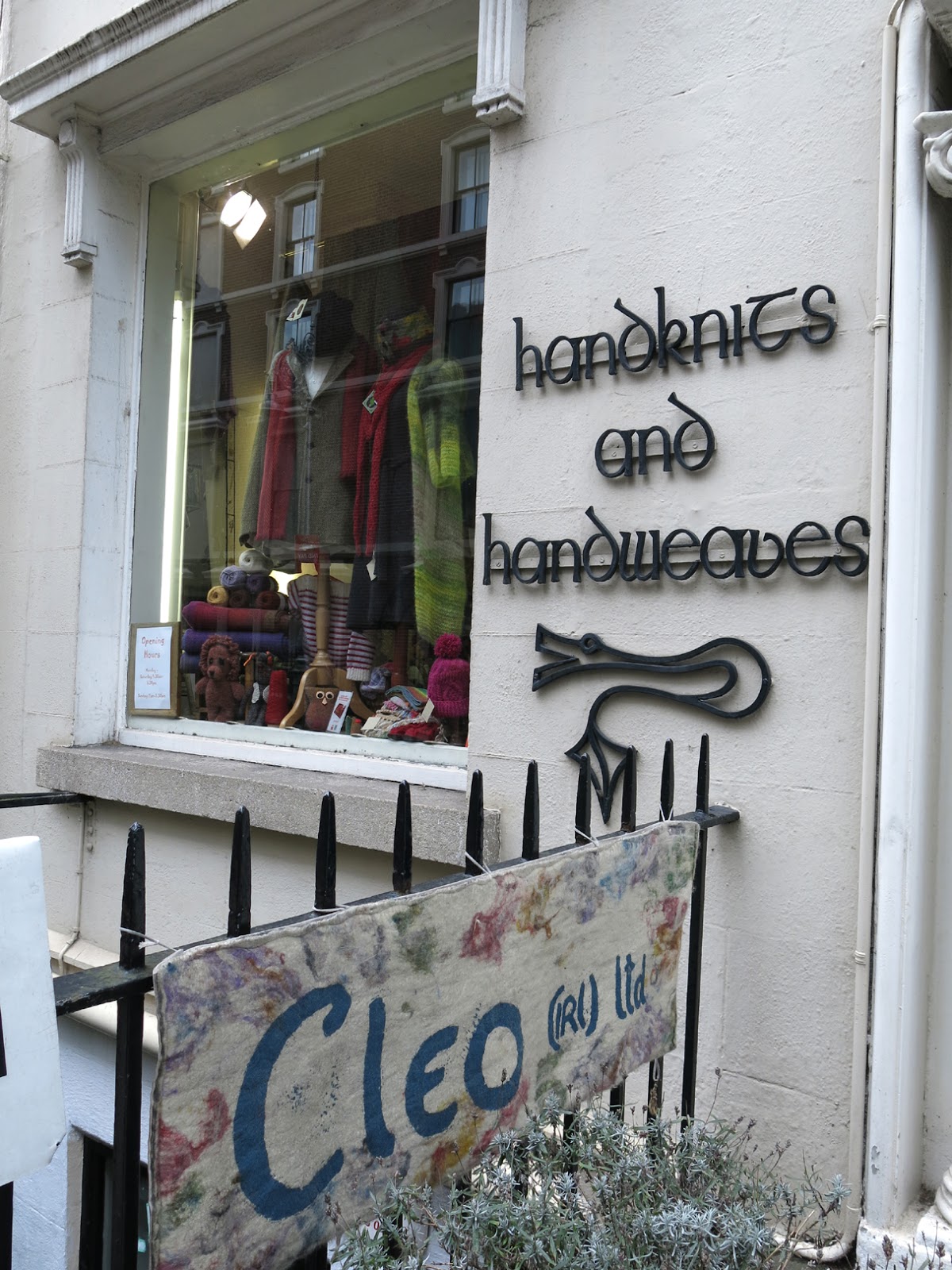
In Dublin near the National Museum and just around the corner from St Stephen's Green is Cleo.


The large sign on the wall proclaimed handknits and handweavers so I had to explore.


In Ireland, the interest in handcrafted Irish goods was stimulated by the opening of The Country Shop in St Stephen's Green in December 1930 by Muriel Gahan.  This was the start of a revival of traditional Irish crafts and brought the variety of Irish handmade wares to the capital.  It was not the first shop to sell Irish craft but it was a non-profit making venture to support the traditional craft workers in rural Ireland. Unfortunately this closed in 1978.

Cleo has been around for 70 years.  It is a family business that the grandmother of Sarah Joyce the current owner, established in 1936. Initially Cleo's sold children’s clothes but in the post-war years Sarah’s grandmother realized there was an increasing number of tourists, especially Americans, visiting Dublin and she started to stock hand-knitted sweaters from the Aran Islands for the new influx of visitors to buy as souvenirs of their visits to Ireland.

Look at the beautiful railings.

Railings outside the shop


The present shop is a riot of colour as you can see from the window display.


Here is a close up of a shawl displayed outside - just the thing for the colder weather.

The lovely shawl - so beautiful to touch.

The shop has a number of handweavers who supply items for sale. Beth Moran (Ballytoughey Loom) is based on Clare Island and makes naturally dyed rugs from her own sheep, and a wide range of shawls, blankets and silk scarves and ties. Also Liz Christie, Co. Monoghan, Deirdre Duffy (Wild Cocoon), Máire Ní Taigh, Galway and Helena Ruuth who is sadly no longer weaving.
The shop is a treasure trove and piled high with interesting items, including wool. The colours glow like jewels and there are some fascinating items to be found.

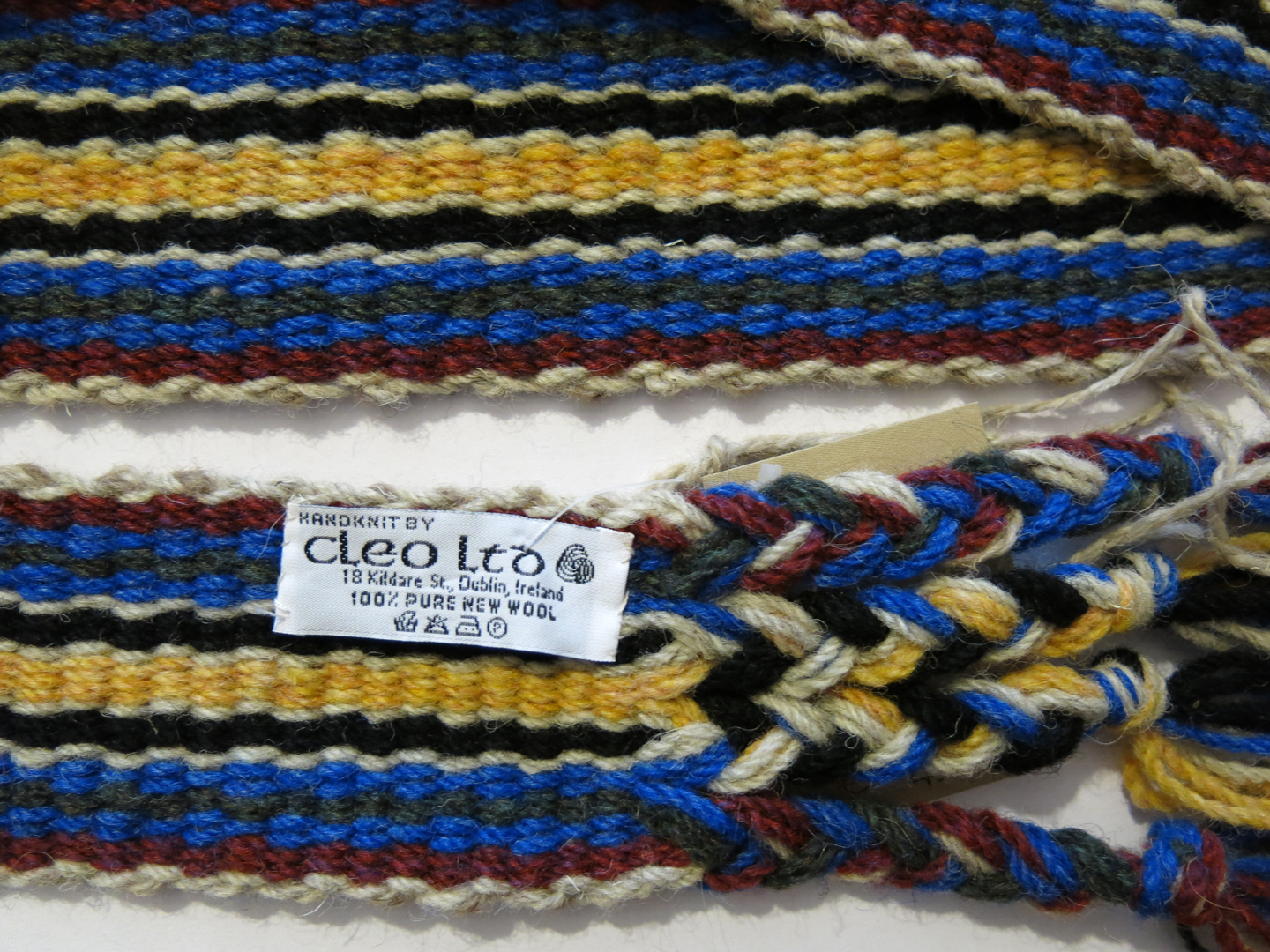
My interest, as you know, is for handwoven belts and I was delighted to find a display of handwoven Crios.


The Crios that I bought in Dublin

This was woven by John McAtasney who is in his 80's. He started weaving in 1948 at the age of 14.

This is a sturdy strap and is woven using Irish wool from Donegal and Kerry woollen mills with the coarse quality of Irish wool.  It is 6 cm (2.5 inches) in width and  190.5 cm (75 inches) in length. There are four plaits on each end about 12.5 cm  (5 inches) in length. It is a plain weave, warp faced band.

Of course it does not need to be used as a belt. Here is another of his Crios used as a guitar strap.


Here is one of John's crios used as a guitar strap.

I wanted to find out more about John who specializes in handwoven blankets, damask linen and criosanna.

I found a short YouTube video of John McAtasney weaving on a loom in the Ballydugan weaver's house in the Ulster Folk Museum.

https://youtu.be/D1mKWyRCnXE

He even has a dedicated poem!  See it at  http://www.craigavonhistoricalsociety.org.uk/rev/mcelroykscutchmill.html

I feel very privileged to own a Crios handwoven by a such a fascinating master weaver.

I found this shop by accident as I was leaving the National Museum.  If you are in Dublin, do go to 18 Kildare Street for a refreshing and colourful encounter with genuine Irish crafts.

I will be visiting Ireland again in future blogs to tell you about my textile adventures.

Susan J Foulkes