Monday, 24 August 2015

AGWSD Summer School Part One

AGWSD Summer School 16th to 23rd August 2015,
at the
Moreton Morrell campus, UK

Cotswold Court

Finally Summer School is here.  I seem to be taking a lot of things for the two workshops that I am running but I wanted to be certain that I had everything that I might need for the week. Every box is labelled and lists made and checked.  There are 250 students attending Summer School and there are many lovely and interesting workshops to choose: weaving, spinning, basketry, ply-split braiding, design and dyeing

Cotswold Court is at the centre of the classrooms for the workshops.  Time stood still for the week whilst we were there.  It was always 5 to 6.

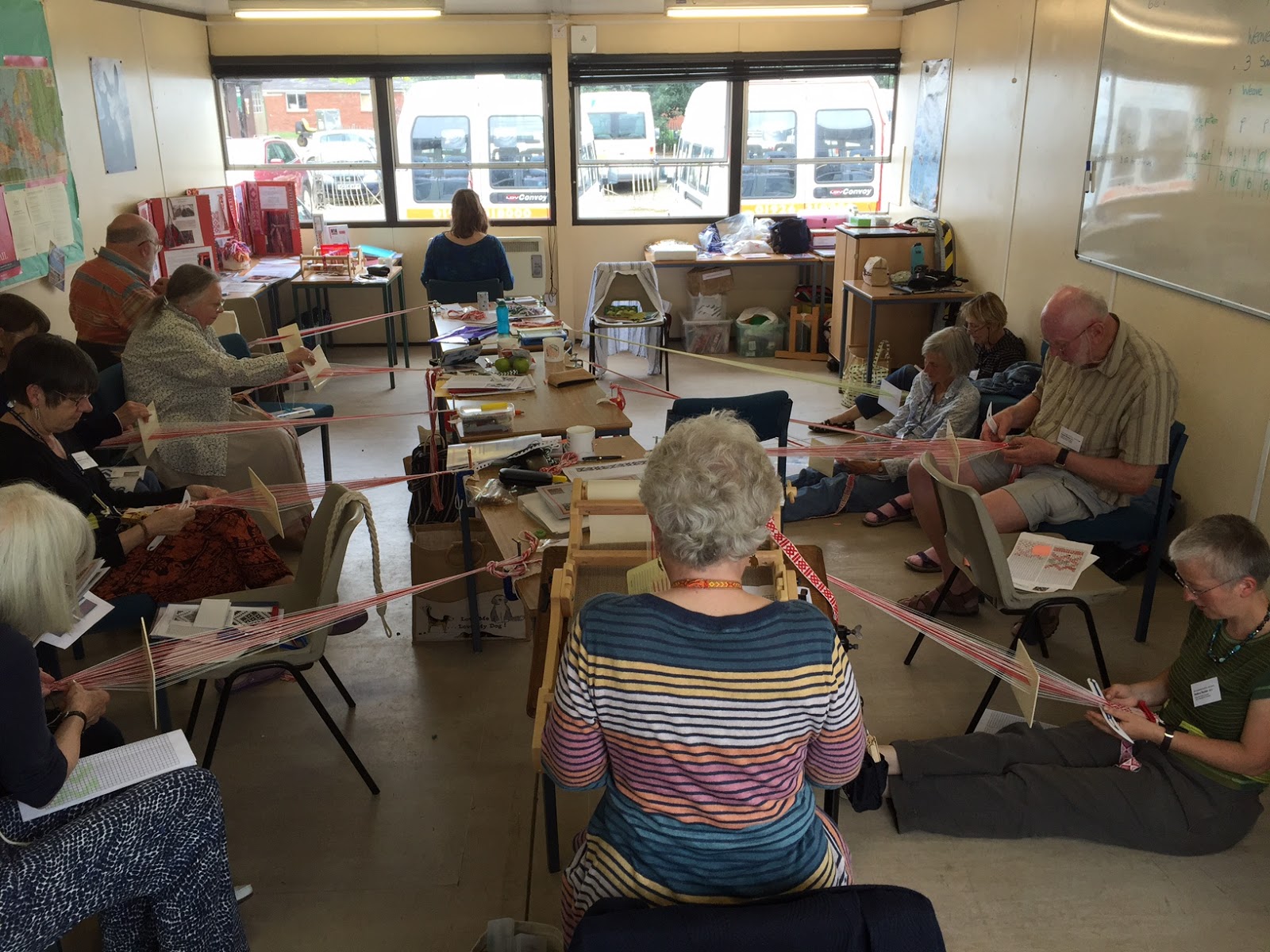
I arrived early to set up my room.  Fourteen students using backstraps take up a lot of space. I had also brought along many woven samples, some bought in the countries around the Baltic.

The clasroom


The theme for the patterns is knots and meanders.  I had produced a booklet of designs for the students to try.
The workshop booklet
The first 2.5 day workshop was for beginners.  Everyone could go at their own pace. The 13 pattern slot Sunna double slotted heddle was used.  All the patterns in the booklet are for 13 pattern threads.

The Sunna double slotted heddle on a loom.
I provided the double slotted heddles ready threaded so that everyone could start weaving straight away. It is important to ensure that the heddle is level and that all the warp threads are at the same tension.  Some students found it easier to work whilst sitting on the floor.  This gives a much better angle for the warp. Some students attached themselves to the window catch which brought the warp up to a good angle for weaving. A couple of students wanted to use their rigid heddle loom.  This also gives a very good weaving position. Posture is very important.  When concentrating it is easy to forget to move occasionally.  Every half hour or so, I would get the class to stretch or stand up and move around.

 A lovely wavy pattern

An interesting variation 
Asymmetrical patterns are harder for beginners and it is easy to make a mistake.  However, this made a lovely variation.

When the first warp was finished, the students had the opportunity to make a warp and thread the heddle.  All useful skills when weaving at home.
Threading the heddle using the cross sticks.

The whole class worked very hard.  We started at nine in the morning and finished at five and some students even went back in the evening.

Workshop one: the whole class at work.

The band lock is veryuseful for keeping the tension of the band and is easy to release.
.
The band lock
|The double slotted heddle and curved Gehpa shuttle.

Using a standard heddle.


We had been advised to bring a cushion to Summer School.  Steve was very industrious and made his own cushion cover from inkle bands he had woven. Everyone was very impressed!

A lovely combination of woven bands, woven together and then stitched.


Using the window catch to make a good weaving position.
Some students attached themselves to the window catch which also gave a good working angle.

Other activities included making decorative tassels and plaiting the loose warp ends.  Four Sami plaits were tried.
The zig zag plait

My information display.


Evening Activities

There were also many evening activities in the Construction Hall, including making party frocks and skirts.

The Association is celebrating its 60th birthday so a party was planned for the final evening with a 1950's theme. I made a fascinator to go with my 1950,s outfit.

Designing a fascinator is helped by a glass of wine (or beer).
My fascinator is in progress with the red and blue feathers.


There was very little time for the tutors to see other classes.  However, the Cocoons to Cloth workshop with Jane Deane was of particular interest for most people.  Here a few silk worms were busy eating and eventually spinning, whilst the rest of the class produced their own spun thread.
Munching leaves.
Soon one of the silkworms had spun a cocoon.
Cosily tucked up in a leaf.
The first three days passed very quickly.  On Wednesday afternoon visits to nearby attractions had been arranged.  I had the opportunity to go around some of the other classrooms to see work in progress.

Susan J Foulkes August 2015


Sunday, 2 August 2015

The Durham Tartan and another tartan mystery

I mentioned the Durham tartan in my last blog so I thought that I would give you more details about this lovely fabric. But first of all I must tell you the story of how I found it.

My friend Richard sent me a picture of a set of Northumbrian small pipes.  These pipes had been made in 1800 by R Reid in North Shields which is just north of Durham.  They had been in a museum in London but unfortunately they were stolen and all that is left are two black and white photographs of the pipes.

The description of the pipes shows that it must have been a special commission because of the materials used.

The stolen pipes


This is a luxurious object.  The chanter and drones are made of ivory and there are 7 silver keys.  The ends of the drones are carved in a lovely thistle pattern.  The bellows are silver mounted. The two photographs were taken using different processes so the black and white images are slightly different.


The stolen pipes picture two.

The picture is not very clear. The description of the bag says that it is an old velvet tartan.  I scoured the books about tartans but could not find anything resembling this pattern.  Tartan velvet was and is a luxury fabric and although the photograph is in black and white it is possible to make out the plaid pattern. The warp and weft are different but it has a very distinctive set of white or light coloured stripes which may make it possible to identify a particular tartan or plaid pattern.


I tried to make a drawdown from the black and white photographs of the pipes.  This is not an accurate tartan pattern but gives some indication of the distinctive white stripes. This may help in identifying a possible pattern. Of course, there is no indication of the actual colour of the velvet tartan bag. The white stripes are the only feature which could assist in any identification. The warp and weft colour order is different, which is also unusual.

My attempt at a drawdown from the black and white photographs.


These pipes were a luxury item made as they are from ivory, silver and tartan velvet.  It would seem probably that they were made for a specific client but who and exactly when we do not know.  If the tartan could be identified this may give another clue as to the reason these pipes were made.

If anyone has any idea what the tartan might be, do get in touch.

If we could identify the tartan, it might give some clues as to where the pipes were used.  Velvet is a luxury material so the velvet tartan might have been a special commission. It is probably made of silk. Nowadays, velvet tartans are used for the waistcoat to match a kilt.


The Durham Tartan.


What I did find in my search for the old tartan pattern, was the Durham tartan.  There is no reason why Durham should have a tartan. The Durham district tartan first appears in the record books of Wilsons of Bannockburn in 1819.  It is an early tartan.

Why it is called the Durham tartan is a mystery.  It may have been named after a person not the county of Durham or Durham city.

Here is the pattern.

The Durham tartan
It is in 2/2 twill.  The warp colour order is as follows.

Red                            4
Blue                     12      12
Black             12                   12
Green       12                               12
Black   4

It is a lovely pattern.


County Durham has not made much of use of this tartan, but I gave the pattern to Douglas in the Durham Guild and he has woven it many times.
Click here for a useful link which shows the range of District tartan patterns:
http://www.scotclans.com/scottish-clans/tartan-pattern-book/district-tartans/


Susan J Foulkes August 2015


Thursday, 9 July 2015

What is on my loom in July.

July has been a very busy month but I have managed to do some complex weaving.  I wanted make a special gift so I wove another version of the Ravenna silk block damask pattern.  Do look at my blog for September 2014 for more details about Roman block damasks. Click here for the link. Roman Block Damasks

My previous scarves have all been woven with 60/2 silk so that the pattern blocks are small.  This time I wanted something a little more dramatic so I wove the pattern with 30/2 silk at 36 epi.

The pattern repeat is much larger and looks amazing from a distance.  I used ivory and a gold silk so that it would look like the Ravenna mosaic.

The Ravenna mosaic silk on my loom.

Off the loom I make the tassels using the braid twister shown in a previous blog.

Using the braid twister to make the tassels.


To finish a woven silk cloth.


Once the tassels are complete, I will then wash the silk.  This is a delicate process.

I put a small amount of liquid soap in a bowl of warm water. I agitate the water and then add the silk material.  I lift and dip the material several times and gently squeeze it.  

I leave the silk in the water for about 10 minutes.  Lift and squeeze again and then take it out..
Now the silk is ready for rinsing.  To ensure that all the soap is removed from the silk, I add a very small amount of clear vinegar to the next bowl of warm rinsing water.  The material is lifted and dipped several times.  I take it out and then rinse it again in a fresh bowl of warm water with no vinegar.  The vinegar is only used on the next to last rinse.

Once it is thoroughly rinsed, I roll the silk in a towel to get rid of the excess water.  The material can be left to dry slightly by hanging it carefully on a clothes rack.

I iron the silk using a steam iron on the silk setting.  For this silk which does not have a raised pattern, I press it on a hard surface.  I have a marble pastry board which I only use for ironing. This helps to bring out the shine of the silk.  Do not rub silk or it will lose its lustre. 

The tassels can be pressed flat and any final adjustment to the length can be made. I find that getting tassels all exactly the same length is difficult.  If anyone has any tips to share do let me know. 

I store my silk scarves rolled around a cardboard tube lined with tissue paper.  In this way they do not crease and look fresh when I want to wear it. Folded silk shows the fold lines. 


Band Loom


On my band loom, I have a narrow band in 16/2 linen.  I love cooking and my apron straps have worn so I thought that I would weave a new set.


The warp colour order is as follows:

White          10     8         8      10
Buirgundy        2      26      2

The band is 2.3 cms in width.    Here is a close up of the band.

Close up of the band

Using a standard heddle.


You can also weave this type of band with a standard heddle.

Stoorstalka have a new YouTube video showing the technique.


Introduction to band weaving with STOORSTĂ…LKA Band weaving kit Small


Click here to view it. https://youtu.be/rAyYXWE8G9o


Happy weaving

Susan J Foulkes July 2015

Saturday, 4 July 2015

Durham Guild Exhibition: Looking Back, Going Forward

I belong to the Durham Guild of Spinners, Weavers and Dyers.  In July 2015, we are holding an exhibition in the Galilee Chapel in Durham Cathedral.  This is a prestigious venue and we are thrilled that we have been granted space for our exhibition.

Last year was the Guilds 35th year. Everyone thought that it would be wonderful to celebrate the event.  It was decided that an exhibition of work would be a good way of advertising what we do and hopefully attract new members.  Durham Cathedral offered us the Galilee Chapel for July this year.

This is wonderful timing as the Magna Carta exhibition is in Durham University Palace Green Library from June-August and many visitors are expected.

Our Guild exhibition is more modest.  The title Looking Back, Going Forward for our exhibition reflects our past and also celebrates our future as a Guild.

I decided to submit two pieces for the exhibition.  The first is a blue wool scarf.  It is the first item that I wove.  It is small and not particularly well designed but when it came off the loom I was so proud!  I had created cloth!

From that moment on I was hooked.  Weaving became my passion.  My only regret is not finding out earlier as there seems to be a lifetimes worth of things to discover about this amazing craft.

The second item is a scarf that I wove this year.  I hand dyed the silk and designed the pattern carefully to echo the patterns and colours of a set of shells.  Far more complex but still as rewarding. Look at my previous two posts for details about this textured silk scarf.

I was asked to submit my Handfasting Bands which were displayed in the Association of Guilds of Weavers, Spinners and Dyers exhibition last year.  I described these bands in my first blog post.This exhibition is held biennially.

On Thursday  2nd July we set up the exhibition.

Durham Cathedral


The Galilee Chapel at the west end.


Exhibition being organised.  There were lots of items still to be displayed.
When we arrived in the Cathedral, the prospect of displaying all the work seem a huge task.  Angela is very experienced in putting up exhibitions and she soon organised her helpers.  We all took charge of various tasks, even the humble one of cleaning all the display cabinets.

We unpacked all the items and then sorted them by colour and theme.  The coats, scarves, rugs jewellery, spun wool samples and dye samples were then distributed to the various display cabinets and boards. There were also covered chairs and stools.  This stool by Douglas, is covered with the Durham tartan.


The work of the Guild looks both back and forward.

Cloth Seals

One fascinating exhibit is a collection of lead medieval cloth seals. These were found by Gary who whose hobby of diving has now led him to studying for a PhD. His topic is A cultural, scientific and technical study of the Durham lead cloth seal collection AD1450-1820.  Diving in the river Wear he has found many artefacts and the cloth seals are rewriting the story of medieval textiles in Durham. He has recovered 266 cloth seals amognst other items.   Below the Cathedral is the Fulling Mill where he has been doing underwater archaeology.

Click on this link to one of his reports.  Medieval and post medieval artefacts from the River Wear.


Here is the Fulling mill below the cathedral.

Durham cathedral and Fulling mill.

A fascinating book about medieval textiles and the economy is:
Textiles and the Medieval Economy: production, trade and consumption of textiles 8th - 16th centuries edited by Angela Ling Huang and Carsten Jahnke 2015 by Oxbow Books.


In the evening, myself and Angela gave a talk to the Durham Guild about our trip to Sweden and the Weave Fair in Umea last September.

It was lovely to share the wonderful time that we both had.   In Mora, I had the opportunity to meet Barbro Wallin the author of the beautifully produced book Moraband.

Part of the display of bands and books from the Baltic region
She contacted me later to show a band she had woven with 97 motifs. It is 5.4 metres in length. The photograph of her band is on the table. It took her two weeks to weave.

Today I have been helping to stewarding the exhibition.  I took my small loom which was a focus of interest for children.


Happy Weaving

Susan J Foulkes July 2015

Tuesday, 16 June 2015

Weaving tips: making tassels.

I thought that it might be useful to describe how I make tassels for my hand woven scarves.

The hair braider
I use a hair braider which I bought many years ago.  It has never been used to braid hair but it makes tassel making easier.

The waste threads at the end of the woven scarf.
At the begining and end of handweaving a scarf, I weave several picks using a waste yarn.  This helps to keep the weft in place when the material is taken off the loom.

I undo this thread at each side of the scarf leaving some of the threads in the cnetre area. You can see that they are fine pink threads.  When making tassels, start at each side of the scarf and work towards the centre.
Three groups of warp ends for the next tassel.
You need to decide how thick you want your tassels to be.  Then divide the ends into three equal groups.

Clip the three groups into the braider
Clip the three groups into the braider.  Hold the scarf fimly with your other hand or place a heavy book on top of the material.

Start to twist
Start to twist the three groups.  The braider does all the work.


Once there is sufficient twist, press the switch on the braider to twist the three groups into one. 


Carefully tie a knot at the end of the newly made tassel.  I try to adjust the length of each tassel as I work along the end of the scarf.

When all the tassels are made, I wash the scarf and then make any final adjustments before trimming the ends.

From July 2nd to 30th July there is an exhibition by the Durham Guild of Spinners Weavers and Dyers to celebrate 35 years.  The exhibition is called 'Looking Back Going Forward'. This exhibition is in the Galilee Chapel of Durham Cathedral,  a prestigious venue. This scarf will be one of my exhibits. 

Susan J Foulkes June 2015

Monday, 1 June 2015

What is on my loom: silk scarves

This post should really be entitled What was on my loom as this was my project for January.  I am a member of the Online Guild of Weavers, Spinners and Dyers.  Each month there is a workshop. For January the workshop was UFO's - unfinished objects.  It is the New Year so it is time to take stock and look at your projects and yarn and decide to finish items that have been left to languish.

My unfinished project was a dyed warp and weft which I had neglected.  I had made the warp in sections and dyed it in a gutter.  Yes, I do mean a gutter.  I bought a 6 ft length of guttering from a DIY store.  The warp was folded into the gutter which enabled me to drip different dye colours along its length.

The inspiration and the woven material.

My inspiration was a set of pretty coloured shells, but when the warp and weft was dyed I was unhappy with the green shade so it was left as a UFO.
Dyed weft yarn 
The weft was wound as skeins and dyed green.  I had to wind the weft onto bobbins which  proved a little more difficult that I had imagined. The dyed silk was sometimes a bit 'sticky'.

My next step was to try to remember what weave pattern I had intended to use as I did not leave myself any notes.  I decided on a densely patterned look to echo the textured nature of the shells.

The pattern is for eight shafts but I also used two extra shafts for a plain weave edging. When I looked at the pattern I realised that I needed to make two additional warp ends for each dyed stripe so that the pattern fitted to the coloured warp. The silk wove beautifully.

The weave drawdown

I managed to complete my UFO by the end of the workshop.  I made two scarves and have decided to keep one for myself.  The colours when woven blended together  and I liked the combination very much.

Here is the completed scarf. It is difficult to photograph as the colours and texture shimmer in the light.

The completed scarf.
From July 2nd to 30th July there will be an exhibition by the Durham Guild of Spinners Weavers and Dyers to celebrate 35 years.  The exhibition is called 'Looking Back Going Forward'. This exhibition is in the Galilee Chapel of Durham Cathedral -  a prestigious venue.

I have decided to enter this scarf and also the very first piece I wove.  This is a blue and grey wool scarf in 2/2 twill.  I can still remember the thrill of weaving and then taking my piece off the loom.  I realised that weaving was the pastime that I had been looking for - something so involving and creative that there seems to be no end to the learning.

Susan J Foulkes June 2015


Saturday, 16 May 2015

Travels around the Baltic: Latvian woven bands.

Woven Bands from Latvia


A friendship bracelet in fine cotton and wool.


This lovely woven band is a friendship bracelet.  The pattern is of two joined hearts and a diamond which is particularly appropriate for a friendship bracelet.

It is woven in very fine cotton - perhaps sewing cotton and the pattern threads are wool. I was so pleased that the label gave the name of the weaver.  It is 1.1cm in width.  There are seven pattern threads.

Here is another bands by the same weaver. It is also  1.1 cm in width. This  band has a similar structure to the Latvian bands and the Sami bands where there are groups of pattern threads lifted up together.
Latvian band for a friendship bracelet

Latvian Weavers.

There are many talented weavers in Latvia.  I bought a Leilvardes belt from Inara and Ziedonis Abolini whose company is SIA Audeju Darbnica   See their web page by clicking HERE

Do take a look at their wonderful web page which shows some of the beautiful traditional Latvian belts that they weave.  I am very proud to own one of their creations.

I have become fascinated by the Leilvardes belt and have researched its origin.  When I return to Latvia, I want to see the collection in the National Museum.

Bookmarks.

I bought a lovely hand woven bookmark in Riga.

Front of bookmark

Reverse side of bookmark

This is a lovely reminder of a pleasant stay.

At home, I decided to try to weave a complex Latvian pattern as a bookmark.  There are 33 pattern threads in red wool.  The background threads are white linen.

Front of bookmark I wove.
Reverse side of bookmark.


Book Search.


There is an out of print book about Latvian woven belts.  I would love to have a copy but I have searched everywhere and it does not seem to be available. 
Out of print but I would love a copy.

Latviešu Jostas (in English Latvian Sashes, Belts and Bands) by Aleksandra DzÄ“rvÄ«tis and Lilija Treimanis in Latvian and English (English text by Vila Abele Wurstner). Published in 1982

It is such a pity that it has not been republished. Lithuania and Estonia all have beautiful books about their band weaving heritage but there is nothing in print about Latvian band weaving suitable for weavers.

However, in Latvia band patterns are everywhere.  Here is a wrapper for some delicious bread that we bought.

bread wrapper
This pattern has 23 pattern threads.  I will have to try it sometime.

Susan J Foulkes May 2015