Wednesday, 1 June 2022

Durham City Freemen 500th Anniversary

On May 14th 2022, the Butchers' Guild celebrated their 500th anniversary. The Butchers' Guild is one of eight surviving Guilds which form the Companies of the Durham City Freemen. Originally there were 16 Guilds of which the Weavers and Websters were the first in 1450. The last Guild to be accepted were the Dyers and Listers in 1667. 

In 1167, Bishop Pudsey granted the first charter to the City of Durham. As the County palatinate of Durham it was unique in that the borough charter was granted by the Prince Bishop rather than the reigning monarch. In the 14th century, trading associations were formed to regulate and control the trades in the city. The first recorded charter was in 1450 for the Weavers and Webster and by the later 15th century there were 16 Guilds. The Guild Hall fronts the Market Place and was built in 1535 but the present classical façade was designed in 1754. 

Nowadays the Freemen can be any man or women of 18 years and over who has any of the qualifications required is eligible to be admitted to the Freemen of the City of Durham. They have ancient privileges which include:

  • the right of herbage on the Sands
  • the right to hold meetings in the Guild Hall
  • the right to have a stall in the market free of charge.  


The Guild Hall room has displays of various items connected to the Guilds including the crests of the Guilds. 

Crest of Butchers' Guild


The Weavers and Webster Crest

It was difficult to photograph because of the sunlight streaming in from the from the balcony window.  The motto for the Guild is  'Weave Truth with Trust.'

The Durham Guild of Spinners Weavers and Dyers were invited to join in the day of celebration for the Butcher's Guild. We set up in the Guild Hall. 


I wove a patterned band.


Diane is one of the spinners

Gary Bankhead is an underwater archaeologist who dives in the River Wear and catalogues all his finds.    https://diveintodurham.uk/gary_bankhead.htm

Some of Gary's recent finds

His table of recent finds was fascinating and included medieval spindle whorls.

On the day, the Mayor, the High Sheriff and the Lord Lieutenant arrived and there was a guest reception. There was a Town Crier in the Guild Hall who went out onto the balcony during the course of the day to announce various events. Outside in the Market Place, there were musical performers dressed in the costume of the middle ages and also Morris dancers. 


Morris Dancers


A butcher gave a demonstration of butchery on his stall outside in the market Place. 
Stall under the balcony


We had a lovely day and enjoyed meeting the people who came into the Town Hall to see the displays.

Spinning in the Guild Hall


I hope that you enjoyed this glimpse of historic Durham.

Susan J Foulkes June 2022


Sunday, 1 May 2022

Weaving a set of placemats

I am weaving a set of four placemats and a centre mat. The warp is 6/2 cotton in blue and white.  The weft is 3/2 cotton in white. 

Sett: 27 ends per inch.  3 warp ends per dent in a 9 dent reed.

I calculated the shrinkage of the small sample piece I had woven all those years ago.  It is 9% so I increased the measurements accordingly allowing for hems for each mat. 


Number of warp ends: 398 This gives an extra two warp ends at one side to balance the design. The warp is approximately 14.7 inches at the reed which I hope will give the width I need once the material is off the loom and washed. Each pattern group of vertical twill is 11 warp ends. It is a 5/1 twill. 


Here is the cloth on the loom.  I am using a rug shuttle because the weft is relatively thick. I have not used this type of shuttle for some time and it took a while to get used to it. For the hem at each end I used a finer weft, 6/2 cotton and wove ten picks in plain weave. This ensures that the hem will be less bulky than using the thicker weft. 

Close up of weaving on loom


Comparison with sample.

I wove a length of 48 cm on the loom which shrank to 44 cm when removed from the loom. I hemmed the piece and washed it to check the shrinkage. 
I was not satisfied with this sample as the white warp shows through the colour stripes.  The width of the material needs to shrink more so that the blue warp stripes are more pronounced. The weft travels over 9 warp ends on every other pick. This will make the width of the cloth shrink.


Reverse of weave draft showing weft floats

The reverse of the material shows how firmly I was beating the weft. 


Top mat weft beaten lightly. Bottom mat weft beaten firmly.

I tries another sample and I decided to beat less firmly. The ppi is now 16 per inch. I was careful to angle the weft at no more than 2 inches up the opposite side of the warp. The weft goes over 10 warp threads 
I took this sample off the loom, hemmed and washed it. 

Hemming.
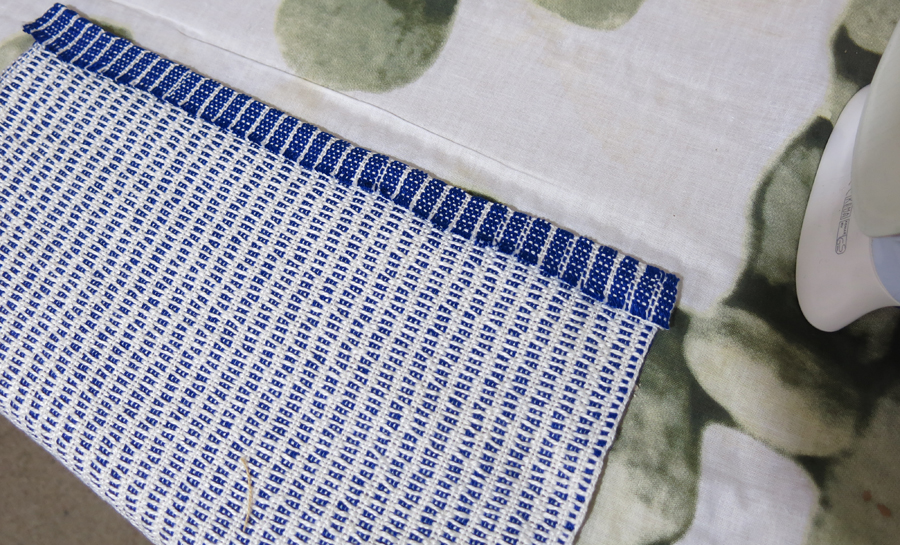
Turn over the plain weave picks and iron firmly.

Now turn the raw edge under and press firmly.

Once the hems are pressed, pin the hem. The edges can be hemmed and pressed. 

Hemming the placemat.


Measurements.
Before washing.
Width on loom with  no tension  33 cms
Woven length on loom not under tension ( not including hem) 47.5 cm 
Off loom and hemmed  length:   46.5 cms

After washing
Width  31.5 cm
Length: 44 cms

For this placemat, the warp stripes were more pronounced so I wove the rest of the warp. 

All the placemats are finished.  Here they are.


These placemats are a replacement for the set I wove in 2014.  

Susan J Foulkes  May 2022.


Friday, 1 April 2022

Course Work - a valuable resource.

I have reorganised my weaving room and book shelves.  I thought that I would start to prune my weaving stock.  Two shelves are filled with the course work that I did for my BTEC in Art and Design (Handloom Textile Design ) in 2001. 

I looked at the first set and realised that here was a resource I had forgotten about. 


Here is one display board


This is the second display board.


These boards were part of my first project  based around architecture in Bradford. We had to sketch buildings as a basis for designing cloth for various purposes. 


I made a folder of my sketches and designs for various types of cloth. 


The old Prudential buildings is a wonderful source of pattern and texture. 


The pattern on the brickwork was very intricate and I made a carpet sample.


Here is a second carpet sample


This sample could be used on a room divider screen.


This is a sample of decorative twill. 


There are three folders to accompany these boards: an Index of development samples, and Index of record sheets and Reference weaves.

 I had not examined these files for some time and I found that there were some interesting textured samples.


I had been intending to throw away all this material but the samples and records of the weaves is invaluable. Here is a group of five sample weaves from the collection. I am amazed at how much work I completed for this course. 


 In fact  I chose one pattern to weave some placements. This sample is in 6/2 cotton with a weft of 3/2 cotton.  It has a pleasing texture and I think would be thick enough for placemats. It is woven on 8 shafts in two blocks.  


Here is a close up showing the vertical twill structure. 


The ridged effect is created by the two vertical rows of plain weave which separate the two blocks vertical 4/1 twill. I have coloured some of the plain weave on the drawdown to show the dividing lines between the blocks of vertical twill. 


I will post a picture of the weaving of these mats in due course. They will be woven in blue cotton with a white plain weave dividing strip. 

Susan J Foulkes April 2022

Tuesday, 1 March 2022

Exhibition pictures

 Spinning Yarns and Weaving Stories

I have been decluttering my weaving 'stuff' to dispose of old material and records that I no longer require.  I came across details of an exhibition that the Durham Guild held in 2004. I still use one of the items I made. Here is the description of the exhibition from the catalogue we produced. 

     'To celebrate our 25th anniversary in 2004 , the Durham Guild of Spinners, Weavers and Dyers decided to hold an exhibition at the Oriental Museum.   Our work was to be inspired by the collection at the Museum.  The question arose as to the title.  What to call our exhibition?  For an earlier display of work at the Botanic Garden two Guild members had produced wall hangings: Jen Campbell made a vibrantly coloured house and Elsie Shaw produced a subtle and sensitive tapestry of a tree.  Independently, they told me the story behind the image that they had chosen.  The stories were interesting, informative and also personal and certainly added to an appreciation of the pieces of work.  So, our design challenge was born - ‘Spinning Yarns and Weaving Stories’.'

The stories gave the visitor to our exhibition an insight into the inspiration and creative journey that led to the item on display.  Guild members wrote their ‘stories’ of how they were inspired by an exhibit(s) in the Museum and how it led to the design of their hand-made item. These stories appeared next to each person’s work.  

Here is the cover of the exhibition booklet. 

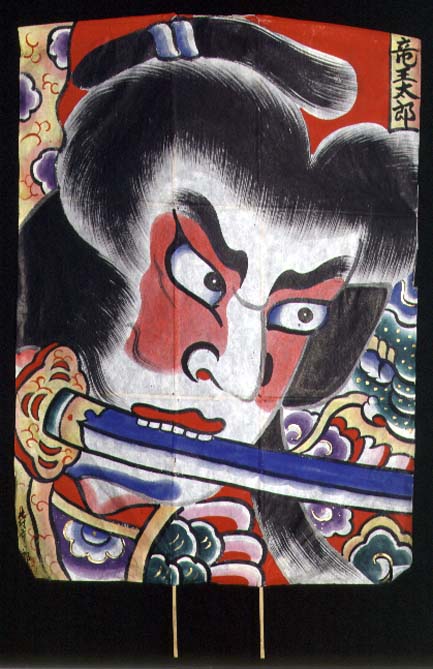
My work for the exhibition was inspired by Japanese kites and Japanese shop curtains which were exhibited in the museum. 

Japanese Kites.

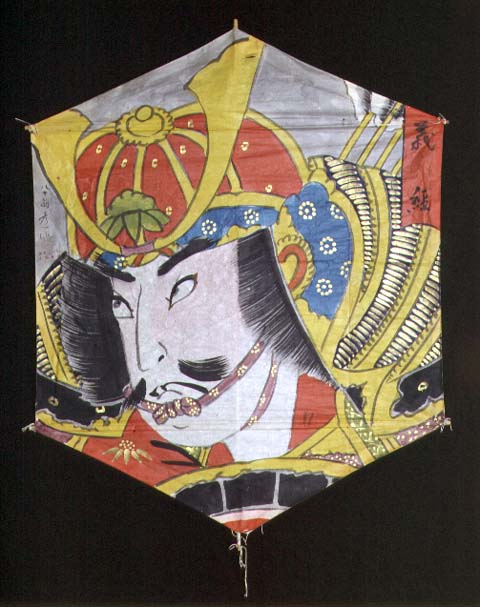
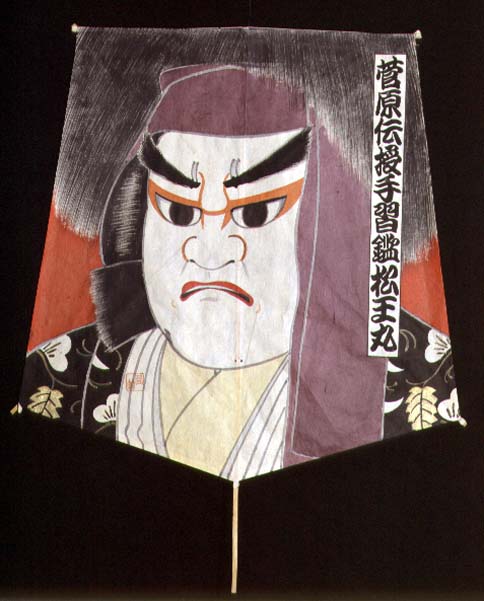
The Oriental Museum has a fascinating collection of traditional Japanese kites.  They were mounted high up on a wall but have no strings or tails.  Using a variety of traditional shapes, they feature characters from Japanese history and folklore.  They are now in storage. 

Three Kites.

1. The Sanjo kite shows Minamoto no Yoshitsune a 12th century samurai.  It was made by Hikoichi, Kobayashi  Creation date  1900-1950; Meiji Period; Taisho; Showa Period. The museum catalogue has this description: kite featuring Minamoto no Yoshitsune, a 12th century character. He is wearing a red, yellow and blue helmet. White face with pink shading in eye and cheek area. Caption in top right hand corner.

https://palimpsest.dur.ac.uk/adlib/?action=image&image=oriental%2F1986%2F1986.50.jpg

2. The Sagara kite is a painting of Matsuomani from the play Sugawara Denju Tenarai Kagami in the Bunraku theatre.    Creation date: 1900-1950; Meiji Period; Taisho; Showa Period. Description: Banraku kite made by Mitsuro Otatuke, 

https://palimpsest.dur.ac.uk/adlib/?action=image&image=oriental%2F1986%2F1986.47.jpg

3. Chozaburo Kitamura, kite, featuring Ryuotaro. The face is white with red upper lip and red patches around eye and cheek bone. Blue sword placed between teeth. Lots of black hair. Colourful background.  Here is the link to the original. https://palimpsest.dur.ac.uk/adlib/?action=image&image=oriental%2F1986%2F1986.49.jpg

I liked this particular kite and drew a copy. I photographed the one hanging in the museum and I transferred my copy onto a tee shirt which I still have after all theses years. 

Here is my tee shirt. 


I remembered the triangular kites from my childhood and my homemade kite tails - simple lengths of string with coloured paper tied in bows.  I decided to use the kites as my inspiration and the idea of kite tails to design and weave some scarves.  I thought of words to describe kite tails - light, airy, frilly, floating, fluttering, balanced.  My scarves had to have some of these properties but also to be practical as scarves. 

 
Floating clouds


Here is one of the scarves that I exhibited called Floating Clouds. This scarf also won third prize at  ‘Convergence’  in the ‘Handwoven’ competition in Denver, Colorado in July 2004. It is a double weave scarf using an overtwisted merino yarn  for the warp and botany wool and silk for the weft.

The name was  inspired by a piece of shakuhachi music - Ukigumo -  ‘As clouds float quietly in the wide deep sky, their shapes and sizes gradually change over time.  This can be seen as a metaphor for human life, in which serenity, tranquility and movement prevail.’  (Tajima Tadashi  - Master of Shakuhachi 1999 WDR World Network).

I became intrigued by kites.  In a book on the ‘Art of the Japanese Kite,’ I discovered that they do not have tails.  In Japan, if a kite has a tail it is said to be of a poor design!  Never mind - my own creative journey led me to scarf designs of greater originality.

Japanese shop curtains: Noren

I liked the Japanese shop curtains in the museum and wove a long length of cloth from unbleached cotton.  I made three separate curtains to be hung as one item.  I did not want to use a too obvious kite design; perhaps a bird would be appropriate.   I found a striking crest design of a crane (Tsuru).  This I thought would be the ideal image to have on my curtain. 


Tsuru  a crane
I decided to use a dye that was activated by sunlight.  This was not an ideal choice as my woven material was plain weave in 16/2 cotton.  This type of dye is best used on silk or fine fabric.  I made many templates of the crane crest and placed them on the cloth. The dye reacts to light so that the cranes appear as undyed shapes. For the blue cranes I made large templates with the crane design as a cut out. I had to purchase many pots of dye to complete this project.                                                         


My display of curtains and scarves. 

Cranes are such an important symbol in Japan.  I made as many paper cranes as I could to hang alongside the curtain - I could not manage one thousand! 
Here are the curtains at home in our spare bedroom.


Here is a close up of the cranes. 


During the course of this project, I read books on Japanese folklore, watched a film of Bunraku theatre plays , wove to Japanese flute music, drew kites, crests, and made lots of origami cranes.  I reacquainted myself with the films of Akira Kurosawa which I love.  It was a fascinating journey.

Two books were very useful.


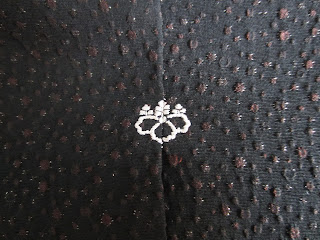
When I visited Japan in 2019, I bought a second hand garment which had a crest on the back. This lovely jacket now has a second life. 


In my book of Japanese design motifs, the crest is similar to crests in the section showing Pawlonia designs.  
There is always something new to learn. 

Susan J Foulkes March 2022