Tuesday, 1 March 2022

Exhibition pictures

 Spinning Yarns and Weaving Stories

I have been decluttering my weaving 'stuff' to dispose of old material and records that I no longer require.  I came across details of an exhibition that the Durham Guild held in 2004. I still use one of the items I made. Here is the description of the exhibition from the catalogue we produced. 

     'To celebrate our 25th anniversary in 2004 , the Durham Guild of Spinners, Weavers and Dyers decided to hold an exhibition at the Oriental Museum.   Our work was to be inspired by the collection at the Museum.  The question arose as to the title.  What to call our exhibition?  For an earlier display of work at the Botanic Garden two Guild members had produced wall hangings: Jen Campbell made a vibrantly coloured house and Elsie Shaw produced a subtle and sensitive tapestry of a tree.  Independently, they told me the story behind the image that they had chosen.  The stories were interesting, informative and also personal and certainly added to an appreciation of the pieces of work.  So, our design challenge was born - ‘Spinning Yarns and Weaving Stories’.'

The stories gave the visitor to our exhibition an insight into the inspiration and creative journey that led to the item on display.  Guild members wrote their ‘stories’ of how they were inspired by an exhibit(s) in the Museum and how it led to the design of their hand-made item. These stories appeared next to each person’s work.  

Here is the cover of the exhibition booklet. 

My work for the exhibition was inspired by Japanese kites and Japanese shop curtains which were exhibited in the museum. 

Japanese Kites.

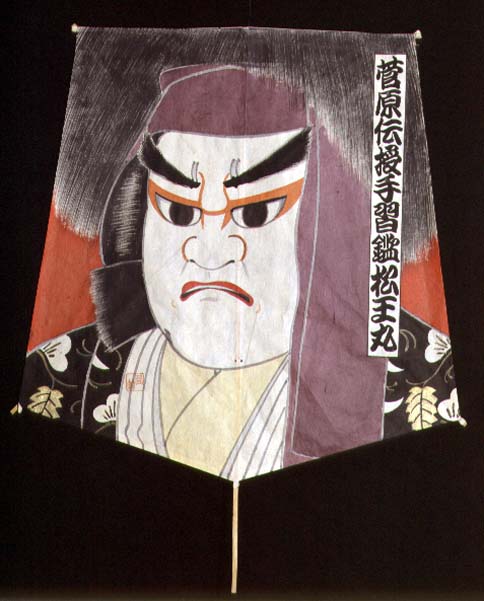
The Oriental Museum has a fascinating collection of traditional Japanese kites.  They were mounted high up on a wall but have no strings or tails.  Using a variety of traditional shapes, they feature characters from Japanese history and folklore.  They are now in storage. 

Three Kites.

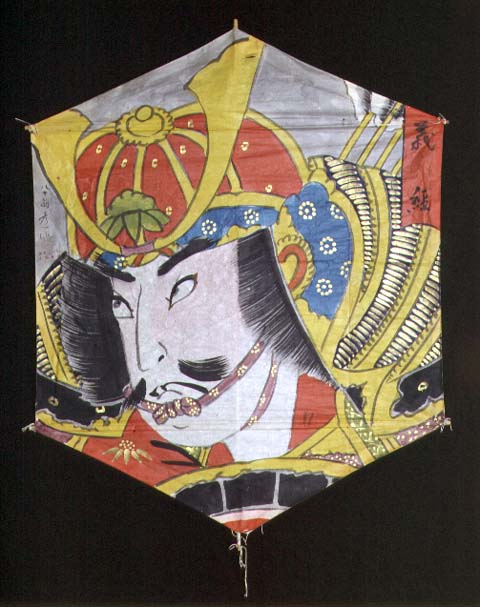
1. The Sanjo kite shows Minamoto no Yoshitsune a 12th century samurai.  It was made by Hikoichi, Kobayashi  Creation date  1900-1950; Meiji Period; Taisho; Showa Period. The museum catalogue has this description: kite featuring Minamoto no Yoshitsune, a 12th century character. He is wearing a red, yellow and blue helmet. White face with pink shading in eye and cheek area. Caption in top right hand corner.

https://palimpsest.dur.ac.uk/adlib/?action=image&image=oriental%2F1986%2F1986.50.jpg

2. The Sagara kite is a painting of Matsuomani from the play Sugawara Denju Tenarai Kagami in the Bunraku theatre.    Creation date: 1900-1950; Meiji Period; Taisho; Showa Period. Description: Banraku kite made by Mitsuro Otatuke, 

https://palimpsest.dur.ac.uk/adlib/?action=image&image=oriental%2F1986%2F1986.47.jpg

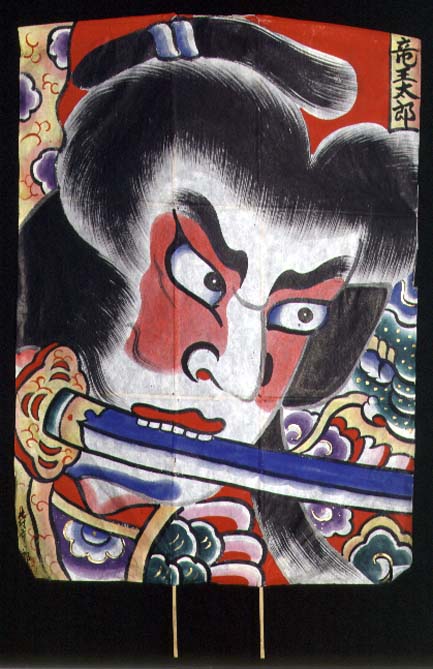
3. Chozaburo Kitamura, kite, featuring Ryuotaro. The face is white with red upper lip and red patches around eye and cheek bone. Blue sword placed between teeth. Lots of black hair. Colourful background.  Here is the link to the original. https://palimpsest.dur.ac.uk/adlib/?action=image&image=oriental%2F1986%2F1986.49.jpg

I liked this particular kite and drew a copy. I photographed the one hanging in the museum and I transferred my copy onto a tee shirt which I still have after all theses years. 

Here is my tee shirt. 


I remembered the triangular kites from my childhood and my homemade kite tails - simple lengths of string with coloured paper tied in bows.  I decided to use the kites as my inspiration and the idea of kite tails to design and weave some scarves.  I thought of words to describe kite tails - light, airy, frilly, floating, fluttering, balanced.  My scarves had to have some of these properties but also to be practical as scarves. 

 
Floating clouds


Here is one of the scarves that I exhibited called Floating Clouds. This scarf also won third prize at  ‘Convergence’  in the ‘Handwoven’ competition in Denver, Colorado in July 2004. It is a double weave scarf using an overtwisted merino yarn  for the warp and botany wool and silk for the weft.

The name was  inspired by a piece of shakuhachi music - Ukigumo -  ‘As clouds float quietly in the wide deep sky, their shapes and sizes gradually change over time.  This can be seen as a metaphor for human life, in which serenity, tranquility and movement prevail.’  (Tajima Tadashi  - Master of Shakuhachi 1999 WDR World Network).

I became intrigued by kites.  In a book on the ‘Art of the Japanese Kite,’ I discovered that they do not have tails.  In Japan, if a kite has a tail it is said to be of a poor design!  Never mind - my own creative journey led me to scarf designs of greater originality.

Japanese shop curtains: Noren

I liked the Japanese shop curtains in the museum and wove a long length of cloth from unbleached cotton.  I made three separate curtains to be hung as one item.  I did not want to use a too obvious kite design; perhaps a bird would be appropriate.   I found a striking crest design of a crane (Tsuru).  This I thought would be the ideal image to have on my curtain. 


Tsuru  a crane
I decided to use a dye that was activated by sunlight.  This was not an ideal choice as my woven material was plain weave in 16/2 cotton.  This type of dye is best used on silk or fine fabric.  I made many templates of the crane crest and placed them on the cloth. The dye reacts to light so that the cranes appear as undyed shapes. For the blue cranes I made large templates with the crane design as a cut out. I had to purchase many pots of dye to complete this project.                                                         


My display of curtains and scarves. 

Cranes are such an important symbol in Japan.  I made as many paper cranes as I could to hang alongside the curtain - I could not manage one thousand! 
Here are the curtains at home in our spare bedroom.


Here is a close up of the cranes. 


During the course of this project, I read books on Japanese folklore, watched a film of Bunraku theatre plays , wove to Japanese flute music, drew kites, crests, and made lots of origami cranes.  I reacquainted myself with the films of Akira Kurosawa which I love.  It was a fascinating journey.

Two books were very useful.


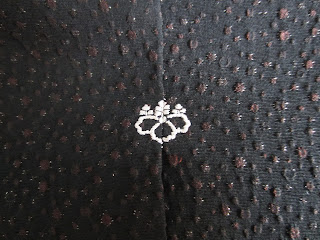
When I visited Japan in 2019, I bought a second hand garment which had a crest on the back. This lovely jacket now has a second life. 


In my book of Japanese design motifs, the crest is similar to crests in the section showing Pawlonia designs.  
There is always something new to learn. 

Susan J Foulkes March 2022


Tuesday, 1 February 2022

Two lovely books


2018 Zhejiang University Press

This is a very large and heavy book. It is in English and the articles and accompanying illustrations are wonderful. I bought it through Amazon. 

A World of Looms - weaving technology and textile arts is the result of a conference in 2018 in China organised by the Chinese National Silk Museum. The sections cover: China, Japan Korea Southeast Asian looms, India, West Asian looms, African and Madagascar, Ancient European looms, Andean looms, and the Jaquard loom. 

Each article is lavishly illustrated with beautiful photographs.  The conference also invited weavers to demonstrate the range of weaving skills from their countries. 

You can take a virtual tour of the exhibition. Here is the link. You will be redirected to the website. The web address is very long!

 Virtual Museum tour 

What is fascinating is the number of reconstructed models of the looms. I wish I had known about the conference. I would have loved to have been there and meet participants from around the world. 

Another new book

2021 Indiana University Press

I ordered this book on Amazon but it was a few months before it became available.  Again it is beautifully illustrated. The book accompanied an exhibition at the Museum of International Folk Art - Dressing with a Purpose: Belonging and Resistance in Scandinavia.

There are three sections, Sweden, Norway and Sapmi. 

The introduction by Carrie Hertz has pictures taken at the Winter Marknad in Jokkmokk in 2017.  One picture was taken in the Stoorstalka shop. There is also a great picture of Per Niila Stalka and Lotta Stoor.  It brought back memories of my visit in 2020. The annual Marknad is a huge occasion. 

Here is my blog about my own visit to the Marknad just before the pandemic. 

https://durhamweaver64.blogspot.com/2020/04/jokkmokk-marknad-6-8-feb-2020.html

It is such a pity that last year and this year as well, the Marknad has had to go digital.

https://jokkmokksmarknad.se/en/

Hopefully, life will get back to normal soon and travelling will be allowed. In the meantime we have virtual tours and digital access and books. 

Workshop in the UK

If you live in the UK, I will be running a workshop at the Pitt Rivers Museum in April. I am looking forward to teaching this fascinating technique for weaving filled cords.  I am busy making items with the cords to show some of the decorative uses for them.  The Pitt Rivers Museum have made the weaving discs which are not available elsewhere. Nowadays, this technique is rarely used but it deserves a wider weaving audience. I am also presenting a workshop for this technique at Nordic and World Braids and Bands 2022 in Denmark. 

Nordic and World Braids and Bands 2022

For the Sigga weaving workshop, participants will have a long warp of Sami band weaving wool to make their own belt.  I have finished weaving a long Sami belt using the Sigga heddle. 

Here is my work in progress using the Sigga heddle.  I had to stretch across the living room to start the belt.  


It is a very long warp. Here is the finished belt for the workshop. Now comes the finishing - making a decorative plait and tassel. 


In the workshop, I will be teaching the method of making this very decorative Sami plait. I have woven short samples for all the participants with long warp ends so that they can practice making this type of plait before trying it on the belt that they will weave. It will be an enjoyable day.

Happy weaving

Susan J Foulkes February 2022


Saturday, 1 January 2022

Weaving patterned bands on multi-shaft looms

 Do check out the January edition of Handwoven magazine.  


I submitted a project about Stash Busting and it was accepted.  My project was weaving tea towels using up small quantities of yarn.  I am sure that all weavers have a stash which needs reducing.  Here are my tea towels, beautifully photographed by Handwoven. (permission was given to use this image).


Stash busting tea towels. Handwoven Jan 2022

My previous submission was Nov/Dec 2014, Vol 172, no 5, pages 66 - 68.   The Heart of the Swedish Band Weaving Tradition. My Baltic heart tea towel has been very popular.  These project details are available as a download at:

https://shop.longthreadmedia.com/products/baltic-hearts-tea-towels 


Using a multi-shaft loom to weave patterned bands.

You can weave narrow bands on a table loom or a floor loom with eight or more shafts.

The advantages of using a multishaft loom are:

  • You can weave more complicated patterns with greater ease.
  • You can weave longer bands.
  • The weaving is tighter because the tension is greater.
  • You can use very fine threads which would be very difficult to use with a back strap.
  • You can use pattern threads similar in colour to the background, which can be difficult to see. 

To help you design or copy bands I have used the Fiberworks PCW weave program.  You will need to adapt the following instructions if you use a different program. 


1.  The Threading Draft


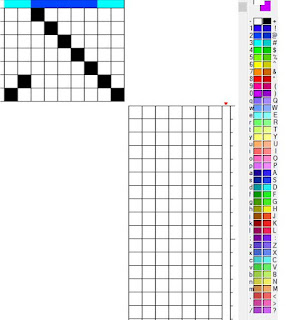
First set up the program so that it is in lift plan mode as the patterns are designed in the lift plan.  I set it to 7 shafts. There are five pattern threads for this band. The warp pattern threads are in dark blue colour. The four border threads are in pale blue. I changed the colour of the weft to white.

The full threading pattern shows the background threads and border threads and the two background threads in between each pattern thread.  It is important that the two background threads in between each pattern thread are threaded in the correct order. A pattern thread on a odd numbered shaft has a background thread on each side on shaft 2. A pattern thread on an even numbered shaft has a background thread on each side of it threaded on shaft 1. This is known as the Baltic threading and produces a crisp pattern on the front of the band and a crisp pattern in reverse on the back. 


The full threading draft


2.  Pattern Threads 

It is easier to plan your design using only the pattern threads and four border threads showing.


3.  Using the Lift Plan

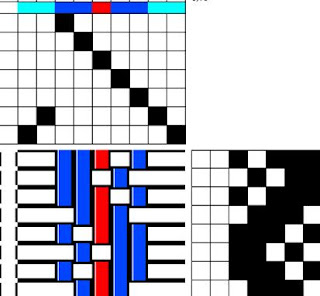
You can now start to put in your pattern on the lift plan.  I have coloured the centre pattern thread red. The first two columns are  plain weave for the background and border threads. Leave these columns blank until the end. 
This pattern is for the Sámi band.  I have copied this pattern into the lift plan. All patterns must repeat over an even number of picks.  The plain weave lifts have not yet been added. Only the pattern is shown on the treadling. 


4.  Adding Plain Weave

The next stage is to put in the plain weave for the background and border. For this you need to examine the centre thread of the pattern.  In this case it is on shaft 5.  I have coloured it red. Look for the section when it is raised over three threads.


When weaving with a rigid heddle, the centre thread is always threaded through the centre hole.  The background threads next to it are threaded through the slots. So, if this pattern thread is on an odd numbered shaft, the first pick raised over three threads should also raise the background threads on shaft 1.  This means that the background thread on shaft 2 which is on each side of the pattern thread will be lowered. This covers the background thread underneath so it does not show on the reverse side of the band. You can now fill in the plain weave.

It is important to add the plain weave in the correct order. These are filled in down the left side of the treadling. 


Here the plain weave has been added to the treadling.


This is the full drawdown.  The treadling repeat is eight rows.  The top row is the first and represents lifting shafts 1 3 5 6 7 
The second pick lifts shafts 2 4 6 7 

5.  Check the pattern repeat

The final check is to ensure that you have a correct pattern repeat. Go to the weft button and repeat the pattern.  If the pattern is regular  you know that your pattern  repeat is correct. The plain weave border threads are in pale blue. The centre of the pattern threads has been coloured red. The treadling now shows two pattern repeats. 


7.  Weaving: more than eight shafts

If you have up to eight shafts available, you can weave all five thread patterns (symmetrical and asymmetrical) and seven and nine thread symmetrical patterns.

For seven and nine thread symmetrical patterns, you will need to use a point draft.  Asymmetrical patterns for 7 and 9 pattern threads require a straight draw on 9 or 11 shafts.


Sashes

In 2018 I was commissioned to weave a set of six sashes for the Journal for Weavers, Spinners and Dyers.  I used my 32 shaft Megado loom.  Here is one sash in the process of being woven. This complex piece of weaving would have been extremely difficult to produce using a heddle. 


Do check out my blog for April 2019 for details. 

I have woven a small banner for the International Conference in Denmark in 2022. These letters have thirteen pattern threads. 


 Nordic and World Braids and Bands 2022
August 14-19, Svendborg, Denmark
5th International Conference on Braiding


The information about this wonderful conference is now available at https://thebraidsociety.wildapricot.org/Braids-2022

Do check out the details of the two workshops I will be taking on my blog. 

A happy and peaceful 2022 to everyone. 
with very best wishes

Susan J Foulkes  January 2022


Wednesday, 1 December 2021

Simple band weaving for Christmas part 2

 Making Christmas cards with woven bands.


Here is an idea for using woven bands for Christmas cards.  I have an collection of woven bands - left over from projects, samples etc. I tipped out my 'band box' and sorted them into colour groups.  


These are some of my woven bands. They are plain bands, that is there are no additional pattern threads.  These are quick to weave and I enjoy making them.  I often weave a much longer length than I need for a project just for pleasure. 

This was my first loom and it has been in constant use ever since.  


I found the band that was on my Swedish band loom when I bought it from Don Porritt. When I visited his showroom, the band loom had a sample warp on it to demonstrate to visitors how it is used.  I found this scrap of band when I sorted my own bands.   It is made with fine cotton in red black and white. It is 1cm in width.


Making a Christmas card with a woven band.

Here is an easy project for you for Christmas to use up some of your own stash of bands. This band was made in white cotton and blue glitter yarn and is 1cm in width. There are 39 ends in total.


1. Choose the blank card and decide upon the height and width of the triangle shape for the Christmas tree.  Draw the triangle onto graph paper.  This will be the template for the front of the card. 

Choose the woven band and lay it along the bottom edge of the triangle. Mark the top and bottom edges of the band.  


2. Draw a straight line across to indicate the position of the band. Now lay the band further up the triangle and mark the top and bottom edges. 


3. Repeat until you have enough lengths of band to fill the triangle.


4. For this card, I used five strips of band.  The band is fairly narrow.  You could use a wider band and have fewer strips across the triangle. 


5. Take a ruler and craft knife.  Cut the slits at each side of the triangle.  They should be slightly wider than the actual woven band.


 6.Now start to thread the band through the slits. Leave a short length on the reverse side to start.


7.  Here is the card on the front with five strips of band.


8. Here is the reverse side of the card front. At the top, trim the band and tuck in behind the top strips.  At the bottom, use a piece of doubled sided sticky tape to secure the end in place.

Finishing the card.

The front of the card needs to be finished.  Add a decorative star or other item for the top of the tree.  For the base of the tree, use some birch bark or other material to indicate the base. 

Some finished cards. 


I have not yet decided what to put onto the top of the Christmas tree shapes on two of the cards. Perhaps a stick-on star?


I wish you all a very happy holiday at the end of this difficult year. Let's look forward to a better 2022.

Happy Weaving

Susan J Foulkes  December 2021


Handwoven magazine 2022


Do check out the next edition of Handwoven magazine.  I submitted a project about Stash Busting and it was accepted. It is in the first 2022 edition of Handwoven.  My project was weaving tea towels and using up small quantities of yarn.  I am sure that all weavers have a stash which needs using. 

My previous submission was Nov/Dec 2014, Vol 172, no 5, pages 66 - 68.   The Heart of the Swedish Band Weaving Tradition. My hearts and flowers tea towel has been very popular. 

These project details are available as a download at 

https://shop.longthreadmedia.com/products/baltic-hearts-tea-towels 

I was asked about this pattern recently which gave me an idea for my next blog in January 2022. I will be examining how a patterned band can be woven on a multi-shaft loom.  


Happy festive season and I do hope that you have a peaceful New Year. 

Susan


Monday, 1 November 2021

Simple Band Weaving for Christmas


 Simple Band Weaving for Christmas 

The three week workshop will run from 1 – 19 November 2021 with Zoom sessions on Tuesdays 2, 9 and 16 November 2021. Instructions, equipment and materials lists are posted on BraidsandBands 

My workshop will run for 2 weeks on Braids and Bands and then for one further week, for Braid Society members only, via the Braids Workshop Forum in the Members’ Area of the Society’s website. 

Why not join the Braid Society?  https://thebraidsociety.wildapricot.org/Join-Us There is an excellent Journal Strands and you get access to international conferences and online workshops. You can also give membership as a gift. What a wonderful Christmas present!

Do check out the Braid Society home page at https://thebraidsociety.wildapricot.org/

I thought that it would be interesting to share another idea for using woven bands at Christmas.  I correspond with an American weaver who is very skilled and enjoys trying new things.  For several years Nancy has sent me decorations for my Christmas tree.  My Christmas tree is a memory tree of friendships and past holidays. It is so exciting decorating the tree each December because each hanging item brings back happy memories. 

Here are two hanging decorations made by Nancy who gave me permission to use them in my blog.


It is such a simple idea and they sparkle on the tree. They are woven with 13 pattern threads with glitter yarn as the pattern thread on a background of plain cotton.  Each end is sealed in a small tape and then folded over. 

Here is the pattern for the central star. 


Nancy wove other more complex patterns as hangings which are larger. One has 21 pattern threads in an everlasting knot pattern. 


Making a bookmark.

I decided to weave a narrow band in 16/2 cotton with a pattern of sparkly stars using 9 pattern threads. I used two designs.  Here is the design for the gold star with 9 pattern threads.


I used 11 border threads - 2 green, 3 red, 2 green and 4 white then the central section with  9 pattern threads in gold yarn then 4 white, 2 green, 3 red and 2 green. There are 2 white threads in between each pattern thread. The band width is 14 mm.


The second design is number 9.9 in my book Weaving Patterned Bands.  For this band I used a silver yarn Ricorumi dk from Fred Aldous and Company. It comes in a variety of colours. The silver is a polyester and nylon mix. 

I used 11 border threads - 2 emerald green, 1 red, 2 mid green, 1 red, 2 light green, 1 red, 2 emerald green then the central section with 9 pattern threads, then the border 2 emerald green, 1 red, 2 light green, 1 red, 2 medium green, 1 red, 2 emerald green. The band width is 14 mm.  I used the band to make a Christmas tree decoration. 


I wove two bookmarks with this design. Each bookmark has the name of the person woven in the centre. An excellent gift for a weaver.  My book Weaving Patterned Bands: How to create and design with 5, 7 and 9 pattern threads has over 140 patterns for you to try. It is published by Schiffer Press and it is available from Amazon and craft shops. Bookmarks and friendship bracelets are on pages 114 - 115

Two bookmarks

Here are the two bookmarks for Camilla and Amelie with silver stars. Bookmarks are quick and easy to make and are such a personal present for Christmas - particularly for a bookworm!  The bookmark is secured at the beginning by using the tail of the first weft pick as a second weft for the next three or four picks.  This secures the weft so that the beginning of the band will not unravel. The centre section can be as long as you like. The end of the band is plaited so the it can hang out from the book. This plait also secures the end. 

You do not have to weave a message - a simple band will do. 


I have written a booklet for 9 pattern threads Weaving Messages: numbers and alphabet with 9 pattern threads which is available from Blurb.com   It is available as an ebook for an IPad, a printed booklet or an instant  PDF version


Happy Weaving.  I do hope that you will enjoy making items for Christmas. A personalised woven gift can mean so much.

Susan J Foulkes 1st November 2021

The latest edition of Strands - the Journal of the Braid Society has just been published. It is sent to all members - another reason to join the Braid Society. It is illustrated with beautiful colour photographs.