Thursday, 1 June 2017

Textile Museum in Prato Italy

Museo del Testuto


Prato is a much overlooked holiday destination as it is near to Florence.  A short train journey takes you to Prato, a lovely town which is Tuscany's second city.  It has a connection to textiles dating back to the 12th century and is still involved in textiles today.  Of course it has a textile museum to celebrate this connection.

I love visiting textile museums. There is always something new to learn about textiles and this museum was no exception.

The Museo del Testuto was founded in 1975 but is now housed in an old textile factory.  The building is impressively large.

The internal courtyard


Here is the museum entrance. As usual there were many school children on visits to the museum.

The museum entrance

Inside the entrance there was a small but well stocked shop.  The books and materials were very tempting but had to wait until I had visited the museum itself.

The museum shop
The museum has a collection of ancient textiles as well as modern.  Their extensive archive covers contemporary fabrics from 1976 to the present day.
There are four main rooms.  The first is full of ancient textiles and the light levels have to be kept low to preserve the fabrics. There is a large area of materials and processes. There is a hall of Prato City showing how Prato became involved in textiles and what the processes were. Textiles from the 12th century until 1950 and finally the Prato Hall and the fashion system which covers the changes from 1960 to 2000.

It is quite a story. There are many old pieces of weaving equipment some of which seem to be in use, presumably for demonstrations.

An old loom


A warping frame

Materials and Processes.


One area was particularly impressive. the materials and processes were very well displayed and presented.  I have not seen a better example of interactive displays which are so informative.  the notices were also in English.

Nowadays, people do not know where nor how material is made. The boards were very useful but even more impressive were the handling samples.


Here you can seen a small part of the collection of handling samples.  Every material seem to be represented even artificial yarns.


It was here that I learned something new.  I had no idea that yarn could be made from the Broom plant, yet here it is in its raw form and with a sample of material.

The broom material, yarn and raw fibre.
A cloe up of broom fibre and yarn.

 Dyeing

 Dyeing was also explained with impressive detail.


Cloth finishing

One process which is often overlooked is that of cloth finishing.  Again, there were a selection of fabrics showing the effects of different types of finishing process. I learned a lot from this section.


There were also a few colourful sample books on display. I would love to have access to their archive collection!


If you ever visit this part of Tuscany, do go to this museum.  It is a treasure house.  The town of Prato is overshadowed by its more famous neighbour, Florence, but a day trip there has made me want to see more.

I came home with a couple of books from the museum.


This book about tartan is in English and Italian.  It was published for an exhibition held in the museum.  It has an interesting historical background about tartan. The section that I was most intrigued with is about tartan as an inspiration for contemporary fashion design.

The other book is about Prato - its history and the stories of the people and places.


I am so pleased that I found this lovely book thanks to a very helpful assistant in the shop.

The town museum in the Palazzo Pretorio itself was stunning and delightfully quiet after the crowds in Florence.  The Palazzo Pretorio was the old city hall in the  town centre. It houses the the Civic Museum of Prato, which was reopened on September 2013.  The art collection was wonderful and beautifully displayed.


Here are the web addresses if you want to find out more.

Museo del Testuto Prato    http://www.museodeltessuto.it/

They also have a YouTube presence.   https://www.youtube.com/user/museodeltessuto

Museuo del Palazzo Pretorio   http://www.palazzopretorio.prato.it/en/

We had a lovely holiday in Florence in March which is a jewel of a city but Prato was a revelation.

Happy textile adventures!

Advance Notice - Free Online Workshop on Band Weaving October 2017

In October  I will be presenting an online workshop for the Braid Society. Details have been posted in the Braid Society Newletter in June. This workshop is open to all.  However, you will need to join the Braid Society Yahoo group Braids and Bands if you want to take part. Check out the Braid Society Home page for details on how to join the yahoo group.  https://thebraidsociety.wildapricot.org/

Do consider joining the Braid Society. The Newsletters and the journal Strands are excellent. Becoming a member has additional benefits.  Don't forget the International Conference to be held in Kyoto, Japan in 2019.

Joining the Yahoo group Braids and Bands


Braids and Bands is a discussion group moderated by the Braid Society and primarily exists to provide members with information about Braid Society activities. Non members of the society with a genuine interest in braids and bands are also welcome to join this group. Members can ask questions about any narrow ware technique, or share details of their latest project.  There is a presentation on the home page which gives step by step guidance for joining and using the service.
You do not need to be a member of the Braid Society to join the Yahoo group but do consider joining the Braid Society.  It will bring extra benefits such as a wonderful journal  Strands and contact with a knowledgeable group of people who are willing to help with any queries about narrow wares. Another advantage is that the online workshop will have additional material for Braid Society members only.

Further details about the workshop will be posted on my blog and on Braids and Bands.  The workshop will be spread over three weeks and will give examples of band patterns from countries around the Baltic.  The fourth week is for Braid Society members only and will have additional patterns and information.

An inkle loom, a standard heddle or a double slotted Sunna heddle can be used, if you want to join in. Notes will be available for download and queries will be answered on the Braids and Bands Yahoo group. On previous online workshops, useful tips are contributed by many people taking part. We all learn from each other.

I am busy weaving the samples for the online course at the moment and I can promise you a colourful journey!

Susan  J Foulkes  May 2017

Update.

Thank you Moni, for recommending the book the Merchant of Prato by Iris Origo.  I have just received the copy I ordered and I am delighted to find that it is a history book.  It is based on an astonishing cache of over 150,000 documents which came to light in 1870.  It paints a portrait of medieval life in Tuscany.  What a lovely find.

Susan J Foulkes June 2017

Monday, 15 May 2017

Knitting and Stitching Show Edinburgh April 2017

The Spring Knitting and Stitching Show, http://www.theknittingandstitchingshow.com/  is a wonderful place to find yarn and creative ideas. I visited Edinburgh last month and went to the show there.

It was held on the Royal Highland Show Ground near the airport.


There was a free shuttle bus service from the city centre which was very efficient and packed with women of all ages excitedly talking about craft.

I wanted to buy some wool in a specific range of colours.  I usually buy online from McAree Brothers in Edinburgh and I sure that they would have a stand at the show.
The first place I went was to see this display of knitted and crocheted pieces.  I had been speaking to someone on the bus who had helped with this wonderful project.  The Butterfly Garden and Enchanted Wood was made to raise money for a hospice. The helpers had a wonderful time making it and putting it together.  It certainly attracted a lot of attention.

A vegetable patch

I love the sheep and shepherd

I arrived at the show early so that I could have a good look around before it got crowded. This standwas very colourful and was from Latvia.  Their shop is in Riga so it is definitely on my list of places to visit when I go back to Riga next year. On my last visit the National Museum was closed after a fire so I was unable to see their collection of woven bands.


A Latvian stand selling mitten kits


The kits for the Latvian mittens were very stylish and beautifully presented.  I am sorry that my photograph does not do it justice.  I forgot to take my camera so i was relying on my phone. Traditional Latvian knitting is so densely patterned with lovely symbols.  Each of the kits came with a description of the pattern and the area from which it originally came.

I found McAree Brothers but although the stand was well stocked I could not find the combination of colours that I needed.


There was plenty more to see and do.  There was a selection of workshops and talks to attend.  The workshops had a lovely way of advertising their content.  A display on the wall showed examples of items  that you could be making- including a pair of knickers.The workshop spaces were very well organised.  As a visitor you could see in to the workshop space to get a feel for the class.


I went to every wool outlet but still could not find my colours.  I did find an excellent pom pom maker which I bought.  Many belts from Sweden use pom poms to weight the ends.  Although I can make them in the conventional way I liked the simple but effective design of this device. to make a number of pompoms at the same time. I have tried it and it works very well.

making pom poms the easy way.

There was plenty of knitting on show and being demonstrated.  I like the broom stick knitting so I asked if I could take a picture for my blog.  She is not a demonstrator but a visitor like myself who wanted to have a go.  She attracted quite a crowd!


There were some delicate and intricate samples on display.  An inspiration to skilled knitters.


There were many stands selling wool and I visited them all.


Guilds and Societies also were represented.  The stand from the Edinburgh Guild of Weavers, Spinners and Dyers had two spinners working away at their wheels.


I had a great day out.  I had never visited the show in Edinburgh before and it was great to see that it is as well attended as Harrogate and London.

Her are some web addresses if you are interested.

Hobbywool  http://www.hobbywool.com/

Multipom    http://www.multipom.com/

McAree Yarn    http://www.mcadirect.com/shop/


Happy Weaving and if you can, do go to the Knitting and Stitching Show. It is great fun. It is on in October in London, November it moves to Dublin and finishes in Harrogate in late November 2017.


Susan
May 1017

Monday, 1 May 2017

Travels around the Baltic:The Russian Museum of Ethnology in St Petersburg

St Petersburg


We visited St Petersburg in 2014 and I was astounded by the wonderful collection of textiles and woven bands in the Russian Museum of Ethnography.  I wrote an article about the museum which appeared in the Journal for Weavers, Spinners and Dyers in    I had long wanted to go back to look at the collection in greater detail, so I arranged to meet a curator with a particular interest in the Finno-Ugric peoples.   I spent a day in the museum asking questions and being shown around the displays.  it was a wonderful opportunity for me to learn more about the costumes and traditions.


The Russian Museum of Ethnography houses an astonishing collection of textiles and artefacts and is is one of the largest of its kind

On the day of my visit I was surrounded by many parties of school children in the museum.  The museum has a dedicated resource and activity area where children were painting and there were resources for many crafts including pottery.  One group was painting. In the end room a group of young children  were dancing and learning songs and obviously having a great time.

A school party learning about different cultures.
This activity area for school children had its own set of display cabinets.


Embroidered towels.
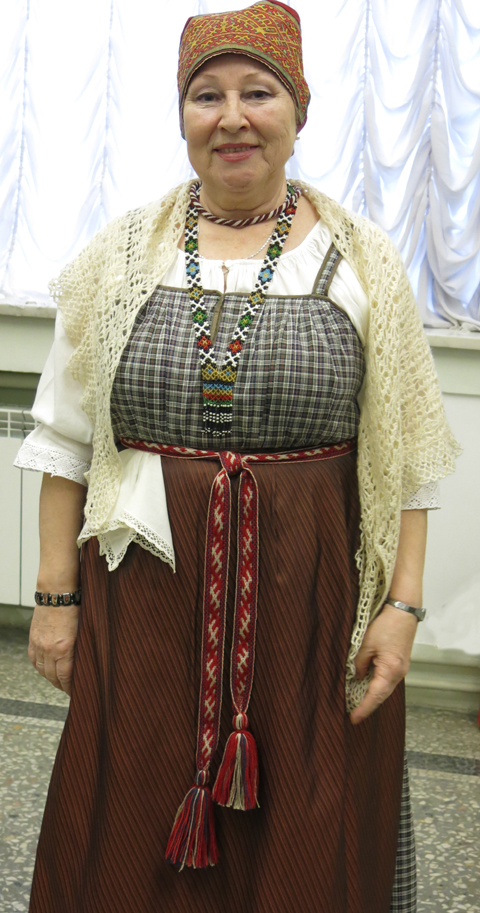
This embroidery had been created by Lidia Vershinina, one of the guides in the museum.  She was dressed in costume and showed me the belt that she had woven herself. 

Lidia Vershinina


Here it is.
close up of belt woven by Lidia Vershinina


Lithuanian Belts


Lithuanian woven band


I was able to ask about a display that I had seen on my previous visit. I liked the white flower pattern on a dark navy background and I had woven a copy of the belt - minus the lettering.  This navy and white belt was used for as a mourning band.


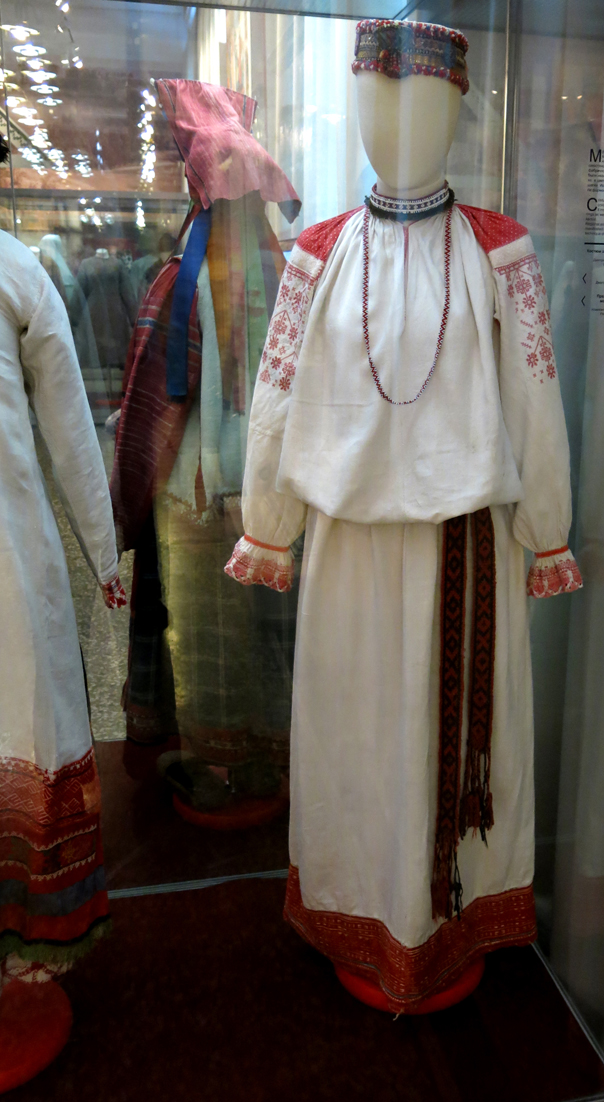
There were many woven bands on display either on models with complete costumes or selections of different bands. 
Selection of bands from different regions.
I was particularly interested in the Sami collection from the Kola Peninsular.  This will have to be left to a future blog.The museum is large and I cannot do justice to the range of costumes and textiles but here are some more images. 

Tula province


This costume is from the Tula province which is about 120 miles south of Moscow.  The belt is a simple 0 and X design but in striking black and red. This makes it stand out against the white skirt. The costume is  from the mid 19th century.

Close up of Tula belt pattern


Here is another costume from South Russia with an elaborate border on the lower edge of the skirt. 

close up of the skirt border

Belarus


Here is a skirt from Belarus with a bright belt in pink and yellow. I love the chunky tassels. The skirt material was also very interesting. It has an attractive damask like design. 


Ukraine


This costume is from the Ukraine where it borders Poland. Sash belts are very dramatic for both men and women.


Here is a close up of the sash belt worn by the woman. This is woven in  warp faced plain weave. I think that colours are lovely.

Sash belt in warp faced plain weave woven in wool.

Nizhny Novgorod


This lovely costume is from Nizhny Novrogod.


Here is a close up of the belt she is wearing. There are 15 pattern threads for this belt. 

Close up of belt pattern.

Books 


The museum has a small but very well stocked book kiosk. I bought a few books and was delighted to find a book on band weaving. It is in Russian but the patterns are clear. 

Published in 2015 ISBN 978-5-904036-37-9


Here is a sample page from the book so you can see the quality of the patterns.

I also bought a book about the European Slavs which is in English.

Published in 2008 ISBN 978-5-9501-0143-4
This book is very interesting as it has old photographs as well as modern photographs of the costumes in the museum.  

I had a wonderful day in the museum.  It is so full of interesting textiles beautifully displayed. 

Tassel making

I find the numerous ways of making decorative tassels fascinating.  I bought a lovely booklet from this Etsy site. It is downloaded as a PDF file. It is called How to make complete tassels.   by Elena Shevtsova. The instructions are for one type of an elaborate tassel. 

Her woven belts look lovely so her shop is great to browse as well. 

Susan J Foulkes    May 2017


Thursday, 13 April 2017

Weaving a band for a Wedding dress.

Recently I was asked to weave a band for a wedding dress.  This was an unusual request but I was delighted to accept.  I weave many samples and have many ideas but I rarely weave for a specific commission.

Someone had seen my picture of the six handfasting bands that I wove for an exhibition. They featured in my very first blog entry.They are in silk and are one inch in width. I designed and wove them for an exhibition and they won a prize. They were sold to someone who wanted to give them as presents for couples for their weddings. The pattern is the Buddhist symbol of the Eternal Knot.


A handfasting band was not wanted however.  A narrow silk band to go around a wedding dress and to form the shoulder straps was required.  She wanted something with a Finnish theme to reflect her Finnish heritage.
Here is a picture I found on the web which shows the type of spaghetti straps that she wanted. The band was also to be sewn around the top of the dress.


I discussed with her various options. One idea is to use a pattern of hearts and flowers, joined hearts, hearts and diamonds or a heart meander pattern. I sent her a picture of some examples woven in cotton which are exactly half an inch in width.

Another idea is to have a non repeating length of pattern.  In Scandinavian countries ( Finland, Sweden and Norway) it was the custom in the early 19th century for a girl to weave her own marriage band - this was worn around the waist.  It would be about 4 metres in length and no pattern motif could be repeated. These were really works of art. At one end the initials of the couple and the year would be woven. By the end of the 19th century, this was no longer done.

The 100 motif band was woven for a challenge on the Online Guild.  It was their 10th anniversary so I wove it as 10x10.

My woven band of 100 motifs from Sweden and Finland.


This example is woven in very fine lace linen. The very fine linen is used for for the background and weft and the traditional red wool (with a centre green thread) as the pattern threads. The centre green thread is known as the heart of the band. The band is just less than half an inch in width.  I had spent many months analysing woven bands that I had seen in museums in Sweden and Finland so that I could devise the pattern.

Each pattern on a band had to be analysed and carefully transferred to a graph - in my case a weave programme.  This weave programme allows me to check that everything is accurate and quickly make corrections if they are not. If I had to manually copy it on to graph paper, the process would take much longer.


Deciding on the colours and pattern.

She liked the colours gold and yellow so I put a short sample warp on my loom. I was not sure whether I could weave in very fine silk.  Only 1 strand of 2/60 silk is used for the background threads and weft and a doubled end for the 13 pattern threads. I wove a short sample and sent it to her so that she could see the colours and quality.

Sample friendship bracelet and bookmark.


I had a short sample of warp left so I wove a bookmark and friendship bracelet. I have a memento of the weaving.

Colour Selection.


I have a selection of yellow and gold silks.  I sent a sample of the silks that I have available. Pictures distort the actual colour. My stash of yarn is rather larger than I would like! A final decision was made to use just the centre pattern thread in ivory to represent the 'heart of the band'.


Sewing the band.

I wanted to check that the band could be sewn neatly onto silk.  I took a scrap of my handwoven silk in red and sewed the band using purple silk thread and a fine needle.  I used purple so that I could check that the band was firmly sewn and the thread did not pull. Success!


Using a matching colour for the silk sewing thread, the band can be sewn invisibly onto the dress.

After some discussion about colours and what was needed, I started to weave the band. I thought that it would be useful to time how long it takes.

I use my 32 shaft Megado electronic dobby loom.  The pattern is one that I put together for the Online Guild but it took me many months of hard work to analyse the motifs from numerous photographs that I had taken across Sweden and Finland.  Now that I have it graphed it and checked that it is accurate, weaving is straightforward .The time taken to weave does not take into account the immense effort to find these patterns originally.  I use an excellent computer program for planning my work and for weaving on my lovely loom.  It is Fiberworks PCW.

This band is a unique addition to a wedding dress.

Time analysis


Making the warp, winding onto the back beam:   30 minutes
Threading the heddles and threading the reed:      24 minutes
Designing the initials and date motif:                    30 minutes

Weaving:  8 hours
Finishing:  approx 30 minutes.

Total time = approx 10 hours

Length of finished band = 422cm  Width just under 12 mm  0.5 inches

The total number of picks to weave this band is 5,515.  Imagine having to weave this using a rigid heddle and back strap.  It would take such a long time.


Finished band. The centre pattern thread is ivory but the effect is too subtle to show. 

Completion.

The band was completed in time for the dressmaker to finish the wedding dress. I am hoping that she will send me a picture of the dress so that I can see how it looked. I also wove two bookmarks with her initials and date so that she and her mother could have a memento of the occasion.

It was a pleasure to weave this item which will be treasured.

Susan J Foulkes  April 2017