Tuesday, 1 March 2016

Fashionable Woven Bands

Wandering through the centre of Durham in January, I saw a white coat in a shop window. Around the waist was a lovely black and white woven band.  I went inside the shop and it was part of the coat not a belt to be bought separately.


Black and white woven belt.
It is really lovely.  It has 27 patterns threads.  Here is a close up.

Close up of pattern

It is very unusual to see a woven belt on a garment.

The pattern is lovely but I have not had time to analyse it yet.
Here is a close up of one of the motifs.  The white pattern on a black background is very striking.


The ends of the belt were finished with a simple fringe.


A few weeks later they had this jacket in the window.  Such lovely patterns on the cuffs.  They are reminiscent of band patterns.


Geometric designs are fashionable at the moment.

I have just received the latest Journal for Weavers, Spinner and Dyers.


Go to the web page for details   www.thejournalforwsd.org.uk

I have a book review published in this edition.

Die fabelhafte Welt der brettchengewebten Stola und Manipel zu St. Donat, Arlon
By Claudia Wollny
Published by Claudia Wollny edition.  Paperback 128 pages
ISBN 978-3-00-047682-2

This beautifully illustrated book is in four languages German, French, English and Dutch.  Her web site is lovely   http://www.brettchenweben.com/ and will be of interest to all tablet weavers.


Susan J Foulkes  March 2016


Monday, 15 February 2016

What is on my loom - February

Handwoven Magazine


In 2003, Handwoven magazine had an issue devoted to stripes.  I love stripes and I particularly liked a set of tea towels which were is the exact colours to match my kitchen.  I wove a set and after constant use, they were looking rather tired so I wove some.  Handwoven is published by Interweave Press and you can now buy digital versions. Click here for details.

http://www.interweavestore.com/weaving/weaving-magazines


March/April 2003 issue 114
Dish towels pages 24 to 27


It is a very inspiring issue.

Two of my new tea towels. 
Another set of tea towels


I also wove a set with the colours reversed so that blue was the predominant colour. I altered the stripe width.


I decided that I would weave some handtowels to go with these lovely tea towels.

Waffle Weave hand Towels.


I love waffle weave and chose the same colours as the new napkins I wove in January.  Do check out my blog for December 2014 when I wove a set of waffle weave hand towels.

Drawdown for waffle weave hand towels.

I used  Nialin which is a cotton/linen mix yarn equivalent to an 8/2 cotton. The waffle weave is on 7 shafts.
Sett: 24 ends per inch

Warp Order

White  36    6    6    18     6     18  
Blue         6    6    6
Yellow                         6     6


Finish with a group of blue .

Warp width at reed:;  26.5 inches (66.5 cm)
Warp width off loom before washing:  23.76 (63.5cm)

I wove several designs.  The first towel I wove as drawn in.  This was quite time consuming because colours had to be changed.  I used three shuttles.  The second towel I wove a border top and bottom of three blue stripes, two yellow stripes then three blue stripes. I wove the final length with an all white weft.  This is useful.  I had slightly miscalculated how much warp for each towel.  the final length is long but I can cut it in half and make two smaller towels.

Finishing the towels.


I used a wide zigzag stitch on the sewing machine to hem the towels. Once hemmed the tacking stitches can be removed.

To wash the towels, I put them into the washing machine with my normal wash and then into the drier.

This weave structure makes very textured towels.  The shrinkage is as follows and is measured with the towel already hemmed.

Before washing ( and after hemming): Length: 33.5 inches  Width:  22.76 inches (63.5 cm)

After washing and drying.: Length:  22 inches (55.5 cm) Width: 20.25 inches (51cm)

There is a lot of shrinkage for this weave structure. The final towels are beautifully textured.


texture of weave after washing


Two towels; only one has been washed so that the difference in size can be seen.
You can see from the picture that there is considerable shrinkage for this weave structure.   Both were the same size before I washed the top towel. However, the hand towels are very absorbent.

Hanging tag.


I also wove a narrow warp faced band to use as a hanging tab on the towels. I used the Nialin in the same colours. Here is the drawdown. There are 37 warp ends


The width of the tag is approx   0.5 inches (1.4 cm)

I have really enjoyed making items for ourselves.  Napkins, tea towels and now handtowels.  What next?

Susan J Foulkes February 2016

Monday, 1 February 2016

What is on my loom - January

I live in the north of England and every year we go to Amsterdam on the local ferry for a couple of nights. The Opera, concerts and museums are wonderful.  On our trip two weeks ago, we visited Haarlem for the day.  The  railway station still has the old waiting rooms.


We wanted to go to the Franz Hals museum which we visited last year, but is well worth a second look. On the walk to the museum I passed a weaving shop.


Unfortunately the shop was not open as it only opens on a Friday. This was very good for my soul as the yarns in the window displays were so very enticing and I might have been seduced into buying more yarn. My New Years resolution was not to increase the size of my 'stash' so I was pleased that the temptation could be resisted.


What a colourful window display!


So very enticing!


The shop web site is www.meervilt.nl   Do take a look.

The weather was very cold.  In the centre of town there is an old cafe which is a very popular. If you go to Haarlem, visit this cafe.  It is splendid and lovely and warm on a very cold day.


Weaving in January - a set of napkins.

Four napkins

But now on to weaving.

I have just completed a set of table napkins.  I used cottolin and plain weave.  The design is very simple - just a set of stripes in two colours. For tea towels I use a set of 20 epi but for napkins I used 22 epi.
close up before washing showing the reed marks

close up after washing
Here you can see the material before and after washing.  Before washing the reed marks show clearly.  After washing the warp and weft comes together and the reed marks are minimised.  However, you can see that the material is not smooth.

Cottolin is a mixture of linen and cotton.  To iron, I use pressure to get rid of the creases in the cloth. Usually, it takes two or three washes and presses to make the cloth smooth.

The marble slab used for ironing.
My normal ironing board has a wire mesh underneath the cover and is not suitable for pressing.  I have found that this marble pastry board is perfect.  I can press very hard to eliminate the creases in the material.

A linen mangle from Denmark.


I visited Denmark a few years ago.  We stayed on a camp site outside Aarhus.  Whilst we were there, I went to an antiques fair in the town.. Normally, I do not check out antique shops but I was searching for a particular item.  In 1947, a wooden rigid heddle was designed as a tourist gift and I had read that it had been very popular. It had 17 long holes and 16 long slots so was made for 33 warp ends. It looks so lovely so I thought that I would search for one but no luck. I would have loved to have an old hand made item like this.

Made as a tourist gift in 1947.


What I did find and buy was an old linen mangle.  It was difficult to carry on the bikes as we had not brought any large bags and the board and rolling pin are very heavy! It hangs on the wall outside my weaving room.  Linen is wrapped around the rolling pin then the board is placed on top.  The horse handle gives a good grip and the board is rolled to and from over the rolling pin.  This presses the cloth.

An old linen mangle from Denmark.

In the 19th century, linen mangles were very popular. The custom in Scandinavian countries was that a young man would carve a mangle and present it to a girl he wished to marry. If she accepted the gift, they were betrothed. 

In Sweden there was a saying,' Beware a man who has too many mangles.' If the girl refused the gift he had to take his mangle home. Usually, the initials of the girl would be carved so he could not use it again.


These were always intended as decorative items to be hung on the wall. If you visit museums in Scandinavia, you can see many examples of these beautifully carved gifts.


Happy weaving.

I must let you know about a wonderful resource - not for weaving but for courses. Currently I am taking a short three week course with Future Learn about the Scottish poet Robert Burns. It is excellent.
 I took a course last year about Hans Christian Andersen run by the University of Southern Denmark.  I can really recommend the quality of the materials.

All the course are free and anyone can join. Indeed people from around the world take part.  There are no exams.
Here is the link. https://www.futurelearn.com/


Susan J Foulkes  February 2016

Friday, 1 January 2016

Slow cloth and slow craft and the Peacock scarf

One year ago, my blog described the Slow Cloth Manifesto.  It is worthwhile to revisit the article by Elaine Lipson which is from a talk she gave to the Textiles Society of America in 2012.  Read her original thoughts about slow cloth  and the link to her article here.  http://elainelipsonart.com/tag/slow-cloth/

Treasuring quality and creativity is a vital part of her description of worthwhile craft.  Slow cloth is about taking time and finding the inspiration and joy in learning and making.

Elaine Lipsons description of Slow Cloth. reprinted with her permission. 


Thinking back over the past year, it is those projects which have taken time which I most treasure.


  • Spending a week teaching at Summer School was tiring but also invigorating.  Having the time to spend with a group of interested and enthusiastic weavers and see the progress in skills and understanding was wonderful. The preparation for a whole week of teaching was huge but in doing so I also gained insights into the learning and teaching process.  Learning was also a two way process.  We learned a lot from each other.
  • Preparing the talk for the Braid Society AGM was a wonderful way to bring together my thoughts about my travels around the Baltic and my understanding of why patterned belts were so important. The background reading for this talk taught me a lot about culture, history, archaeology, symbolism, and so many aspects of peasant life  - far more than I needed for the  talk but so enriching for me personally. 
  • The relearning of the principles of collapse weave took a great deal of experimentation to get the effect that I wanted.  The Online Guild of Weavers Spinners and Dyers is a great forum for learning.
  • The sudden flash of my imagination when told about a cloth embroidered with peacock feathers sparked a desire to try to create iridescence.  Thinking about how to achieve this and sampling took time but I was thrilled with the result.  
  • Preparing materials for my workshop in Tacoma, USA in August 2016 has been an ongoing revision of ideas.  Writing an article for the conference proceedings has provided a focus for my work in analysing patterned bands and taken me into areas that have been quite surprising. Three months later it is finally ready to send off!


My New Year resolutions for 2016 is to spend more time on fewer projects.  It is exploring ideas and techniques in depth which for me brings most satisfaction (and sometimes frustration!).

The Peacock Silk Scarf.

As I mentioned in my last blog, the talk about Chinese Imperial textiles inspired me to think of a way of creating iridescence in a design for a silk scarf.

The three colours of silk yarn.

The Weaving Draft


Here is the weaving draft. It requires 16 shafts and a floating selvedge. This is the first time that I have used three strands of 2/60 silk together. I was not sure what sett to use so I allowed an extra length for the warp to weave practice pieces. I could try different setts and  weft threads to create the best effect.


Here is the tie up drawdown for those of you who are interested.


There are 54 picks in the pattern repeat.


First sample


I tried a sample at 30 epi using three strands of 2/60 silk for the weft.  I used two strands of black and one of green 60/2 silk.  The sample was very firm and not suitable for a scarf. The colours in the weft obscured the colours in the warp.


My first sample at 30 epi with three strands of 60/2 silk for the weft.


As you can see, the green strand in the weft detracts from the threads making the pattern. I realised that I would need to use a solid colour for the weft. This would create a background for the colours of the silk warp.

Second sample


I decided to try using a fine 3/45 dark navy cashmere and silk yarn for the weft. This was a 'bin end' so I cannot buy any more. I used two strands used together.  I changed the sett to 25 epi. 

This time the sample material felt lovely and soft and the leaf shape was outlined by the dark navy weft. 

However, I decided that the finishing of the scarf should also be luxurious.  For the twisted fringes, I separated out the three colours of the warp yarns.  This was a slow, laborious task but I thought that it would add a touch of mystery to the finished project.  It took a day and a half to complete the fringes but I think that the extra effort was worth it for the effect.

Twisting the fringes.


I twisted the three colours together.  The fringes are a lovely twisted rope of silk.

Here is the completed scarf.
The completed scarf


close up
It is difficult to get the full effect of iridescence in a static image.  The colours glow when the material moves when it is worn.

There was a wonderful series on BBC television recently about colour called 'Colour - the Spectrum of Science.'  Episode two explained how iridescence works. There are still clips about the programme available to watch on the BBC web site. This clip is about peacocks.   http://www.bbc.co.uk/programmes/p0371l2f  


I wish you all a happy and creative 2016.

Susan J Foulkes


Friday, 11 December 2015

Dragon imagery in Chinese Imperial Textiles

The Oriental Museum, Durham University   

The Oriental Museum in Durham University opened in May 1950. Since then the collections have grown and it now has around 30,000 objects with collections covering Ancient Egypt, the Near and Middle East, China, Korea, Japan, India and the Himalayan region and stretching into South East Asia. The Ancient Egyptian and Chinese collections are of particular significance and hold 'Designated Status', recognising their importance on a national and international scale.
The unprepossessing outside of the museum gives no hint of the treasures inside. 


In addition to an exciting programme of temporary exhibitions, over the last 5 years the permanent galleries have been fully refurbished. The Museum attracts over 30,000 visitors a year.  You can visit the website at this address; https://www.dur.ac.uk/oriental.museum/

Here are two views inside the museum.
The Macdonald Gallery


The new South East Asian gallery opened in March 2015

The Friends of the Oriental Museum support the Museum in a number of ways. They help the Museum to acquire new objects into the collections and volunteer on museum projects such as cataloguing the departmental library. The Friends also arrange a series of talks each term which are open to members and non- members.  For information on forthcoming talks and how to join the Friends and support the museum, click here;

I am fortunate to live within walking distance of the museum so naturally I want to support it.  The museum’s Friends put on a series of talks each term. Recently I went to a fascinating talk by David Rosier about Dragon imagery in Chinese Imperial Textiles.  His talk was very well received and hopefully, he will be able to give another talk in the lecture series next year.  .

David lived for a many years in Hong Kong and worked extensively in China. During this time he and his wife became interested in the stunning imperial textiles that they saw and started to create an extensive collection of Court Costume predominately from the Qing Dynasty (1644-1911).

His lecture was a tour of over 1000 years of colourful silk embroidery with the focus being on the Ming and Qing Dynasties (1368 to 1911). I contacted David to ask if I could use  some of the pictures that I had taken on my blog.  He gave his permission and also provided additional notes to explain some of the significance of the imagery.  (My note taking during lectures is rather rusty!)


The Chinese Dragon Symbol.


The Chinese dragon symbols are thought to originate from Neolithic times (6000-1600 BC) in the Yellow River Valley where jade carvings provide recognisable dragon images. One of the earliest examples of the dragon imagery that would be adopted by the Imperial Court as the personal emblem of the Emperor originates in the Song Dynasty in the Nine Dragons Scroll by Chen Rong dated 1244. This scroll is in the Museum of Fine Arts in Boston, USA.

The scroll shows the nine different forms of dragons. Imperial Dragons are a combination of 9 animals and are represented in 9 different forms each with specific powers and attributes. Nine is regarded as the most auspicious number in Chinese culture.

The ‘benevolent’ Imperial Chinese Dragon is associated with control of the weather which will determine the success or otherwise of crops grown to produce food. The dragon is adopted as the personal emblem of the Emperor because of this association of providing adequate food for the population. All Emperors took this responsibility very seriously and performed numerous rituals and sacrifices during the year to ensure the success for all forms of agriculture.

It is thought that the adoption of the dragon on Court Costume as an indicator of Imperial status dates to the commencement of Imperial rule in China with the Qin Dynasty (221-206BC). Dragons were deployed on a variety of court costume and their structure (number of claws, position, nature of the body scales and the number of dragons incorporated) were used as indicators of the seniority of the wearer (Insignia of Rank).

Dragons were incorporated into formal state costume in the form of Roundels (4 on each robe) or Squares (2 on each robe) positioned on plain outer surcoats (Chao Fu) to indicate the status of the individual within the 12 ranks of the Imperial Clan, which included the Emperor and Empress, plus the 9 Ranks of Civil and Military Officials that formed the upper echelons of the Imperial Government.

A state robe known as a Chao Pao would have been worn beneath the surcoat and dragons were deployed in the design on a silk ground of a colour appropriate to the rank of the wearer.

Dragons were also used on semi-formal court costume (Dragon Robes known as a Jifu) which were worn by all members of the Imperial Clan plus the 9 Ranks of Civil Officials (Mandarins) and 9 Ranks of Military Officers. Individual Imperial edicts, determined all forms of costume and dress accessories for all ranks at the Chinese court.  In 1759 these regulations were reviewed, revised and extended by the Qianlong Emperor. The project resulted in the regulations being  codified in 18 volumes with 5000 pages of descriptive text and over 6000 illustrations which  indicates the complexity of this system. Despite the reference documents having been partly looted from The Summer Palace in 1860 the surviving folios are an invaluable source of information regarding the actual regulations and their visual form.

Robes worn by the Emperor and Empress. 


Robes incorporating dragon imagery which were worn by the Emperor and Empress were embroidered on an Imperial Yellow Silk ground. This colour was for their exclusive use and robes for other ranks utilised colours appropriate to their rank and status. In 1759 the Qianlong Emperor introduced the usage of the twelve ancient symbols of Imperial Authority which were embroidered in fixed positions according to the nature of the robe and for the exclusive use of the Emperor and Empress.

Dragons of the highest status, representing the Emperor and the first 4 ranks of the Imperial Clan had five claws and are known as Lung Dragons. There are dragons with 4 claws (Mang Dragon) as well as those with only 3 or 2 claws. The number of claws are the main indicator of the dragon’s status.
Semi-formal dragon robes (Jifu) were worn by all members of the Imperial Clan (men and women) plus the officials of the Court and Government. Dragons were an integral part of the design and those of high imperial status would have 9 dragons where those of lower rank would have 7 or 5 dragons. The colour of the silk ground would change according to the rank of the wearer and these robes varied in their structure according to the season of the year.

Imperial dragons were worn by women of the Imperial Clan as well as wives of officials. Their rank was derived from their father or husband and robes were of a similar construction to their male counterparts. Whilst men of the highest rank would wear 9 dragons on their semi-formal robes the women would have no more than 8 dragons (8 being the luckiest number in Chinese culture).

Finally the characteristics of a dragon were incorporated into mythical creatures that formed insignia of rank of certain officials. A First Rank Military Official was represented by a creature known as a Qilin which had a head of a dragon, body of a deer and tail of a bear. In addition a creature with the head of a 1 horned dragon and body of a bear, known as a Xie Chai, represented the group of 50 exceptional Civil Officials that were known as Censors and acted as the Emperor’s Auditors.

Examples of Imperial Insignia.

David brought along many examples of the imperial insignia for us to see.  It was a stunning collection of shimmering embroideries. He has given his permission for me to use some of my images.


Imperial dragon insignia roundel with a five-clawed dragon. © David Rosier
This shows an imperial dragon insignia roundel with a five-clawed Lung dragon.  It dates from the late 19th century and has as an additional, and optional, design feature. These are the eight precious items for the Buddhist religion. Similar symbols exist for the Daoist/Taoist and Confucian religions.
The flaming pearl in the centre of the roundel indicates knowledge and enlightenment. In the majority of examples the dragon is chasing the pearl but occasionally the Emperor would allow the dragon to be portrayed having caught the pearl. This would normally be a reward for exceptional intellectual services to the court.

Finally the design above the head of the dragon is known as the Shou symbol and relates to a wish for longevity. This particular form means 10,000 times 10,000 years-a wish for immortality. This iconography was reserved for the Emperor and his designated heir, the Crown Prince,

Close up of Eternal/everlasting knot  © David Rosier
Here is a close up of the eternal/everlasting knot which is one of the 8 precious items of the Buddhist religion. It is very similar to the Celtic Knot.  I have used this symbol in my weaving. Go to my first post in June 2014 to see the silk handfasting bands that I wove with this symbol.


Imperial princess roundel © David Rosier

This is an imperial princess roundel showing the Lung dragon on a green background. Green was the next highest ranking colour for women after Imperial and then Apricot Yellow. The flaming pearl has been replaced by the Shou symbol which is a wish for a long life. 

This roundel, along with 7 identical ones, would have been deployed on a semi-formal ‘celebration’ robe, identical in structure to the Jifu Dragon Robe, which would have been used for a special birthday celebration such as the ‘coming of age’ at 15 years. This example dates from the mid 18th century.


Imperial dragon collar trim © David Rosier

This is part of an imperial dragon collar trim for a robe and dates from the 19th century. Dragons in a running or flying design, chasing the flaming pearl, would decorate robe trim which normally extended around the neck of the collar and could encircle the body of the robe. An identical design would have been used to form ‘horseshoe’ cuffs.

It was wonderful to have the symbolism of the robes explained.  I shall look at Chinese textiles in a new way in future.

Embroidery with peacock feathers  © David Rosier 

Finally, but certainly not least is this beautiful embroidery.  Peacock feathers have been used to make a shimmering surface.  David did not bring this example with him as it is so fragile but he described it. His description of it fired my imagination. I contacted David and he kindly sent me an image of this highly unusual and delicate piece.


Contact details for David Rosier.

David can be contacted at drosier@yahoo.com to discuss a possible lecture or special interest day topic and the logistics associated with staging an event.

Here is a list of lectures:

Lectures of approximately 60 minutes cover a range of topics linked with Chinese Imperial Court Costume of Qing Dynasty (1644-1911).
The most popular lectures include:
Chinese Imperial Court Insignia of Rank-‘Ultimate Power Dressing’
Chinese Imperial Court Costume-‘A Journey through the Emperor’s Wardrobe’
Dragon Imagery in Chinese Imperial Costume-‘Ruling from the Dragon Throne’
Emperor Qianlong-Ultimate Renaissance Ruler and Fine Art Collector.
In addition David gives full and half day Special Interest/Study Days ( ‘Dressing the Emperor’s Court’) plus a double lecture session. All talks are illustrated with digital images plus a display of relevant textiles.

He lectures regularly to textile and costume organisations, historical societies, museums, universities, Chinese Cultural groups, The National Trust and Art Fund around UK and is an accredited lecturer for the National Association of Decorative and Fine Arts Societies (NADFAS). http://www.nadfas.org.uk/ which has 300 societies around UK and approaching 100,000 members.

There is a link to a lecture David gave for the Oriental Rug and Textiles Society.   You can view his talk here.  http://www.orientalrugandtextilesociety.org.uk/imperial-wardrobe-talk.php


A Source of Inspiration.

As you can see from the selection here, the textiles that he brought along for us to see were stunning. I was taken by the idea of peacock feathers being used in embroidery to give iridescence to the background.  I wondered whether I could produce such an effect in weaving by using several colours in silk to make up the warp threads.

Here is a close up of a peacock feather.  The number of colours is astonishing when magnified.


I decided to try if I could achieve the effect of iridescence.  I took silk in three colours: emerald green, bright blue and dark blue to use as the warp.  Three strands of 60/2 silk were used together to make the warp.


I have a weave pattern which gives the effect of feathers so I thought that I would try to weave a scarf with iridescence inspired by the Chinese embroidery.

The details of this scarf will be given next month as this is already a long post to end the year and the scarf is taking a long time to design and weave.


I hope you have enjoyed my posts for 2015.  Do tell your friends about my blog.

With best wishes


Susan J Foulkes

Tuesday, 1 December 2015

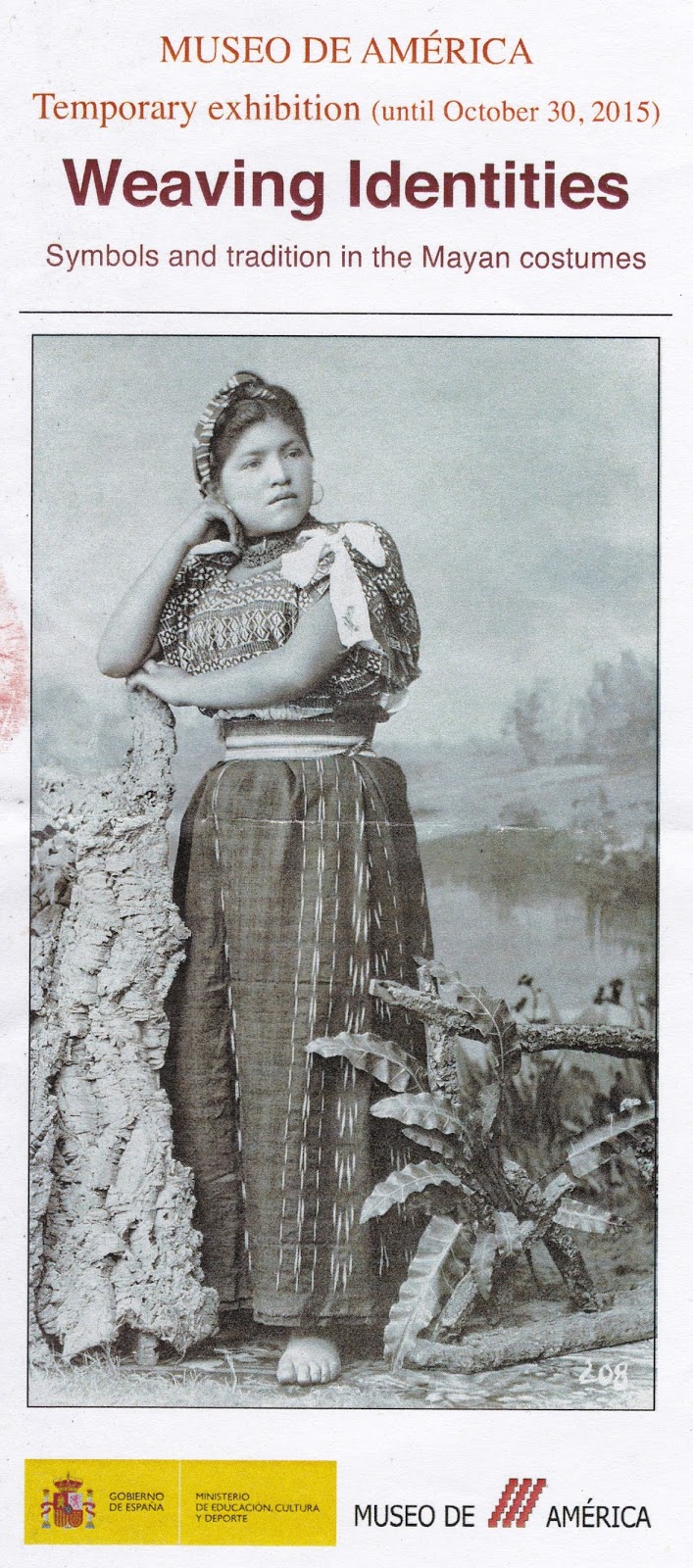
Museum of America in Madrid

I spent a week in Madrid last month and had a wonderful time.  One of the unexpected delights is the Museum of  America.  If you get the opportunity to visit Madrid, do go to this museum. Click here for their web site to view the collection. The site is in Spanish.  http://www.mecd.gob.es/museodeamerica/coleccion.html


This stunning museum has a magnificent collection of textiles from South America.  I was fortunate to be there at the same time as an exhibition of a selection of their collection of Huipils. Fortunately the exhibition dates had been extended.


Here is a flavour of the colours.


The vibrant stripes are a wonder.  Colours that I would not usually put together look stunning.

Vibrant stripes


The book about the museum collection was only available in Spanish but worth buying. It is listed on the museum web site.

Tradición de tradiciones  by María Jesús Jiménez Díaz   2006  ISBN 978-84-8181-386-9
published by Ministerio de Cultura, Madrid


All textiles are a good source of inspiration.  The huipils are usually woven in warp faced weave so the lovely stripes can be examined in detail.  Choose an area that you like and make up a pattern. 

close up of Huipil


graph for narrow band
For this band of 37 warp ends. I used a double thread in the centre so that the deep pink would show more clearly.  I wanted a narrow band so I reduced the pattern. 


Here is the band I wove./  I used 16/2 cotton so the band is very narrow. 


I made part of the band into a bookmark.


Here is another lovely book with lots of inspirational pictures to help with stripe design.


Textiles from Guatemala by Ann Hecht 2001  British Museum Press ISBN  0-7141-2739-6


Madrid is an amazing city.  We had beautiful weather - sunshine and blue skies for the whole week in November!  The art galleries are first class.  


Susan J Foulkes December 2015