Showing posts with label Chinese textiles. Show all posts

Saturday, 1 April 2017

Dressing To Impress: Chinese formal and informal costumes

Dressing to Impress

'Dressing to Impress': Chinese Formal and Informal Costume and Dress Accessories
(Qing Dynasty 1644 - 1911)

Lecture by David Rosier.

Wednesday 8th February 2017 at 7:30 organised by the Oriental Museum, Durham.


The Friends of the Oriental Museum organise a series of talks each year which are open to the public. https://www.dur.ac.uk/oriental.museum/

David Rosier lived for a many years in Hong Kong and worked extensively in China. During this time he and his wife became interested in the stunning imperial textiles that they saw and started to create an extensive collection of Court Costume predominately from the Qing Dynasty (1644-1911). His previous talk on Dragon Imagery in Chinese Imperial Textiles was colourful, informative and exciting.  I have a new appreciation of the range and purpose of the robes seen in many museums. 

His previous talk was described in my blog for December 2015 and you can quickly go it it with this link.  https://durhamweaver64.blogspot.co.uk/2015_12_01_archive.html

For the talk in February 2017, David showed us the many and varied clothing items worn by officials and the military and also described dress accessories. These ranged from elegant purses, spectacle cases and jewellery.  There were many examples of these textiles for us to see in detail.


My note taking skills have declined so I am doubly indebited to David for supplying these notes to accompany the pictures on this blog.  He is generous with his time and has a real love of these wonderful examples of Chinese costumes.

General costume


The informal costume items date from the 19th Century and would have been worn by men and women within the nobility (Imperial Clan) and the officials (and their wives) of the 9 Ranks of both Civil Officials (Mandarins) and 9 Ranks of Military Officials. In addition these items would also have been worn by those who would be regarded as being part of Chinese High Society (eminent scholars, wealthy landowners and merchants). 

The costumes worn, plus dress accessories, were not governed by the strict regulations applied to Court Costume and therefore the wearer could determine the design and iconography to be used. The items would be produced on commission by Commercial Workshops, as opposed to the Imperial Workshops, with designs either being the unique requirement of the wearer or taken from pattern books maintained by the workshop.

Whilst the majority of items originate from Commercial Workshops a few items (such as the Mirror Cover) are evidence of the skills of ladies of Chinese High Society. Embroidery was regarded as the 'premier feminine art form' and girls born into elite families would be trained in the art and expected to produce exceptional items. A prospective daughter-in-law would often produce a selection of such items to hopefully convince her future mother-in-law that she had the appropriate skills and was a suitable bride for her son. These items are generally unique in their design.


Civil Rank Badge:

This is a front badge for a 2nd Rank Civil Official. The central split indicates its position on a plain outer robe known as a Pu Fu-the badge on the back would be solid. The bird is a Golden Pheasant. The border symbols are alternating wishes for long life and happiness. Bats are an indication of happiness as are the Buddhist swastika design so they indicate in effect a wish for 'double happiness' The position of the sun symbol indicates this is a badge for a man - his wife would have had the sun in the opposite corner.


Badge for the front of a robe of a Civil Official.


I particularly liked the Golden Pheasant on the Civil Official’s rank badge.  It is embroidered in satin stitch with gold and silver couching.  It was made in Suzhou about 1870.  The bird is very lively with beautiful colours for the tail feathers and wings. I think that this will be a great source of inspiration for my a design for weaving.


Purses


Formal and informal robes had no pockets and any items required day to day for practical purposes were attached to a belt known as a Chao Dai. There were ceremonial and informal versions of the belts. Whilst there were a myriad of items created to be worn in this way purses were by far the most common articles. This was due in part to the tradition, from the Emperor downwards, to giving embroidered purses as a gift for Chinese/Lunar New Year.

Some were produced in the Imperial Workshops but the majority came from specialist Commercial Workshops and were either made from an existing pattern or a unique design was created at the request of the person commissioning the piece. These decorative accessories were most popular in 19th Century but some surviving examples date back to 18th Century but tended to be plainer in design/decoration. These items were 'unisex' and so it is impossible to tell if this was worn by a man or women. Unlike formal court costume these items were handed down the generations as were informal robes.

Purse 1: a coin purse.

Purse 1: this is a coin purse with a protective flap and the embroidery is suggestive of production in Canton. The embroidery is fine but the design is rather basic indicating this is a lower quality item made from an established pattern


Purse 2: a dalian purse.


Purse 2: this is known as a dalian purse. It hooks over the belt and has two separate compartments. This example combines a number of symbols associated with longevity such as the shou symbol, peony and lotus. The animal is a tiger (4th Rank Military animal) but also used as a protective symbol for young boys. David thinks that this may have been a birthday gift for a young boy and was probably made in Suzhou or Nanjing.

Purse 3 Tobacco or snuff purse

Purse 3: this is a tobacco or snuff purse shaped as a gourd. The size and design indicates that this is late 18th Century. The design has symbols of happiness and the tassels have the Buddhist everlasting knot design added. 


Ear Muffs:


These would have been produced for women living in Northern China where the winter climate is cold. They are embroidered with a selected design of an ancient landscape. There are remnants of the rabbit fur that would have lined the ear muffs. It probably dates to the mid 19th Century. 


Spectacle cases: 


These are for a man and a very common item worn from the belt. Women also had these cases but the glasses tended to be much smaller hence would have a much more delicate case. The bats are a symbol of happiness and hope for good fortune. The trellis background pattern is a decoration that had been used for many centuries but gave a 'modern'  or 'ageless' feel to the design. It is difficult to be specific on the date but it is probably from the 19th Century.


A case for spectacles.

Pocket Watch Cover:


Pocket watch cover


This is a spectacular piece from the late 19th Century given that the inner mauve lining indicates the use of aniline/artificial dyes which were not commercially available until 1890's in China. It may have been added later as the embroidery suggests an earlier production time.
The silk ground is in Imperial Yellow the colour reserved for Emperor/Empress so far as regulated court costume was concerned. Whilst this colour could be used by others for informal items it was rarely selected as a colour given its associations with the Emperor.


Because of the superb embroidery, David thinks that this may have been produced for the Emperor to give as a gift. The Peacock represents the 3rd Rank for a Civil Official but here it is a symbol associated with splendour and wealth. The peony and pine trees are other symbols associated with longevity.


Collar:

Collars were fully detachable and were worn by women and children. Men did not wear decorative collars - only a stiff reinforced plain collar with their informal robes (Long robe (Nei Tao), 3/4 length tunic top (Wei Tao) plus collar-the full outfit was called a Chang Fu.

Collars ranged from small to vast and there was a massive range of design elements. Collars were detachable so designs appropriate to the occasion could be worn. Collar design often was coordinated with sleeve panel and robe trim themes. The plants on this collar relate to specific months of the year. Each month had a plant allocated as did the seasons.

A collar for a child with embroidered flowering plants

This is exquisite.  The curving shapes of the panels and the elegant embroidery make it a beautiful piece for a child to wear.

Sleeve panels:

Sleeve panels in terms of design were as variable as the collars ranging from auspicious or religious designs, stories from classical literature to complete random selection of imagery. They were detachable and so worn only when the design was relevant to the occasion. They were often bought with a set of matching robe trim and a collar.

They were created by specialist workshops. In David's collection and his experience of examining these textiles, it is the only item that mixes Chinese and Western images. He suspects that these were made for the wife of an official in a trading port, probably Canton, who was involved with trade with foreigners. It is unlikely to have been created for a wife of Western Trader as these items would not have displayed anything other than Chinese decoration although there are always exception to the rule. The border design has no particular meaning-purely decorative.


Silk sleeve panels


Close up of one of the boats.  


Mirror Cover:

The mirror cover is almost certainly a unique item created by one of the ladies within an elite family. It dates from early 19th Century with different domestic scenes on both sides and an inner silk-lined section to protect the mirror whilst travelling.

The interesting aspect is that the creator has recycled some much older scraps of silk brocade. These appear to be from robes typical of the Ming Dynasty (1368-1644) and have been identified as 16th Century. Recycling of textiles has been prevalent with textiles for many centuries and continued into 20th Century following the collapse of Imperial Rule in 1911.  Items such as Rank Badges were turned into ladies evening bags, screens etc and sleeve panels/Robe trim created table coverings and similar. This was most prevalent 1920-1940 and were often bought by Westerners.


A mirror cover
The embroidery is exquisite. I love the scenes of everyday life around the edges.  The two central characters are playing the game of Go.

Jewelry 

The times that I found most interesting were the items of jewellery.  These are made with Kingfisher feathers.  These feathers were farmed and then the sections were glued into the metal framework ensuring that the adhesive did not discolour the outer feather.
hairpin

close up of another hair ornament. What delicate work!
Last year I visited Basel and there was a special exhibition in the museum.  They had a display of Chinese jewellery which the curator was eager to show me.  I think he said that it was made with peacock feathers but the uniform blue would seem more typical of the kingfisher. (David confirmed that these are made with Kingfisher feathers.)

 Here are some examples from Basel.  Some of the items were so delicately made that the ends of the flowers  or wings of the bird would tremble when worn.  This would add to the iridescence of the colour.


As usual, Davids talk  finished all too quickly.  The items he brought for us to see were spread over several tables.  Although we could not touch, it was lovely to be able to see these items so clearly.

Glass display cabinets in museums although vital, do make examining textiles very difficult. 


Porcelain flower and Kingfisher feathers


David sent me a photograph of another piece from his collection. This decoration is so delicate.It is a hair pin with a porcelain flower. 

I want to thank David again for being so generous as to supply most of these detailed notes about his collection and additional photographs.  I can recommend him as a speaker for any group interested in textiles, clothing and accessories of China. 

Contact details for David Rosier.


David can be contacted at drosier@yahoo.com to discuss a possible lecture or special interest day topic and the logistics associated with staging an event.


Here is a list of lectures:

Lectures of approximately 60 minutes cover a range of topics linked with Chinese Imperial Court Costume of Qing Dynasty (1644-1911).
The most popular lectures include:
• Chinese Imperial Court Insignia of Rank-‘Ultimate Power Dressing’
• Chinese Imperial Court Costume-‘A Journey through the Emperor’s Wardrobe’
• Dragon Imagery in Chinese Imperial Costume-‘Ruling from the Dragon Throne’
• Emperor Qianlong-Ultimate Renaissance Ruler and Fine Art Collector.
In addition David gives full and half day Special Interest/Study Days ( ‘Dressing the Emperor’s Court’) plus a double lecture session. All talks are illustrated with digital images plus a display of relevant textiles.

He lectures regularly to textile and costume organisations, historical societies, museums, universities, Chinese Cultural groups, The National Trust and Art Fund around UK and is an accredited lecturer for the National Association of Decorative and Fine Arts Societies (NADFAS). http://www.nadfas.org.uk/ which has 300 societies around UK and approaching 100,000 members.

There is a link to a lecture David gave for the Oriental Rug and Textiles Society. You can view his talk here. http://www.orientalrugandtextilesociety.org.uk/imperial-wardrobe-talk.php


Susan J Foulkes April 2017

Wednesday, 15 March 2017

Travels around the Baltic:St Petersburg


The Kunstkamera  (Museum of Anthropology and Ethnography) in St Petersburg, Russia


The Kunstkammer in February 2017 
We visited St Peterburg in February this year.  Having seen the city in the summer when it was very hot, we thought that it would be interesting to see the winter season. Yes, it was cold and it was the first time that I had seen a wide frozen river.

 The Kunstkamera (Museum of Anthropology and Ethnography) is one of the first museums in the world.  It was established by Peter the Great, an enlightened and intelligent monarch who started to collect curiosities. This was a fashionable educational pursuit at the time. The heart of the collection is still made up of exhibits collected during Peter's lifetime.  It houses over one million ethnographic, anthropological and archaeological artefacts. This beautiful building, on the right in the photograph, was built to house the collection and opened in 1734.

The web site is   http://www.kunstkamera.ru/en/

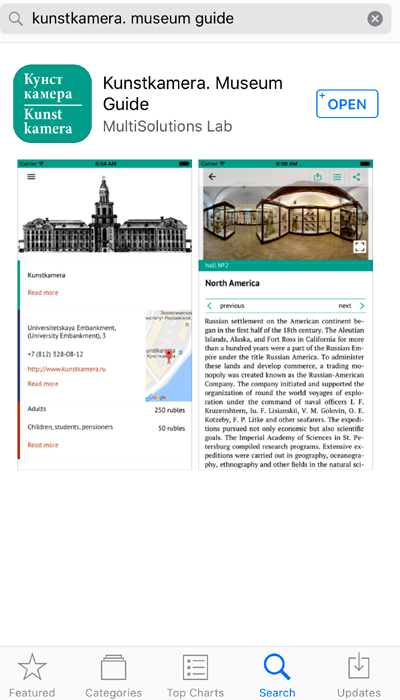
Mobile app.

The museum houses a wonderful collection of clothing and artefacts from many cultures.  The web site is good but the mobile app is wonderful. Going around the museum, I could upload information from QR points on the display cabinets. However, you do not need to go to the museum in person. You can browse the collection yourself by downloading this app for your  mobile phone.  It is free in the app store. There are lots of pictures and information about the exhibits.

The Kunstkamera Museum guide app. 

This app is very easy to use.


Start to browse by clicking on the museum guide.
One you have clicked onto the museum guide you can explore each floor of the museum.

Floor one. 
On each floor you can virtually walk around and click onto any of the numbered display cabinets. You can enlarge each floor so that the numbered cabinets appear.

There is plenty of information and pictures of the exhibits to see in detail. This picture shows Floor One, Hall 4, Japan and case 33. Clicking on the case brings up the information and pictures. It is about Kabuki and Noh theatre in Japan.

Inside the museum.


Here I am wandering around the museum.

Here are some of the amazing garments from 19th century Alaska.

Close up of the border from the Alaskan coat. 

The border on the coat is particularly attractive.


The cabinets displayed the garments and other artefacts clearly.  As you can see, many of the cases could be viewed from three sides which is very useful when examining textiles.


Here is a display of narrow band weaving from Africa. It is on Floor One, Hall 6 Africa,  case number 8 if you want to see it on the mobile app.  The textiles are gorgeous.

close up of textiles.

My interest was taken by a Manchurian costume. This can be seen on Floor Two, Hall 9 China, Mongolia and Korea in  case number 33 on the mobile app.


Costume from Manchuria with a woven belt.

This was the only belt on display which is similar to belts from countries in northern Europe in particular to those in the Ukraine, Russia, Belarus, Latvia and Lithuania.

The central area has a pattern with 11 pattern threads on a background of half basket weave.  There is a small pattern on either side which is a supplementary warp pattern on a background of warp faced plain weave. The fringe on the ends is used extensively in the Baltic area.  Was this an export item?

I consulted David Rosier who is an expert on Chinese textiles. He took me through the history of the Manchu. (See my next blog in April on Dressing to Impress).

As the Manchu took power in 1644 they had very clear ideas on the design of Court Costume but this was in terms of structure rather than designs/iconography. The Manchu adopted the Confucian based system of government and all the infrastructure that had existed in previous dynasties. As such they did little to change the iconography on costumes initially and this was adapted gradually up until 1759 when Emperor Qianlong undertook the most comprehensive review, revision and expansion of the costume regulations ever undertaken. This has not provided us with any specific design patterns attributed to this group.

However the Manchu evolved into traders in 16th and 17th century, in particular in fur and ginseng. They certainly had trade links with Russia. It may be that this belt was a commissioned piece. Of course, it may be an ethnic minority piece of China.   More information is needed. 
Thank you David, for your comments about this piece.


Close up of the ends of the belt. 


Weave pattern for 11 pattern threads.


Here is the weave pattern showing two of the motifs on the Manchurian belt with the cross pattern. There are 11 pattern threads. Each pattern is repeated twice with the cross motif in-between.  The whole belt was not visible but there were eight patterns on the front each repeated twice and separated by the cross pattern. It would be lovely to be able to see the whole belt. 
I have not had time to weave this pattern, but it is on my list of things to do.

Enjoy your virtual visit to the museum. 
In a later blog I will show items from my visit to the Museum of Ethnography in St Petersburg.  This is one of the largest museums of its type in the world and the collections are simply stunning. You can have a preview here.  http://eng.ethnomuseum.ru/

Peter the Great


The Bronze Horseman
This is the statue of Peter the Great in St Petersburg. it is known as The Bronze Horseman.


The Hermitage Museum - The General Staff Building.

We visited the Hermitage Museum which now has a modern annex in the General Staff Building. The internal spaces of the building have been creatively altered to make a stunning new set of exhibition rooms.

The new staircase leading up to the exhibition rooms.

The first exhibition space. 


Uniform of Peter the Great
In the Hermitage, there is a portrait of Peter the Great wearing his military uniform with his sash being worn around the waist. Amazingly the actual uniform which dates to before 1709 is on display with the military sash  near the original portrait.
Unfortunately I could not find out any further information about this uniform.
The sash interested me as I know that many military sashes are made using the sprang technique.  I looked carefully at the sash in display but could not see the details that might identify the technique. 


Close up of sash.  It appears to have been striped but the colours have faded.
During the International Conference of Braiding at Tacoma in July 2016, I went to a lecture by Carol James.  She told the story of how she made a replica of a sprang military sash which had belonged to George Washington. 

Carol has made a special study of military sashes made using the sprang technique. 

Technique    from this web address:


Her YouTube video How to Make a Sash using the Sprang Technique is excellent.

 https://www.youtube.com/watch?v=WoFMeGNshcM

Carol recreated the red silk sash which tradition states was given to George Washington by Major General Edward Braddock. She has written a very useful guide to identifying a sprang sash.  You can view the article here.

http://www.clothestellstories.com/index.php/sprang

Update

Unfortunately, I was unable to decide if the sash belonging to peter the Great was made by the sprang technique. However, Carol James has been in touch.

She sent me a photograph of a sash that she made which showed the S lean on the left and the Z lean on the right. This is diagnostic of the two-at-the-same-time work of sprang.

Take a closer look at the sash of Peter the Great.

close up of fringes of sash
Look at this close up of the two fringes on the sash.  Carol thinks that there is an  S lean to the stitches on one end of the sash and a Z lean on the other. This, in combination with the chain-link-fence type of structure is diagnostic of sprang.

She also thinks that there looks like several different qualities of thread have been used to compose the different stripes in the sash. The manner in which the holes stay open, it looks like a stiffer material, perhaps linen.

Many thanks Carol for your comments about this military sash.

Special Exhibition at the General Staff Building.

I was very fortunate to be visiting in February as the special exhibition in this annex was about Mariano Fortuny - the great designer of the 20th century, celebrated by his contemporaries as “The Magician of Venice.” The Fortuny fabrics, especially the Delphos dresses were stunning.

The light levels had to be kept low but here are two images taken from Pinterest and the Met.


The Delphos Dress by Fortuny

This dress and more can be seen on the Met web site at http://www.metmuseum.org/

The shimmering bronze outfit is at  http://www.metmuseum.org/art/collection/search/81594

Ever since I first saw one of these dresses in a museum many years ago, I have longed to wear one!

Happy weaving.

Susan J Foulkes  March 2017

Friday, 11 December 2015

Dragon imagery in Chinese Imperial Textiles

The Oriental Museum, Durham University   

The Oriental Museum in Durham University opened in May 1950. Since then the collections have grown and it now has around 30,000 objects with collections covering Ancient Egypt, the Near and Middle East, China, Korea, Japan, India and the Himalayan region and stretching into South East Asia. The Ancient Egyptian and Chinese collections are of particular significance and hold 'Designated Status', recognising their importance on a national and international scale.
The unprepossessing outside of the museum gives no hint of the treasures inside. 


In addition to an exciting programme of temporary exhibitions, over the last 5 years the permanent galleries have been fully refurbished. The Museum attracts over 30,000 visitors a year.  You can visit the website at this address; https://www.dur.ac.uk/oriental.museum/

Here are two views inside the museum.
The Macdonald Gallery


The new South East Asian gallery opened in March 2015

The Friends of the Oriental Museum support the Museum in a number of ways. They help the Museum to acquire new objects into the collections and volunteer on museum projects such as cataloguing the departmental library. The Friends also arrange a series of talks each term which are open to members and non- members.  For information on forthcoming talks and how to join the Friends and support the museum, click here;

I am fortunate to live within walking distance of the museum so naturally I want to support it.  The museum’s Friends put on a series of talks each term. Recently I went to a fascinating talk by David Rosier about Dragon imagery in Chinese Imperial Textiles.  His talk was very well received and hopefully, he will be able to give another talk in the lecture series next year.  .

David lived for a many years in Hong Kong and worked extensively in China. During this time he and his wife became interested in the stunning imperial textiles that they saw and started to create an extensive collection of Court Costume predominately from the Qing Dynasty (1644-1911).

His lecture was a tour of over 1000 years of colourful silk embroidery with the focus being on the Ming and Qing Dynasties (1368 to 1911). I contacted David to ask if I could use  some of the pictures that I had taken on my blog.  He gave his permission and also provided additional notes to explain some of the significance of the imagery.  (My note taking during lectures is rather rusty!)


The Chinese Dragon Symbol.


The Chinese dragon symbols are thought to originate from Neolithic times (6000-1600 BC) in the Yellow River Valley where jade carvings provide recognisable dragon images. One of the earliest examples of the dragon imagery that would be adopted by the Imperial Court as the personal emblem of the Emperor originates in the Song Dynasty in the Nine Dragons Scroll by Chen Rong dated 1244. This scroll is in the Museum of Fine Arts in Boston, USA.

The scroll shows the nine different forms of dragons. Imperial Dragons are a combination of 9 animals and are represented in 9 different forms each with specific powers and attributes. Nine is regarded as the most auspicious number in Chinese culture.

The ‘benevolent’ Imperial Chinese Dragon is associated with control of the weather which will determine the success or otherwise of crops grown to produce food. The dragon is adopted as the personal emblem of the Emperor because of this association of providing adequate food for the population. All Emperors took this responsibility very seriously and performed numerous rituals and sacrifices during the year to ensure the success for all forms of agriculture.

It is thought that the adoption of the dragon on Court Costume as an indicator of Imperial status dates to the commencement of Imperial rule in China with the Qin Dynasty (221-206BC). Dragons were deployed on a variety of court costume and their structure (number of claws, position, nature of the body scales and the number of dragons incorporated) were used as indicators of the seniority of the wearer (Insignia of Rank).

Dragons were incorporated into formal state costume in the form of Roundels (4 on each robe) or Squares (2 on each robe) positioned on plain outer surcoats (Chao Fu) to indicate the status of the individual within the 12 ranks of the Imperial Clan, which included the Emperor and Empress, plus the 9 Ranks of Civil and Military Officials that formed the upper echelons of the Imperial Government.

A state robe known as a Chao Pao would have been worn beneath the surcoat and dragons were deployed in the design on a silk ground of a colour appropriate to the rank of the wearer.

Dragons were also used on semi-formal court costume (Dragon Robes known as a Jifu) which were worn by all members of the Imperial Clan plus the 9 Ranks of Civil Officials (Mandarins) and 9 Ranks of Military Officers. Individual Imperial edicts, determined all forms of costume and dress accessories for all ranks at the Chinese court.  In 1759 these regulations were reviewed, revised and extended by the Qianlong Emperor. The project resulted in the regulations being  codified in 18 volumes with 5000 pages of descriptive text and over 6000 illustrations which  indicates the complexity of this system. Despite the reference documents having been partly looted from The Summer Palace in 1860 the surviving folios are an invaluable source of information regarding the actual regulations and their visual form.

Robes worn by the Emperor and Empress. 


Robes incorporating dragon imagery which were worn by the Emperor and Empress were embroidered on an Imperial Yellow Silk ground. This colour was for their exclusive use and robes for other ranks utilised colours appropriate to their rank and status. In 1759 the Qianlong Emperor introduced the usage of the twelve ancient symbols of Imperial Authority which were embroidered in fixed positions according to the nature of the robe and for the exclusive use of the Emperor and Empress.

Dragons of the highest status, representing the Emperor and the first 4 ranks of the Imperial Clan had five claws and are known as Lung Dragons. There are dragons with 4 claws (Mang Dragon) as well as those with only 3 or 2 claws. The number of claws are the main indicator of the dragon’s status.
Semi-formal dragon robes (Jifu) were worn by all members of the Imperial Clan (men and women) plus the officials of the Court and Government. Dragons were an integral part of the design and those of high imperial status would have 9 dragons where those of lower rank would have 7 or 5 dragons. The colour of the silk ground would change according to the rank of the wearer and these robes varied in their structure according to the season of the year.

Imperial dragons were worn by women of the Imperial Clan as well as wives of officials. Their rank was derived from their father or husband and robes were of a similar construction to their male counterparts. Whilst men of the highest rank would wear 9 dragons on their semi-formal robes the women would have no more than 8 dragons (8 being the luckiest number in Chinese culture).

Finally the characteristics of a dragon were incorporated into mythical creatures that formed insignia of rank of certain officials. A First Rank Military Official was represented by a creature known as a Qilin which had a head of a dragon, body of a deer and tail of a bear. In addition a creature with the head of a 1 horned dragon and body of a bear, known as a Xie Chai, represented the group of 50 exceptional Civil Officials that were known as Censors and acted as the Emperor’s Auditors.

Examples of Imperial Insignia.

David brought along many examples of the imperial insignia for us to see.  It was a stunning collection of shimmering embroideries. He has given his permission for me to use some of my images.


Imperial dragon insignia roundel with a five-clawed dragon. © David Rosier
This shows an imperial dragon insignia roundel with a five-clawed Lung dragon.  It dates from the late 19th century and has as an additional, and optional, design feature. These are the eight precious items for the Buddhist religion. Similar symbols exist for the Daoist/Taoist and Confucian religions.
The flaming pearl in the centre of the roundel indicates knowledge and enlightenment. In the majority of examples the dragon is chasing the pearl but occasionally the Emperor would allow the dragon to be portrayed having caught the pearl. This would normally be a reward for exceptional intellectual services to the court.

Finally the design above the head of the dragon is known as the Shou symbol and relates to a wish for longevity. This particular form means 10,000 times 10,000 years-a wish for immortality. This iconography was reserved for the Emperor and his designated heir, the Crown Prince,

Close up of Eternal/everlasting knot  © David Rosier
Here is a close up of the eternal/everlasting knot which is one of the 8 precious items of the Buddhist religion. It is very similar to the Celtic Knot.  I have used this symbol in my weaving. Go to my first post in June 2014 to see the silk handfasting bands that I wove with this symbol.


Imperial princess roundel © David Rosier

This is an imperial princess roundel showing the Lung dragon on a green background. Green was the next highest ranking colour for women after Imperial and then Apricot Yellow. The flaming pearl has been replaced by the Shou symbol which is a wish for a long life. 

This roundel, along with 7 identical ones, would have been deployed on a semi-formal ‘celebration’ robe, identical in structure to the Jifu Dragon Robe, which would have been used for a special birthday celebration such as the ‘coming of age’ at 15 years. This example dates from the mid 18th century.


Imperial dragon collar trim © David Rosier

This is part of an imperial dragon collar trim for a robe and dates from the 19th century. Dragons in a running or flying design, chasing the flaming pearl, would decorate robe trim which normally extended around the neck of the collar and could encircle the body of the robe. An identical design would have been used to form ‘horseshoe’ cuffs.

It was wonderful to have the symbolism of the robes explained.  I shall look at Chinese textiles in a new way in future.

Embroidery with peacock feathers  © David Rosier 

Finally, but certainly not least is this beautiful embroidery.  Peacock feathers have been used to make a shimmering surface.  David did not bring this example with him as it is so fragile but he described it. His description of it fired my imagination. I contacted David and he kindly sent me an image of this highly unusual and delicate piece.


Contact details for David Rosier.

David can be contacted at drosier@yahoo.com to discuss a possible lecture or special interest day topic and the logistics associated with staging an event.

Here is a list of lectures:

Lectures of approximately 60 minutes cover a range of topics linked with Chinese Imperial Court Costume of Qing Dynasty (1644-1911).
The most popular lectures include:
Chinese Imperial Court Insignia of Rank-‘Ultimate Power Dressing’
Chinese Imperial Court Costume-‘A Journey through the Emperor’s Wardrobe’
Dragon Imagery in Chinese Imperial Costume-‘Ruling from the Dragon Throne’
Emperor Qianlong-Ultimate Renaissance Ruler and Fine Art Collector.
In addition David gives full and half day Special Interest/Study Days ( ‘Dressing the Emperor’s Court’) plus a double lecture session. All talks are illustrated with digital images plus a display of relevant textiles.

He lectures regularly to textile and costume organisations, historical societies, museums, universities, Chinese Cultural groups, The National Trust and Art Fund around UK and is an accredited lecturer for the National Association of Decorative and Fine Arts Societies (NADFAS). http://www.nadfas.org.uk/ which has 300 societies around UK and approaching 100,000 members.

There is a link to a lecture David gave for the Oriental Rug and Textiles Society.   You can view his talk here.  http://www.orientalrugandtextilesociety.org.uk/imperial-wardrobe-talk.php


A Source of Inspiration.

As you can see from the selection here, the textiles that he brought along for us to see were stunning. I was taken by the idea of peacock feathers being used in embroidery to give iridescence to the background.  I wondered whether I could produce such an effect in weaving by using several colours in silk to make up the warp threads.

Here is a close up of a peacock feather.  The number of colours is astonishing when magnified.


I decided to try if I could achieve the effect of iridescence.  I took silk in three colours: emerald green, bright blue and dark blue to use as the warp.  Three strands of 60/2 silk were used together to make the warp.


I have a weave pattern which gives the effect of feathers so I thought that I would try to weave a scarf with iridescence inspired by the Chinese embroidery.

The details of this scarf will be given next month as this is already a long post to end the year and the scarf is taking a long time to design and weave.


I hope you have enjoyed my posts for 2015.  Do tell your friends about my blog.

With best wishes


Susan J Foulkes