Thursday, 1 October 2015

Peruvian band weaving

I am often asked when I became interested in band weaving.  In 2007, we had a wonderful holiday in South America and visited Peru.  I found the Centre for Traditional Textiles of Cusco. This wonderful shop and museum was inspirational.
I had tried band weaving before but had been very unsuccessful.  I always show my very first attempt at band weaving when I am teaching workshops. It is a very uneven scrappy piece.  It has 17 pattern threads and is made of linen. I found it so hard that I gave up trying to learn band weaving.

After seeing the lovely work of the weavers, I decided to try band weaving again once I arrived home. Band weaving is an absorbing hobby.  The patterns seem infinite in variety.

Peruvian Woven Bands.


Here are a selection of bands that I bought in Peru. The bands that I bought in the Centre for Traditional Textiles had a card with the name of the weaver.  How wonderful!  So often weavers are anonymous and yet they are skilled artists.


This is a small back strap with the warp and some of the completed weaving.  It makes a pretty wall hanging.


A close up of the pattern.
Here are some more bands which are called chumpi.


close up of one of the motifs


Two beaded hat bands known as jokimas


by Nilda Callanaupa Alvarez
This book is published by Interweave Press and has lots of illustrations of the weaving of the highland people.  ISBN -13:978-1-59668-055-5   published 2007

These bands were a revelation for me.  I was intrigued by their complexity and wonderful  use of colour. I had forgotten that it was only nine years ago that I really began to study band weaving.  It feels as though I have been doing it as long as I have been weaving.

When I started to learn, most of the patterns that I found were from Scandinavia.  I had to find out more about them so we visited Sweden to explore museums and collections.  I had not realised that this was only the start of a long journey of discovery.


Susan J Foulkes  October 2015


Saturday, 19 September 2015

What is on my loom: September

Weaving Scarves for the Autumn Season.


Some years ago, I bought three cones of baby alpaca yarn.  It is very fine and weaves beautifully.  It was a 'mill end' so I cannot buy any more.  The only label inside says Inca Tops which is not very informative but it is from Peru.

I had to sample the yarn to find out what sett to use.  I found that using a sett of 24 epi for a Huck Lace threading it works beautifully.


Warp and weft 2.28 alpaca in black with red and grey for the stripes.

Sett at 24 epi for huck lace

12 dent reed at 2 per dent.  See Best of weavers Huck lace page 18

I tried two samples - one in all over lace and one in spot lace with plain weave squares.  The second looked better. The weave draft is given below.

I only had smaller quantities of the red and grey left so I used them in stripes at the edges of the scarf for emphasis.

The plain weave border is sett at three per dent in a 12 dent reed so that the border would be tighter.


The Huck lace patterning gives a lovely drape to the scarf and the yarn is so soft and cuddly.  Just the thing for colder weather.

Scarf and book

Huck Lace


This book is published by Interweave Press. The editor is Madelyn van der Hoogt and it was first published in 2000
ISBN 1-893762-01-7

The book has some basic theory for weaving and designing drafts. There are many projects and ideas for how this lovely weave structure can be used to best effect.


September 2015

Tuesday, 1 September 2015

AGWSD Summer School Part Two


The Association of Guilds of Weavers, Spinners and Dyers Summer School, part two


Th second workshop built on the skills acquired on the first.  Four new students arrived to take the place of four who booked only for the first workshop.


The double slotted heddle works well on a rigid heddle loom.


On the final day, there was a display of student work. I wish that I had taken more photographs, but I was so engrossed in the teaching that I kept forgetting to take out my camera.


Part of the display.
Barbara took many lovely pictures of the woven bands.  Here is a selection.


The woven bands were pinned up on the wall.  Each band told the story of the week.  From first hesitant beginnings and wobbly edges to neat crisp patterns by the end.

The students worked very hard and gained the skills to carry on their interest in this lovely craft.

The band on the left has a decorative tassel typical of Lithuanian bands.

.

Two Sami zig zag plaits and
 a decorative figure on the end of one band.


The band lock is very useful.


Some bookmarks and samples


Thank you Barbara for sharing these lovely photographs.

In addition to being a class member, Barbara was also the class prefect.  Every morning she would read out the notices from the office about the arrangements for the day. It was an entertaining start to every day.

Thank you again.


Party Like It’s 1955


Finally, the evening entertainment 1950's style, Elvis and rock and roll. 

A parade of the 1950's costumes: circular skirts and frilly petticoats.


Moreton Morrell Hall

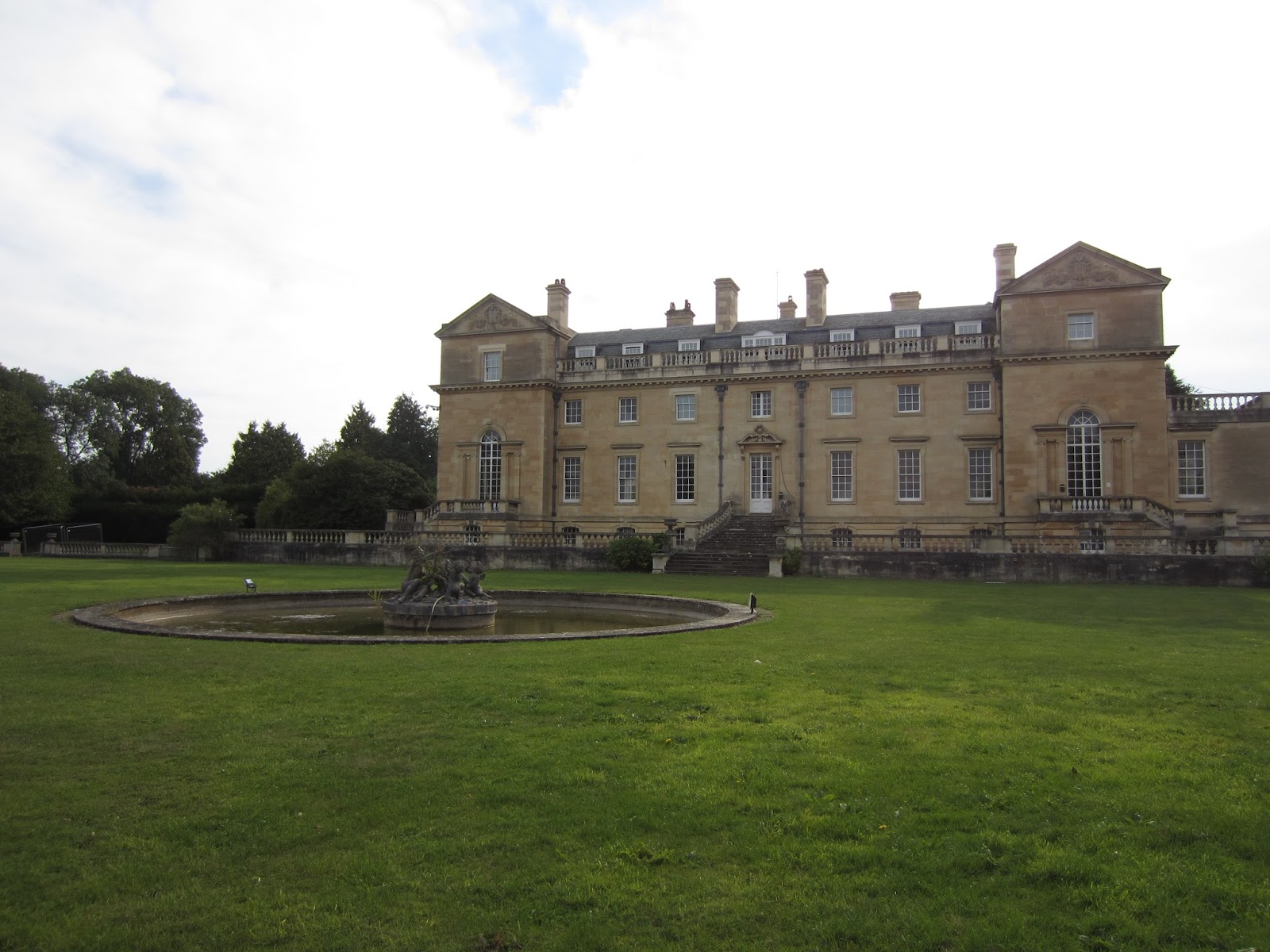
On Sunday morning, I wandered around the grounds. Moreton Morrell Hall was built in 1906 in the style of William and Anne.  Unfortunately, there was a fire some years ago and some of the main hall cannot be used.  A previous Summer School had been held in the Hall itself.  Now, there is a general air of neglect around the once beautiful gardens..


Moreton Morrell Hall

The walls and seats are broken

The neglected lily pond. 


The back of the Hall.

The view across the lawn and across the surrounding countryside
 should be magnificent but is now blocked by trees. 

The abandoned and overgrown terrace
This pretty fountain is surrounded by green lifeless pond..

.

The nymph is being transformed like Daphne into a bush.


I had a wonderful week.  The students were all enthusiastic and interested, although I had over-prepared and taken far too many activities for them to try. I am already looking forward to the next summer school - perhaps as a student after seeing the activities on offer in other classrooms.

Susan J Foulkes September 2015


Monday, 24 August 2015

AGWSD Summer School Part One

AGWSD Summer School 16th to 23rd August 2015,
at the
Moreton Morrell campus, UK

Cotswold Court

Finally Summer School is here.  I seem to be taking a lot of things for the two workshops that I am running but I wanted to be certain that I had everything that I might need for the week. Every box is labelled and lists made and checked.  There are 250 students attending Summer School and there are many lovely and interesting workshops to choose: weaving, spinning, basketry, ply-split braiding, design and dyeing

Cotswold Court is at the centre of the classrooms for the workshops.  Time stood still for the week whilst we were there.  It was always 5 to 6.

I arrived early to set up my room.  Fourteen students using backstraps take up a lot of space. I had also brought along many woven samples, some bought in the countries around the Baltic.

The clasroom


The theme for the patterns is knots and meanders.  I had produced a booklet of designs for the students to try.
The workshop booklet
The first 2.5 day workshop was for beginners.  Everyone could go at their own pace. The 13 pattern slot Sunna double slotted heddle was used.  All the patterns in the booklet are for 13 pattern threads.

The Sunna double slotted heddle on a loom.
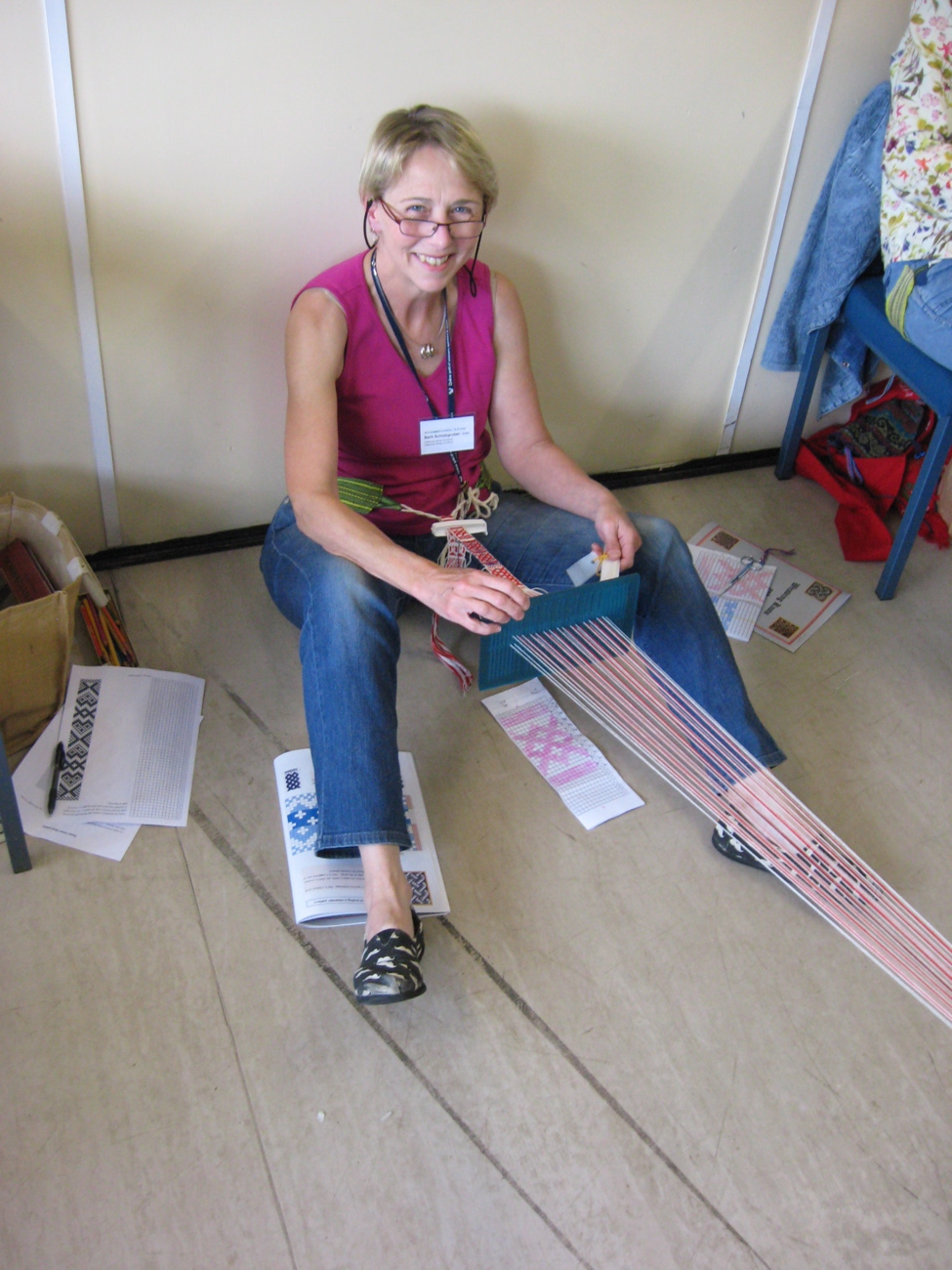
I provided the double slotted heddles ready threaded so that everyone could start weaving straight away. It is important to ensure that the heddle is level and that all the warp threads are at the same tension.  Some students found it easier to work whilst sitting on the floor.  This gives a much better angle for the warp. Some students attached themselves to the window catch which brought the warp up to a good angle for weaving. A couple of students wanted to use their rigid heddle loom.  This also gives a very good weaving position. Posture is very important.  When concentrating it is easy to forget to move occasionally.  Every half hour or so, I would get the class to stretch or stand up and move around.

 A lovely wavy pattern

An interesting variation 
Asymmetrical patterns are harder for beginners and it is easy to make a mistake.  However, this made a lovely variation.

When the first warp was finished, the students had the opportunity to make a warp and thread the heddle.  All useful skills when weaving at home.
Threading the heddle using the cross sticks.

The whole class worked very hard.  We started at nine in the morning and finished at five and some students even went back in the evening.

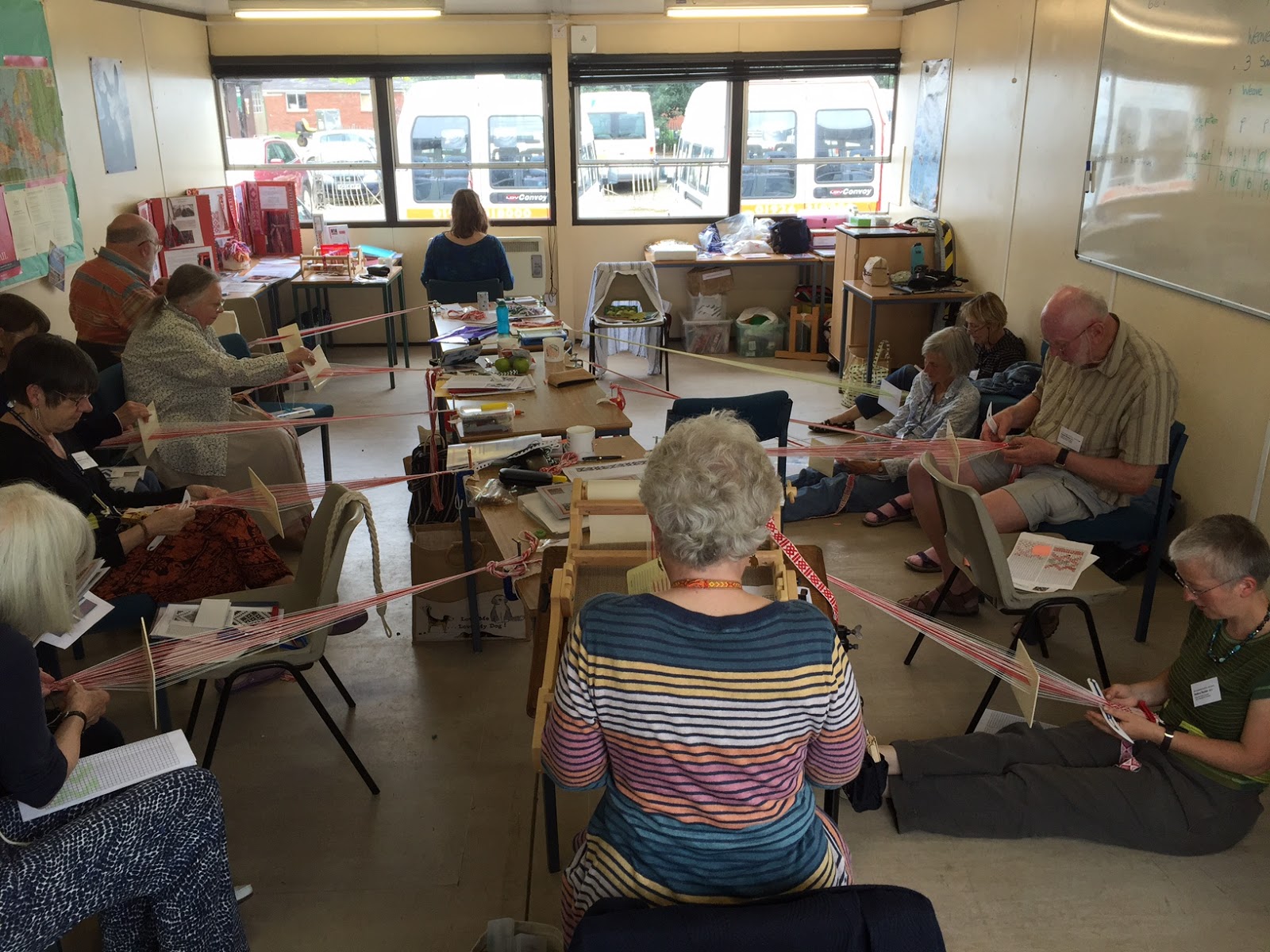
Workshop one: the whole class at work.

The band lock is veryuseful for keeping the tension of the band and is easy to release.
.
The band lock
|The double slotted heddle and curved Gehpa shuttle.

Using a standard heddle.


We had been advised to bring a cushion to Summer School.  Steve was very industrious and made his own cushion cover from inkle bands he had woven. Everyone was very impressed!

A lovely combination of woven bands, woven together and then stitched.


Using the window catch to make a good weaving position.
Some students attached themselves to the window catch which also gave a good working angle.

Other activities included making decorative tassels and plaiting the loose warp ends.  Four Sami plaits were tried.
The zig zag plait

My information display.


Evening Activities

There were also many evening activities in the Construction Hall, including making party frocks and skirts.

The Association is celebrating its 60th birthday so a party was planned for the final evening with a 1950's theme. I made a fascinator to go with my 1950,s outfit.

Designing a fascinator is helped by a glass of wine (or beer).
My fascinator is in progress with the red and blue feathers.


There was very little time for the tutors to see other classes.  However, the Cocoons to Cloth workshop with Jane Deane was of particular interest for most people.  Here a few silk worms were busy eating and eventually spinning, whilst the rest of the class produced their own spun thread.
Munching leaves.
Soon one of the silkworms had spun a cocoon.
Cosily tucked up in a leaf.
The first three days passed very quickly.  On Wednesday afternoon visits to nearby attractions had been arranged.  I had the opportunity to go around some of the other classrooms to see work in progress.

Susan J Foulkes August 2015


Sunday, 2 August 2015
The Durham Tartan and another tartan mystery

I mentioned the Durham tartan in my last blog so I thought that I would give you more details about this lovely fabric. But first of all I must tell you the story of how I found it.

My friend Richard sent me a picture of a set of Northumbrian small pipes.  These pipes had been made in 1800 by R Reid in North Shields which is just north of Durham.  They had been in a museum in London but unfortunately they were stolen and all that is left are two black and white photographs of the pipes.

The description of the pipes shows that it must have been a special commission because of the materials used.

The stolen pipes


This is a luxurious object.  The chanter and drones are made of ivory and there are 7 silver keys.  The ends of the drones are carved in a lovely thistle pattern.  The bellows are silver mounted. The two photographs were taken using different processes so the black and white images are slightly different.


The stolen pipes picture two.

The picture is not very clear. The description of the bag says that it is an old velvet tartan.  I scoured the books about tartans but could not find anything resembling this pattern.  Tartan velvet was and is a luxury fabric and although the photograph is in black and white it is possible to make out the plaid pattern. The warp and weft are different but it has a very distinctive set of white or light coloured stripes which may make it possible to identify a particular tartan or plaid pattern.


I tried to make a drawdown from the black and white photographs of the pipes.  This is not an accurate tartan pattern but gives some indication of the distinctive white stripes. This may help in identifying a possible pattern. Of course, there is no indication of the actual colour of the velvet tartan bag. The white stripes are the only feature which could assist in any identification. The warp and weft colour order is different, which is also unusual.

My attempt at a drawdown from the black and white photographs.


These pipes were a luxury item made as they are from ivory, silver and tartan velvet.  It would seem probably that they were made for a specific client but who and exactly when we do not know.  If the tartan could be identified this may give another clue as to the reason these pipes were made.

If anyone has any idea what the tartan might be, do get in touch.

If we could identify the tartan, it might give some clues as to where the pipes were used.  Velvet is a luxury material so the velvet tartan might have been a special commission. It is probably made of silk. Nowadays, velvet tartans are used for the waistcoat to match a kilt.


The Durham Tartan.


What I did find in my search for the old tartan pattern, was the Durham tartan.  There is no reason why Durham should have a tartan. The Durham district tartan first appears in the record books of Wilsons of Bannockburn in 1819.  It is an early tartan.

Why it is called the Durham tartan is a mystery.  It may have been named after a person not the county of Durham or Durham city.

Here is the pattern.

The Durham tartan
It is in 2/2 twill.  The warp colour order is as follows.

Red                            4
Blue                     12      12
Black             12                   12
Green       12                               12
Black   4

It is a lovely pattern.


County Durham has not made much of use of this tartan, but I gave the pattern to Douglas in the Durham Guild and he has woven it many times.
Click here for a useful link which shows the range of District tartan patterns:
http://www.scotclans.com/scottish-clans/tartan-pattern-book/district-tartans/


Susan J Foulkes August 2015