Showing posts with label Finland. Show all posts

Monday, 1 January 2018

Cataloguing the World 3: The Inkle Loom.


Do you remember this image from my previous bog about inkle looms from January 2017 .  Whilst on holiday in Finland in September we visited Turku, the old capital of Finland.
Turku castle was restored after the war and is a must see sight for anyone visiting the town. 


Turku Castle, Finland

The dining tableau.

In one room, the displays were captivating. The centre of the room had a tableau of mannequins in period costume. The information was extensive. Displays around the room had various artefacts relating to costume. One had this picture as a backdrop.
I did not expect to see an enlarged picture of the inkle loom.


It is from Le Livre de bonnes moeurs de Jacques Legrand which dates to the 15th century. The probable date is 1490.

The close up gives the detail of how the weaving is threaded around the posts.  Unfortunately as the weaving has not started, the process is unclear

Inkle looms now come in various shapes and sizes.  There is a wonderful variety available, particularly in the USA.


In this upright model the weaver has a good view of the woven band. 


Double sided looms are also popular.  The pegs will not bend in use and the whole loom is very stable.


This one is illustrated in the Estonian band weaving book. Again with a removable side, the pegs will stay level and will not warp.


This crescent shape is so elegant.


You can even make one out of a cardboard box!


Another home made loom. 
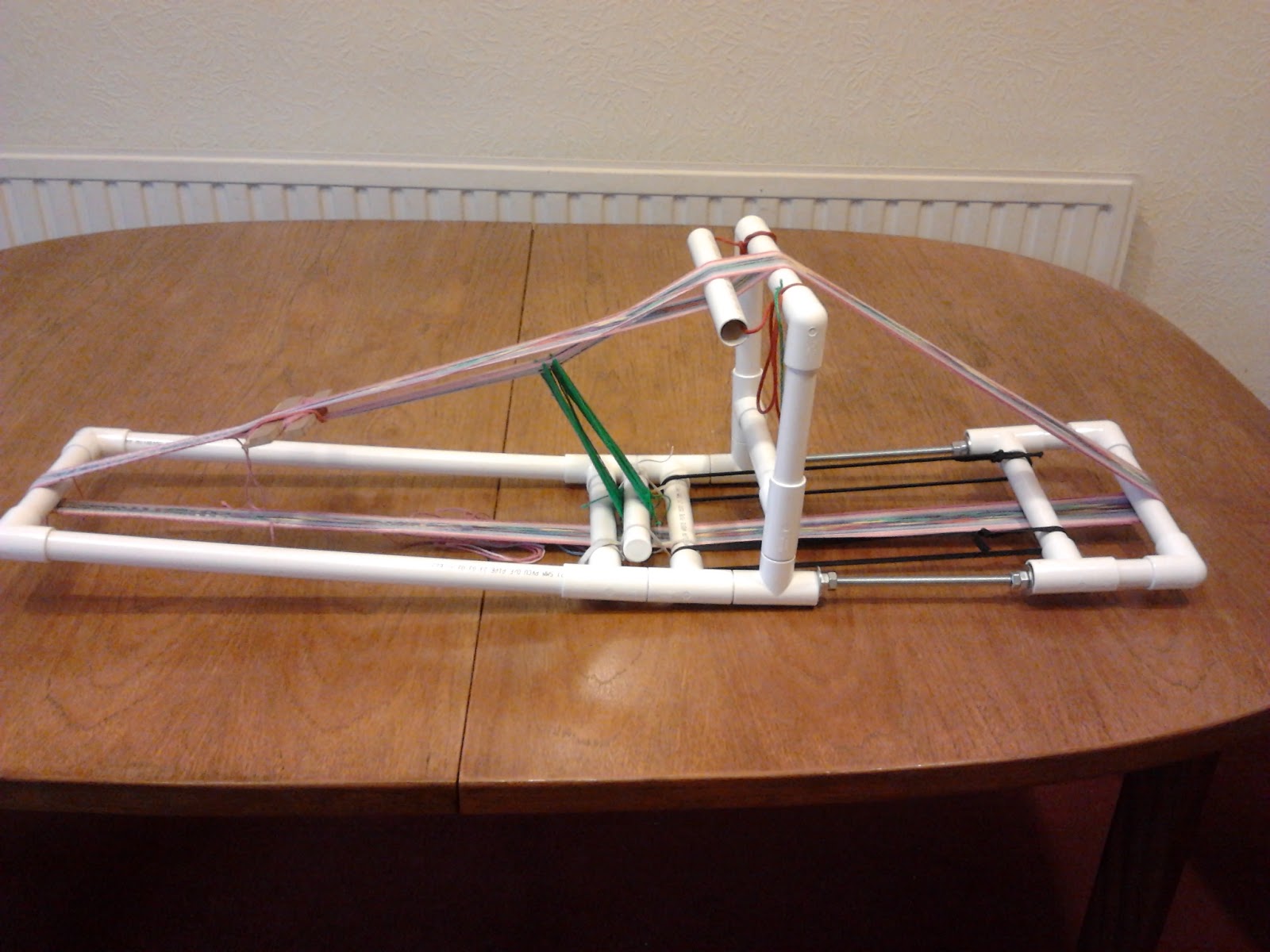


This loom was made by Margaret Parker and her husband out of waste water pipes.

They made it following the instructions in the link to an Interweave Press booklet on band weaving, but it was difficult to understand how to get the two sheds. The geometry of the loom, the path taken by the warp and the position of the heddle and shed sticks seemed to make this impossible. They made some modifications: .

- made the heddles at least twice as long which means there is  nowhere on the loom which can be used as a former for  making them.
- tied the shed rod firmly once we had got it in place.
- use hand manipulation to get the two sheds

Although it seems bow shaped it works well. As it is not as rigid as a wooden inkle loom it can become a bit skew whiff (or wonky!) with use but it is easy to straighten it all out again from time to time and make it all the angles sit at 90 degrees. This does not seem to affect the tension across the width of the weaving.
Inkle looms are expensive, so this cheap alternative is ideal for someone who would like to try this craft. York and District Guild of Weavers Spinners and Dyers have planned an informal workshop for people interested to make their own from this plan.

Floor inkle looms


I have a floor inkle loom given to me by a friend.  It is not in the best of conditions but it works. The earliest floor inkle I have found is from Scotland.  It is dated 1688. My floor inkle loom has a sliding peg in the centre collumn so that the tension can be altered.


A Scottish floor inkle loom dated 1688

Floor inkles also come in a variety of shapes. Some give the opportunity to make very long band indeed. This is being used for tablet weaving but is also designed for inkle weaving.

This lovely floor Cendrel inkle by Leclerc looms is an updated and very practical design  What I particularly like is the fact that it can be used as a warping frame as well.

http://www.leclerclooms.com/ind_eng.htm

The Cendrel floor inkle loom and warping frame


These two versions are very attractive and allow for a very long warp. They look very stable and there is plenty of room for the weaver's legs. 


Here are two Swedish band looms which give the weaver the choice to weave as an inkle loom with heddles or with two shafts to make the sheds. 


This is my Swedish band loom with my own handy brackets for warping.


Finally, I found a picture of this tape loom.  It is not an inkle loom but has two rigid heddles operated by foot treadles.


It is a fascinating version of a tape loom from the Landis Valley Farm Museum, a museum that documents Pennsylvania German culture and history. This museum looks wonderful and I would love to visit it.

I was particularly interested in this unusual design because of the picture in the frontispiece of a book from 1524.


This is a page from the  Ein new Modelbuch by Johann Schönsperger the Younger (German, active 1510–30) and dates to 1524. You can see the large loom on the bottom left of the engraving which shows a woman weaving a narrow band using a rigid heddle. Examine the original image here:

https://www.metmuseum.org/art/collection/search/354660

She appears to have two pedals to use but there is no connection between the pedals and the rigid heddle. 


Tablet weaving

Of course there are also some very creative designs for tablet weaving.

A table tablet loom with a very long warp.

An elegant design for a short warp.


This looks very stable and ornate with the horses head carving.


A magnificent tablet loom which looks as though it should have been used by the Vikings.


This is a very interesting variation.  This design allows for the warp ends to be untwisted when weaving with tablets.  The warp can be as long as will pack onto the warp beam at the front.


A big thank you all the Museums, Universities and Galleries who are taking the time to digitise their collections and to Pinterest for providing a way for people with similar interests to share their finds.

Happy New Year to everyone.  Enjoy your weaving.
Susan J Foulkes January 2018

Sunday, 15 February 2015

Travels around the Baltic: Finland

Helsinki


We spent two weeks in Finland on our travels around the Baltic.  We took the ferry to Helsinki from Tallin, Estonia.

Part of the historic Fish Quay in Helsinki


The fish quay in Helsinki was wonderful.  There is an old fish market which sells a large variety of fish, fresh and smoked.  The cafe providing fish soup is well worth a visit.


Waiting for the fish soup


What a lovely country! I knew very little about Finland other than that Finnish design is highly regarded. We love visiting new places and seeing the local styles of architecture.  One famous Finnish architect is Alva Aarto. We saw his house and office in Helsinki and visited the museum in Jyväskylä . We also went to Noormarkku to see the Villa Mairea, which houses an astonishing modern art collection. If you get the opportunity it is worth the effort to  make a visit.  It is the first time I have seen an art collection in a homely setting.  Art museums and stately homes make art seemed detached - objects to view.  Seeing Kandinsky, Degas, Gris, Braque, Picasso and Leger in such an intimate atmosphere gives another dimension to the experience of paintings and sculpture.


Villa Mairea built in 1938
Staying for a while in Seinajoki, enabled us to see the town centre that Alva Aalto designed. 

To return to the topic of weaving, when we were in Helsinki, we visited the National Museum which is built in the National Romantic style. There is a lovely collection of costumes and woven bands.  I was particularly interested in the carved wooden heddles. These were made as gifts for an intended bride and have an immense amount of careful work lavished on them.  Some of them were circular, a feature of heddles from the coastal area of Finland, which was strongly influenced by Sweden. 


National Museum, Helsinki.


Guarding the National Museum entrance


When I started weaving I subscribed to Vav Magasinet, the Swedish Weaving Magazine, and bought several interesting back issues. One contained an article about Kitty Collan-Tham. (Vav Magasinet, Nr 4, 1993 pages 20 - 22).  I did not weave bands at the time but this article inspired me to find out more about this lovely craft.  When I was researching places to visit on our Baltic trip, I was thrilled to find that the museum in Jyväskylä has a collection of her woven bands.  A curator at the British Museum had given me details about the Jyväskylä collection.


Jyväskylä

In the Craft Museum in Jyväskylä there is a beautiful display of textiles, including woven bands. There are also information sheets in Finnish which can be downloaded.  The pictures of woven bands are detailed and to my delight the information sheets mentioned that they had a Kitty Collan-Tham collection.

I contacted the museum and arranged to visit whilst we were in Finland.  I was made very welcome and thoroughly enjoyed my visit.  I saw about 200 woven bands in detail.  The work to analyse the patterns and weave examples is going to take a long time.  I was intrigued to see the influences from Sweden, Estonia, Russia and the Sami in the band patterns.

 I was particularly impressed that the collection also included narrow bands where the pattern is simply formed by the order of the warp threads.  These are the easiest bands to weave yet can be very decorative.  Too often museums only collect the most impressive or colourful so the collection is skewed in favour of the most decorative examples.  These humble examples of design are also important as they show the full range of the type of bands that were woven.

Here is an example.

There are 27 warp ends for this band

The woven band


I wove this band on my Swedish band loom.  It is another Finnish pattern which I saw in the National Museum.  There are 27 woollen warp ends.


I have analysed and woven one of the bands with 25 pattern threads because it was so intriguing. I am still examining my photographs of the collection.

I was particularly thrilled that the final box of bands that I examined were the bands woven by Kitty. In fact they were the bands featured in the Vav Magasinet article. I carefully lined them up in the same formation as the picture in Vav.  Her weaving is lovely and the colours were quite varied.  I am looking forward to weaving some of them myself.
I am very grateful for the staff who gave up their time to answer my questions and make my visit to the conservation centre so rewarding.  I was even treated to cinnamon buns with my coffee!

We drove further north and stayed in Oulu.  This town on the coast was very attractive with its islands and bridges.  It was ideal for cycling.
Oulu
We found the delightful Northern Ostrobothnia Museum, which has an informative exhibition of Sami artefacts. Look at my previous blog about Sami weaving for more details.

Cinnamon Buns

And now a coffee break! One of the delights of Sweden and Finland is the cinnamon bun.  We had to have at least one a day. The smell of freshly baked buns is truly marvellous and entices you into coffee shops. When we got home, my husband decided to bake his own to feed our addiction.

Here is the link to the cinnamon bun recipe that he found. It evokes for us the holiday in Sweden and Finland.  It is from the Guardian newspaper.

Fresh from the oven


The wonderful cinnamon and cardamon aroma when they are baking perfumes the house. It is so hard just to eat one.
Bageriet in London


 Last week I was in London and went to my favourite coffee shop - a tiny Swedish bakery which does the most wonderful cinnamon buns.

They are tucked away in Rose Street, next to Standford's bookshop near Covent Garden.


Their  mouthwatering cinnamon buns.

Susan J Foulkes 2015


Tuesday, 13 January 2015

Travels around the Baltic: Sámi weaving

The Sámi people

The Sámi people are the indigenous people of northern Norway, Sweden, Finland and Russia. When I first became interested in band weaving, I decided to travel to Sweden to see the type of bands that were in museums.  I had only seen black and white diagrams of band patterns and a few colour photographs.

In 2009, travelling up to Sweden through Europe, we stopped in Schleswig and it was there that I saw my first collection of bands.  They were Sámi bands - and I knew nothing about the Sámi people  I was thrilled to see such lovely examples of band weaving and I wanted to find out more about the Sámi people, their crafts and culture.

Of course, in Sweden most museums have collections of woven materials and many small towns have small museums as well. I have researched the beautiful woven Sámi bands from Sweden.  Looking closely at the patterns is illuminating.  The colours have a particular significance; a rare example of there being a meaning in the woven bands.  Too often meaning is assigned to patterns and symbols and this meaning is assumed or ascribed but has no basis in fact.


Sweden

In Stockholm, the Nordiska museum has a Sámi gallery which was very interesting and introduced me to the place of Sámi people and culture in the history of Sweden.  Going back last summer, I was slightly disappointed to see that the gallery has hardly changed in the last six years.

In 2011, we travelled as far as Kiruna and Jokkmokk to attend the Sámi market in August in Jokkmokk. However, the real highlight was the Ájtte, Swedish Mountain and Sámi Museum which has a stunning collection of clothes and lots of examples of woven bands. Every year the most important Sámi market is held in Jokkmokk in the first week in February.  I would love to attend this event. 

Last summer, we went to the Weave Fair in Umea.  Umea was the European Capital of Culture in 2014 and the programme for the year included many events for and about the Sámi people.


 Sámi heddles and bands


At the Weave fair, Astrid Enoksson, who lives in Tarnaby, had a display of display of Sámi costume and weaving. Her rigid heddles are made out of reindeer antler.

This beautiful coat and band was on the display.

See the blog entry for October for more about the Weave Fair in Umea.


This band has nine pattern threads and is a very quick design to weave.


At the Weave Fair, Stoorstalka had an attractive stall at the entrance of the Market Hall. They had a  very dramatic backdrop for their stall. 

The Stoorstalka stand at the Weave Fair

Sámi rock art


In Umea in the Västerbottens Museum there was a display of  ancient Sámi rock art.  A fascinating glimpse into another world.


 a replica Sámi pot


I bought this lovely copy of an Iron age Sámi pot.  It is 3.5 inches tall and stands on my desk as a reminder of a wonderful holiday.


 Finland


On our travels around the Baltic, I found two other museums with a Sámi collection. Unfortunately the museum in Estonia had none of its collection on display when I visited.  In Finland however, there were many examples of Sámi weaving and craft. We spent two weeks in this lovely country.

I visited the craft museum in Jyväskylä in central Finland which I will mention next month in my blog about Finland. We traveled further north and stayed in Oulu.  Here, I stumbled across a lovely museum, the Northern Ostrobothnia Museum which had a collection of Sámi artifacts.  These had been collected by the museum director who spent his summers with the Sámi people in the north of Finland.  He counted them as his friends and the collection was displayed with much thought.


There were a number of bands displayed.  These lovely Sámi shoe bands have one of my favourite
patterns ( see Handwoven  2013, March /April Vol 164, no 2 for the weave pattern).


One of the shoe bands on display had three motifs.  I analysed the pattern and wove it.  It has eleven pattern threads and the graph is given on my blog.  The speckled edges are made by using a yellow weft thread so that it shows up against the red border threads. It is a very attractive shoe band. I have posted the pattern draft onto the blog for you to try.

This shoe band has eleven pattern threads.

If you want to know more about Sámi weaving, I am running an online workshop for the Braid Society on their Yahoo discussion group, Braids and Bands in March 2015. The workshop shows how to weave a particular type of band using a newly designed heddle from Stoorstalka - the Sigga heddle.  This heddle is used to make bands that have 'jumping' pattern threads. Details about the workshop and how you can join in are given on my blog.

I think that it is rather exciting that a new weaving tool has been developed.  It shows that the craft of band weaving is still meaningful and creative.

An excellent booklet The Sámi - People of the Sun and Wind, published by the
Ájtte Swedish Mountain and Sámi Museum is available in the Nordiska Museum 


Happy weaving

Susan J Foulkes
January 2015