Monday, 16 November 2015

Collapse Weave 2


Collapse weave 2: Completing the workshop.

I liked the collapse weave effect with the first warp but I felt that the white wool stripes were too wide.  I wanted to have the effect of blue waves with white tops.  I made a new warp with only 4 ends of wool for the white stripes.  See my blog entry for October for the first post about this workshop.

New warp:

Six blue silks: B1 is the lightest blue and B6 is the darkest blue.


Wool
16

4

4

4

4

4

4

4

4

4


4
Centre
Silk

B1
32

B1: 16
B2: 16

B2: 32

B2: 16
B3: 16

B3: 32

B3: 16
B4: 16

B4: 32

B4: 16
B5: 16

B5: 32

B6: 16
B5: 16


B6; 32


Total number of warp ends:  784                     silk: 672 and wool: 112


Sample two


Width at reed: 25.5  inches
Width off loom:  18.25  inches

I used a temple (also known as a stretcher) to keep the width of the piece even.

The second warp on the loom.  I used a temple ( stretcher) to keep the width even.

Sample measurements:

Length:  15  inches including borders.
After washing in machine:   Length:   approx. 12 inches

The width varies according to the type of weft yarn.

Sample details:

A. 3  inches 56/2 merino overtwisted wool
approx. 24 ppi         Width after washing: approx. 12 inches

B. 3 inches  56/2 merino overtwisted wool
  approx. 12 – 14 ppi    Width after washing: approx. 11.25  inches

C. 3 inches unknown fragile merino yarn
12 – 14 ppi    Width after washing: approx. 12 inches

D. 3 inches unknown fragile merino yarn
24 ppi   Width after washing: approx. 1114 - 15 inches

E. 3 inches 500 gm cone fine merino
at 24 ppi   Width after washing: approx. 16 inches

F. 3 inches blue overtwisted yarn.  I do not know what type of yarn this is.
 at about 18 – 20 ppi  Width after washing: approx. 21 inches

Close up of weaving on the loom

close up unwashed sample


The washed sample
Washing the sample and examining the different weft yarns was fascinating.  It was very instructive to see how the yarns reacted to machine washing and the effect produced.  Keeping detailed notes for the blog and for the workshop will be very useful in the future when I try some more examples of collapse weave.


I completed the workshop by weaving the rest of the warp as a scarf.

Scarf

Length off loom = 235 cm
Width off loom = 61 cm  (approx. 24 inches).

Scarf after washing:  149 cm by 21 cm

The completed scarf. 

The scarf rippled beautifully and I was pleased with this final result.  The narrower wool stripes and the wider blue silk stripes looked like rippled waves with white tops.  Here is a close up of the scarf.

Close up showing the felted wool stripes and the rippled silk.
The workshop has been a lovely way to find out more about overtwisted yarn and collapse weave.


Susan J Foulkes November 2015.

Sunday, 1 November 2015

The Braid Society November 2015:

The Braid Society is a fantastic organisation for anyone interested in narrow wares - braiding, plaiting, band weaving, tablet weaving, sprang, etc.  There is a facebook page for the Braid Society on https://www.facebook.com/groups/BRAIDSandBANDS/

It was founded in 1993 and has members around the world.  The aim of the Society is to promote the education and practice of the art and craft of making constructed or embellished braids and narrow bands. Next year is exciting as the 3rd International Braiding Conference is being held in Tacoma in the USA.

Check out my blog for details of the workshop that I will be running at the conference.

Click on this link to see what other workshops are on offer. https://thebraidsociety.wildapricot.org/
Booking is now open for Braid Society members.  Non-members will have to wait for a couple of weeks.

Cover

Here is the latest annual journal Strands.  I always look forward to it as there are so many different craft interests and so many interesting craft practitioners.

This edition is no exception.


Contents page


My article about the stunning Latvian belt from Lielvārde has an accompanying YouTube video to illustrate the weaving process. The Lielvārde belt: weaving motifs can be found at this link.
 https://youtu.be/t9Dekjt8uog


The article by Celia Elloitt-Minty is a wonderful detailed examination of some of the tablet woven textiles from the Hallstadt culture 850 - 450 BCE.  It is fascinating to see some of the motifs which also appear in patterned band weaving. Tablet weavers will be interested in the details of threading tablets explained by Gail Marsh.

There are three articles about different aspects of braiding. Barbara Walker describes one type of braid with six variations. Rosalie Neilson shares her red white and blue braids inspired by the US team at the Sochi Olympics and their sweaters. Jacqui Carey tells of her search for Naxi braids in China. The final article by Shirley Berlin looks at prayer ropes.  The instructions for making these lovely knotted strings are given in detail with an excellent series of photographs.  I will definitely be trying this technique for myself.

The centre pages are a set of beautiful photographs from the Braid Society Travelling Exhibition 2015. The theme for the exhibition was Spring is Sprung and the different interpretations of this are so colourful.

Curiosity and experimentation are such important foundations of innovation.  It is an inspiring issue, as usual.

Online discussion group. 

https://groups.io/g/braidsandbands is a discussion group moderated by the Braid Society and primarily exists to provide members with information about Braid Society activities. Non members of the society with a genuine interest in braids and bands are also welcome to join this group. Members can ask questions about any narrow ware technique, or share details of their latest project. For details on how to join, go to the Braid Society home page.

I have organised five online workshop for Braids and Bands over the years.

I will be running another workshop next year for Braids and Bands.  I thought that it would be useful to go 'back to basics' and take a closer look at bands with 5, 7 and 9 pattern threads. The workshop will be useful for beginners but also remind more experienced band weavers that using only a few pattern threads, delightful bands can be produced.  I do not have a date for the workshop as yet as I am still working on the materials.  It will probably be later next year.

AGM of the Braid Society.


The AGM was held in a beautiful building in the centre of Leeds.  The facilities were excellent.  I was thrilled to be asked to give the talk in the afternoon.

I brought along examples of the bands that I have  woven and set up a display.  Here is one of my tables showing bands from Lithuania, Finland, Russia, Estonia and Latvia.

One of my display tables showing bands that I have bought or woven myself.


The title of my talk

I am showing the fragment of a marriage band from Leksand Sweden dated to 1850. I am wearing the Delsbo belt from Sweden.
I wove this Lithuanian belt which I saw in the museum in St Petersberg, Russia. I am wearing a copy of it which I wove.


Examining some of the bands I used in my talk.  I am now wearing the Lielvārde belt from Latvia.
The Lielvārde belt I am wearing was made by Ziedonis Abolini.  You can see other examples of his beautiful work on their web site. 

Click here to go to the English page. http://www.audejudarbnica.lv/#!home/mainPage

It was a lovely day.

Susan J Foulkes November 2015


Friday, 16 October 2015

Collapse Weave

The Online Guild of Weavers, Spinners and Dyers.


I am a member of the Online Guild of Weavers, Spinners and Dyers. This wonderfully enthusiastic group has monthly online workshops and a membership from around the world.

To find out more details about the Guild click on this link  http://www.onlineguildwsd.org.uk/
Details on how to join the Online Guild are given on the web site.

Do check out the web site and look at the gallery which shows the work produced by members in previous workshops. The annual subscription is very reasonable and you also receive the Journal four times a year. The Journal can be viewed at this link http://www.thejournalforwsd.org.uk/


Weaving Challenge Workshop.


This month the workshop is a weaving challenge which I could not resist.

Ann Sutton in her book 'Ideas in Weaving' describes a design game. She has a set of cards which are divided into categories such as  material, colour, weave structure, and design feature. It is this design game which is the workshop. Everyone wishing to take part in the design challenge was given three 'cards'. 

It is a challenge for me but also, for the large number of workshop participants.  It is fascinating to read the other combinations of cards and see how the different challenges are met.  I am learning a lot by reading other peoples comments and the pictures that they post on the online web site. Members of  Online Guild have a wide breadth of interests and expertise.

Design Challenge Cards.


Here are three three 'cards' which I was given. 

Colours: Inspired by water

Material: fine threads

Design: start from plain weave

I had to think carefully how to interpret my challenge. A few years ago I experimented with collapse weave. Plain weave and fine threads can be an option. I thought of waves with their white tops and decided that this would be my inspiration.

Warp and weft details.


Selvedge


Centre
110/2 wool
22

16

16

16

16

16

60/2 silk

32
Light blue 

32
Blue

32
Blue

32
Blue

32
Blue

32 
Dark blue

Total number of warp ends: 556

Weft: 56/2 merino wool overtwist yarn.

Sett wool at 24 epi and silk at 32 epi.  Sett at approximately two thirds of plain weave sett. I used a 12 dent reed so that the wool was sett at 2 ends per dent and the silk at 2/3/3 ends per dent.

Six shades of silk are used.  The dark silk is in the centre and the silk shades lighter towards the edges of the piece.

The wool warp is 110/2 merino wool. These slightly thicker warp stripes in wool should give pleating which will look like white tops to waves. 

Width at reed: 19.25 inches                                Width off loom: 18.25 inches

weaving the collapse weave piece.
Here is the piece being woven.  I use a stretcher to keep and even width for the piece. I used eight shafts, four for the wool areas and four for the silk areas. 

Sample: details

5.5 inches plain weave
3 inches 2/2 twill in wool areas
3 inches 3/1 twill in wool areas
1 inch plain weave.
sample off loom
Close up of weave on the loom.  You can see the 2/3/3 threading for the silk in the 12 dent reed and the 2 per dent threading for the wool. 


Sample: washed and collapsed!

Width off loom: 18.25 inches
Length: 15 inches including starting borders.
After washing in machine: 9.75 inches  Length:  9.75 inches

Sample description.

machine washed sample

Silk areas pleated length ways and there was also some twisting of the pleats due to lengthways collapse.
Wool areas in plain weave showed tracking but on warp showed collapse.
Wool areas in 2/2 twill and 3/1 twill felted with a small amount of collapse widthways. 

Plain weave and 2/2 twill wool areas in close up. You can see the tracking at the top of the picture.
3/1 twill in wool area close up.

Scarf.

I used the rest of the warp to weave a scarf.  

Before washing.


Length of scarf: 70.75 inches
Width: 18.25 inches.

The silk ends were plaited together in groups of three – one plait for each stripe.
The wool was loosely plaited and tied off longer than the silk plaits. I hope that the wool would felt slightly so that I could cut off the knotted end to make a neater fringe for the finished scarf.

After machine washing.

Length: 57.25 inches
Width: 8 inches

I was surprised that the width of the scarf after machine washing was narrower than the width of the sample.  The scarf and sample were both washed at 30 degrees in a normal washing machine cycle with other garments.  I was expecting that the lengthways shrinkage would be less for the scarf.


The completed scarf

I have decided to try another warp using more silk stripes and narrower wool stripes.  I have yet to discover what will happen. Collapse weave is a wonderful adventure.  Exploring the possibilities are endless. 

Collapse Weave book


Collapse Weave: creating three-dimensional cloth by Anne Field, published in 2008 by Willson Scott Publishing, New Zealand. ISBN: 978-1-877427-17-6

When Anne was writing this book, I had long conversations with her about aspects of collapse weave. I was particularly interested in the mechanics of tracking and we spent some time analysing the effects and why it happens. She used one of my samples and two of my scarves in her book. 
One of my scarves had won third prize in an Handwoven competition in 2004.  Inspired by fleeting clouds, it had a double weave collapse structure. 


New band weaving book

I have just bought a new band weaving book from Finland. Check out my blog pages for the details. It is called Traditional Finnish Decorative Bands  and has illustrations of bands in the National Museum in Helsinki.  It is a reprint in English of a book first published in 1903.


This book is available from http://www.salakirjat.com/  


Susan J Foulkes October 2015


Thursday, 1 October 2015

Peruvian band weaving

I am often asked when I became interested in band weaving.  In 2007, we had a wonderful holiday in South America and visited Peru.  I found the Centre for Traditional Textiles of Cusco. This wonderful shop and museum was inspirational.
I had tried band weaving before but had been very unsuccessful.  I always show my very first attempt at band weaving when I am teaching workshops. It is a very uneven scrappy piece.  It has 17 pattern threads and is made of linen. I found it so hard that I gave up trying to learn band weaving.

After seeing the lovely work of the weavers, I decided to try band weaving again once I arrived home. Band weaving is an absorbing hobby.  The patterns seem infinite in variety.

Peruvian Woven Bands.


Here are a selection of bands that I bought in Peru. The bands that I bought in the Centre for Traditional Textiles had a card with the name of the weaver.  How wonderful!  So often weavers are anonymous and yet they are skilled artists.


This is a small back strap with the warp and some of the completed weaving.  It makes a pretty wall hanging.


A close up of the pattern.
Here are some more bands which are called chumpi.


close up of one of the motifs


Two beaded hat bands known as jokimas


by Nilda Callanaupa Alvarez
This book is published by Interweave Press and has lots of illustrations of the weaving of the highland people.  ISBN -13:978-1-59668-055-5   published 2007

These bands were a revelation for me.  I was intrigued by their complexity and wonderful  use of colour. I had forgotten that it was only nine years ago that I really began to study band weaving.  It feels as though I have been doing it as long as I have been weaving.

When I started to learn, most of the patterns that I found were from Scandinavia.  I had to find out more about them so we visited Sweden to explore museums and collections.  I had not realised that this was only the start of a long journey of discovery.


Susan J Foulkes  October 2015


Saturday, 19 September 2015

What is on my loom: September

Weaving Scarves for the Autumn Season.


Some years ago, I bought three cones of baby alpaca yarn.  It is very fine and weaves beautifully.  It was a 'mill end' so I cannot buy any more.  The only label inside says Inca Tops which is not very informative but it is from Peru.

I had to sample the yarn to find out what sett to use.  I found that using a sett of 24 epi for a Huck Lace threading it works beautifully.


Warp and weft 2.28 alpaca in black with red and grey for the stripes.

Sett at 24 epi for huck lace

12 dent reed at 2 per dent.  See Best of weavers Huck lace page 18

I tried two samples - one in all over lace and one in spot lace with plain weave squares.  The second looked better. The weave draft is given below.

I only had smaller quantities of the red and grey left so I used them in stripes at the edges of the scarf for emphasis.

The plain weave border is sett at three per dent in a 12 dent reed so that the border would be tighter.


The Huck lace patterning gives a lovely drape to the scarf and the yarn is so soft and cuddly.  Just the thing for colder weather.

Scarf and book

Huck Lace


This book is published by Interweave Press. The editor is Madelyn van der Hoogt and it was first published in 2000
ISBN 1-893762-01-7

The book has some basic theory for weaving and designing drafts. There are many projects and ideas for how this lovely weave structure can be used to best effect.


September 2015

Tuesday, 1 September 2015

AGWSD Summer School Part Two


The Association of Guilds of Weavers, Spinners and Dyers Summer School, part two


Th second workshop built on the skills acquired on the first.  Four new students arrived to take the place of four who booked only for the first workshop.


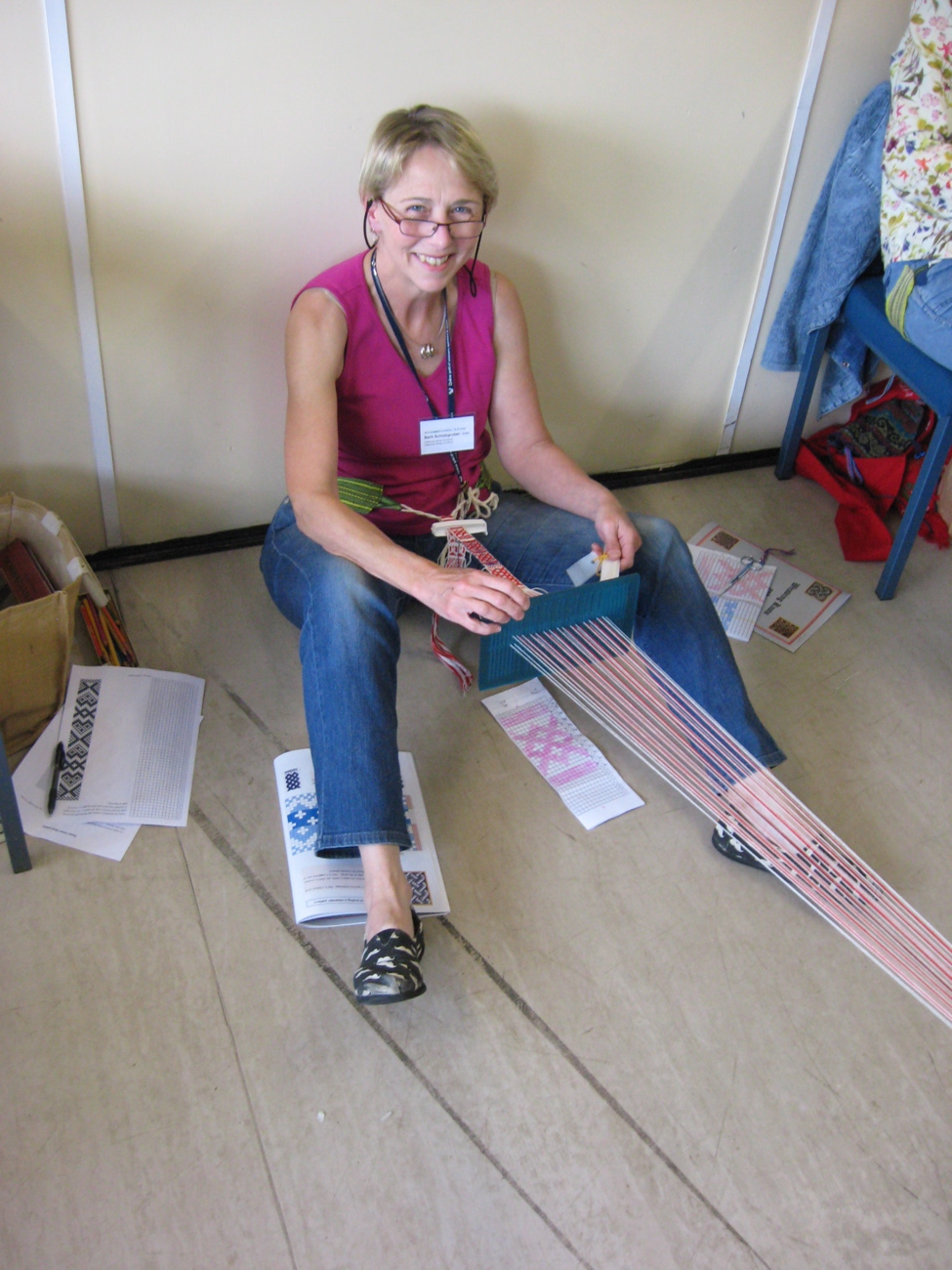
The double slotted heddle works well on a rigid heddle loom.


On the final day, there was a display of student work. I wish that I had taken more photographs, but I was so engrossed in the teaching that I kept forgetting to take out my camera.


Part of the display.
Barbara took many lovely pictures of the woven bands.  Here is a selection.


The woven bands were pinned up on the wall.  Each band told the story of the week.  From first hesitant beginnings and wobbly edges to neat crisp patterns by the end.

The students worked very hard and gained the skills to carry on their interest in this lovely craft.

The band on the left has a decorative tassel typical of Lithuanian bands.

.

Two Sami zig zag plaits and
 a decorative figure on the end of one band.


The band lock is very useful.


Some bookmarks and samples


Thank you Barbara for sharing these lovely photographs.

In addition to being a class member, Barbara was also the class prefect.  Every morning she would read out the notices from the office about the arrangements for the day. It was an entertaining start to every day.

Thank you again.


Party Like It’s 1955


Finally, the evening entertainment 1950's style, Elvis and rock and roll. 

A parade of the 1950's costumes: circular skirts and frilly petticoats.


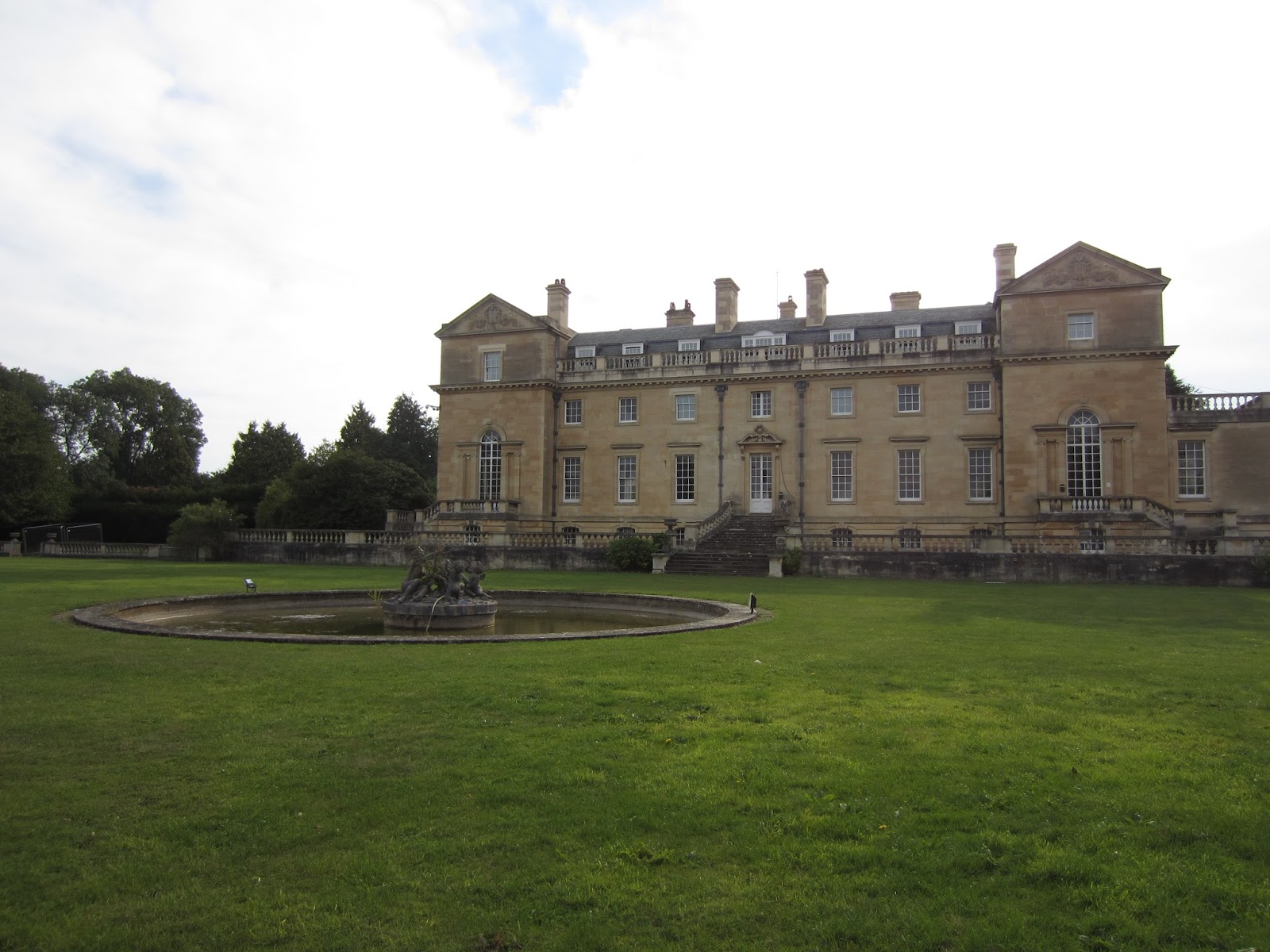
Moreton Morrell Hall

On Sunday morning, I wandered around the grounds. Moreton Morrell Hall was built in 1906 in the style of William and Anne.  Unfortunately, there was a fire some years ago and some of the main hall cannot be used.  A previous Summer School had been held in the Hall itself.  Now, there is a general air of neglect around the once beautiful gardens..


Moreton Morrell Hall

The walls and seats are broken

The neglected lily pond. 


The back of the Hall.

The view across the lawn and across the surrounding countryside
 should be magnificent but is now blocked by trees. 

The abandoned and overgrown terrace
This pretty fountain is surrounded by green lifeless pond..

.

The nymph is being transformed like Daphne into a bush.


I had a wonderful week.  The students were all enthusiastic and interested, although I had over-prepared and taken far too many activities for them to try. I am already looking forward to the next summer school - perhaps as a student after seeing the activities on offer in other classrooms.

Susan J Foulkes September 2015