Thursday, 22 September 2022

national exhibition of Weavers Spinners and Dyers

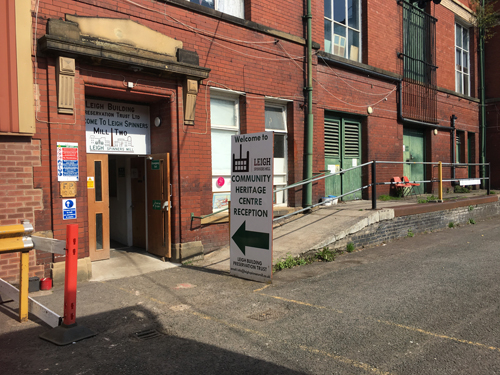
 The National Exhibition of the Association of Weavers, Spinners and Dyers was held at Leigh Spinning Mill in September.        https://www.facebook.com/Leighspinnersmill/

Here are some photographs about the exhibition.

The unprepossessing entrance

The heritage lift was over 100 years old

Entrance to the exhibition space

Leigh Mill is undergoing a transformation.  The renovation project is very ambitious and will provide a wonderful outlet for creative talent. It is very much a work in progress.

Alison from the Lancs and Lakes Guild welcomed visitors. Alison's wonderful bed spread is next to her. The whole exhibition was set up by five volunteers. 


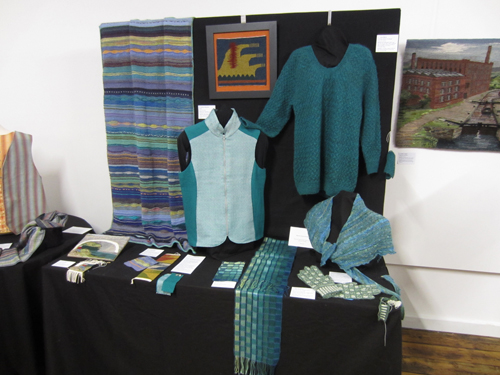
Two general views


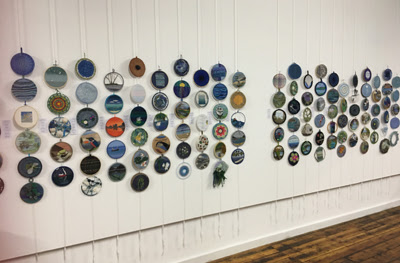
A wall of discs - the fascinating interpretations using a disc.


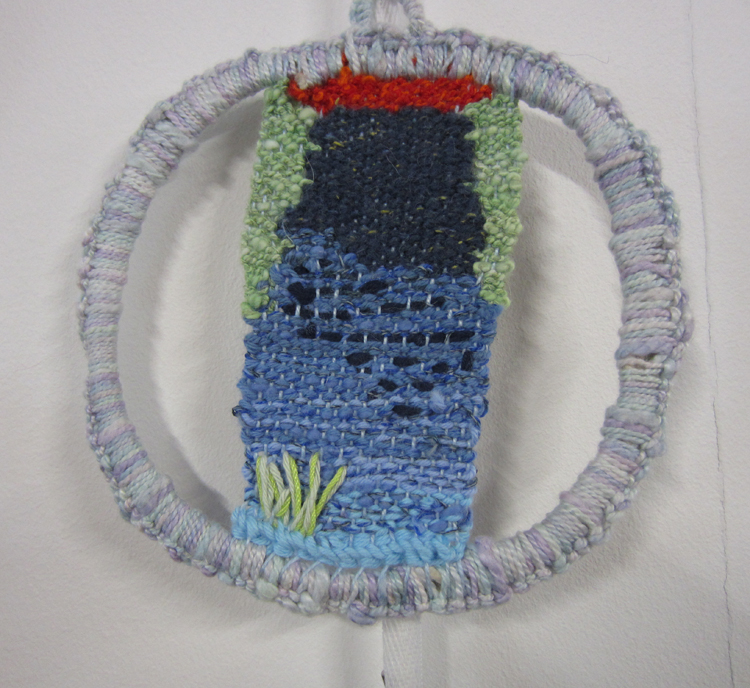
Unfortunately exhibitors had asked that images of their work are not shared on social media so I cannot add the rest of the photographs that I took.  However, one member from Durham Guild had a disc on the wall display. Anne is one of our oldest members and a founder member of the Durham Guild of Spinners Weavers and Dyers. 

Anne Evans

 After viewing the exhibition we walked along the canal to Leigh town centre. 

It was an interesting walk and we passed two boat yards and some canal boats. 


A great day out from Manchester.

Susan J Foulkes September 2022


Thursday, 1 September 2022

The Red Thread

 My piece for the exhibitors exhibition was entitled The Red Thread.

All the sayings are from different Nordic countries.  The border for each saying is in the colours of the national flag. The motifs at each end of the band were chosen to link to the particular country. 


  The red thread seemed a suitable idea that underpinned the conference in Denmark bringing together crafts people from around the world with a common love of creating narrow wares. 
The red thread around the sayings is a lucetted woollen cord. 


On the display is a Sami belt woven with the Sigga heddle, a tasuki cord in red silk, a handfasting band woven in red and gold silk and a marriage band from Sweden.  

The Sami belt woven with the Sigga heddle

A Japanese tasuki cord woven in red and gold silk

A tasuki cord is used in Japan to tie up the sleeves of a kimono or wide sleeved jacket. It is used by men and women.  

A handfasting band in red and gold silk with the eternal knot symbol

The Swedish marriage band with 101 different motifs. My initials and date are woven at one end. It is over 4 metres in length.


The Japanese lotus bag with two woven filled tubular silk cords. 

Exhibitors displays

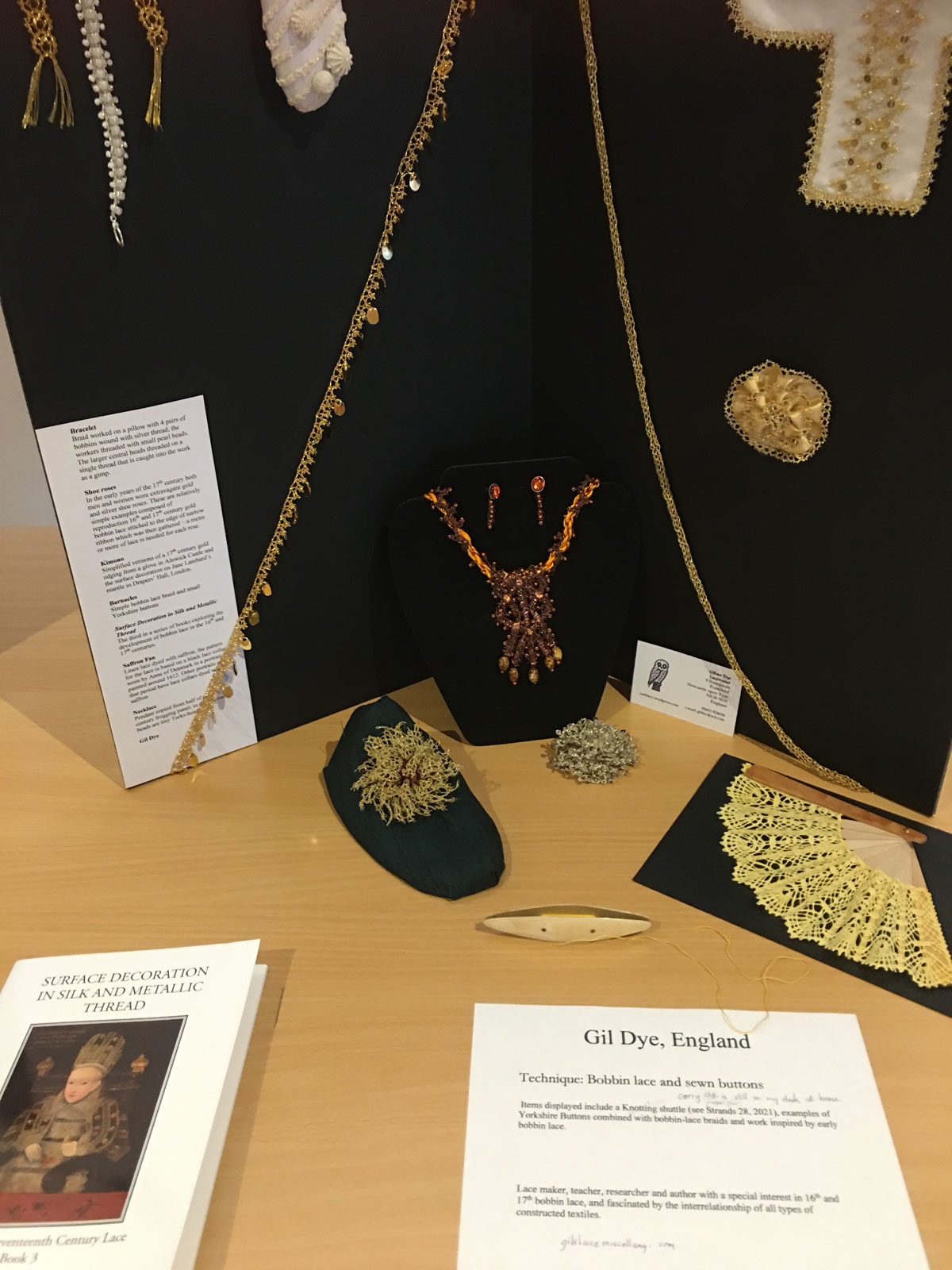
There was an exhibition of work by all the workshop providers.  Here are some

of the displays.


Exquisite work

I love these colourful bands.

The cushion cover is beautiful.


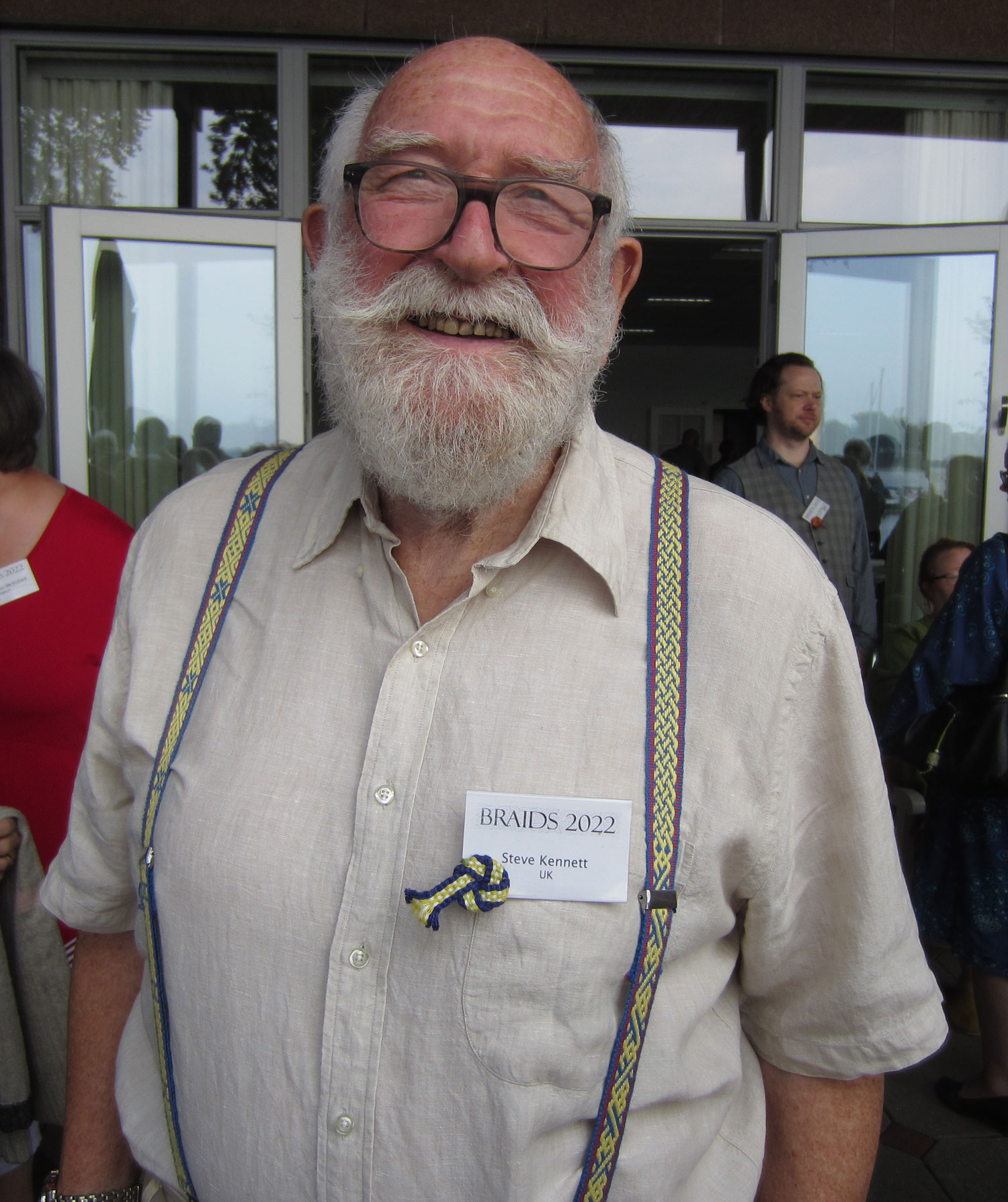
I loved the participants who wore something that they had made.
Carol's sprang trousers

Steve's inkle woven braces

Ziggy's colourful laces made with a lucet.

The next International Conference will be held in the USA in 2025.  I hope to see you there. Perhaps we should all try to make something to wear. 

Susan J Foulkes September 2022

Monday, 1 August 2022

Band patterns from Nordic countries

I wove items for my display of work at the  5th International Conference on Braiding:   Nordic and World Braids and Bands 2022, August 14-19, Svendborg, Denmark.

I enjoy weaving sentences so I have found sayings/proverbs from each of the Nordic countries. I asked a number of people for their suggestions for sayings/proverbs that had some connection to weaving or craft. Each band has a particular motif. Each saying has a border of the colours of the flag for that country.

For Sweden I chose the lovely Leksand pattern which looks like two fish.


The Sámi pattern is found in many areas but I saw it first on a long band in the Cambridge Museum of Archaeology and Anthropology.  They have a fascinating collection of Sámi artefacts and plenty of bands on display.

From Norway I chose this pattern with a heart. Norway and Sweden have many variations of heart patterns.  


From Finland I found this pattern on one of the many bands that I have examined in museums around the country.
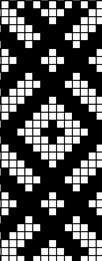


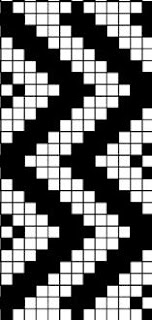
From Denmark I found this wavy pattern which evokes water.


From Iceland I found this motif which originally came from a complex band I saw in a small museum in the north of the country.


Of course, all these six patterns are shared in many countries. The geometrical nature of weaving means that there is a set of patterns which are ideal for weaving on patterned bands. Some cultures favour some types of motifs over others. It has been great fun looking at photographs that I have taken around the region. There are strong connections amongst all the countries which I hope will be reflected in in final piece. 

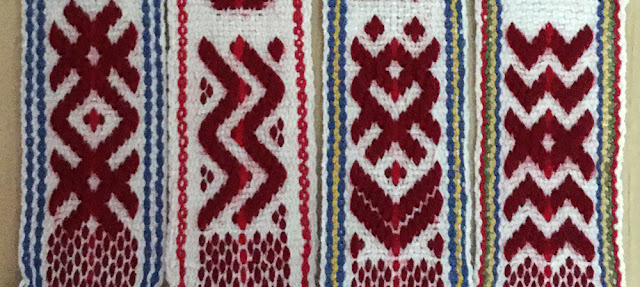
Here are the first four motifs.

The final motifs are for Greenland and the Faroe islands.  

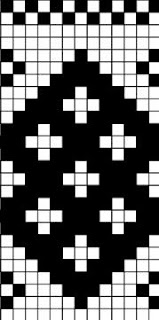
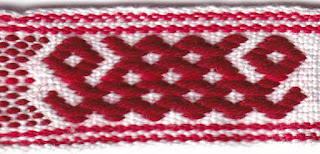
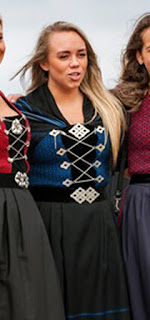
For the Faroe Islands I found a photograph of the folk costume.  One girl was wearing a lovely belt with a distinctive buckle.  I used this design for the band with the saying from the Faroe Islands.


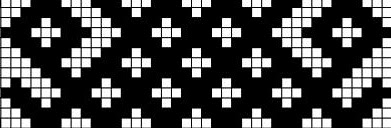
Here is the graph for the woven band.  
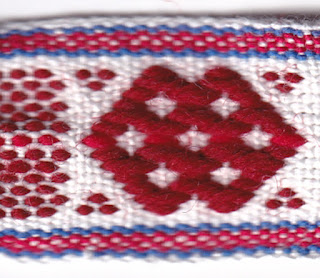


Greenland was settled by Norwegian and Icelandic explorers during the 10th century CE. There were two Viking settlements on the island. One imaginative story about the Viking voyage from Greenland to the New World was written by Nevil Shute in 1940: The Old Captivity.  He is an excellent storyteller but this book is unlike his previous stories as it deals with a mystical dream experience of a young pilot whilst recovering from an illness in Greenland. It is a haunting tale. I was reminded of it whilst I was weaving and I have started to reread the book after many years. 

I thought about what motif would be suitable for the beginning and end of the band.  When analysing motifs, I found that I would give some of them names.  When weaving, this naming is useful as it places the design in my mind and fingers.  One such design is one I have always called the 'Viking boat.' There are a few coins with Viking boat designs such as this one.
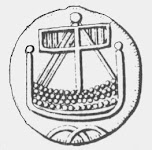
Viking coin

Here is the weave chart. 


Here is the final woven design.


This has been a fascinating project.  Here are the sayings:

den röda tråden

gennem livet går der en usynlig tråd.  

øving gjør mester  

vuosttaš maid meašttir dahká, lea oahppat   

að komast í álnir

mestariksi tuleminen vaatii kaikkien virheiden tekemistä     

altíð bagir illum barni okkurt  

uppertunut ajornartoqanngilag

I am intending to display the bands with a lucetted red cord which joins them together.  The red thread is a well used metaphor in Scandinavian countries.  It means the heart of the matter or the fundamental issue. It joins friends and communities together and is the link between Nordic countries. The red thread connects us all. 

My display of woven sayings.

I will give the translations next month. 

Susan J Foulkes August 2022


Friday, 1 July 2022

Handtowel in M's and O's


Handtowels on the loom

I wove some of these handtowels in 2017 ( see my blog for 15th June 2017)  I decided to weave another set and used the same pattern. However, I realised that I had not threaded the coloured warp ends correctly. I wove one handtowel and then corrected the threading. I had not realised this mistake when I wove the previous set so it was interesting to see if a revised threading would make a noticeable difference. 

The warp sett is 24 epi.  It is important to weave each block as a square.


M and O pattern with stripes - corrected threading

Mistake

Previously I had not recorded the pattern colours correctly for threading and I made an error.  M & O is a block pattern with two blocks. Each block had 8 warp threads. One block is threaded: 4,3 - 4,3 - 2,1 - 2,1 and the second block is threaded: 4,2 - 4,2 - 3,1 - 3,1 . The threading has three blocks with a stripe of 2 warp ends dividing the the pattern for the next three blocks. My threading mistake was to have the two coloured threads as the first two warp ends of a block.  

Threading error for the two coloured warp ends

Corrected mistake

I think that the correct colour order should have one coloured thread as the final warp end of one block and the first warp end of the next. Here is the correct warp plan.

Corrected warp colour error. 


I wove the first towel before I realised that this could be a mistake. Fortunately I did not have to rethreaded the entire warp. I rethreaded the two coloured warp ends and one of the background warp ends. 

Does this make a difference? The dividing warp ends form a wavy line down the cloth when it is washed. In the first handtowel when the two coloured ends are in one block the stripe is flattened although when washed it does appear wavy. 

Here I have overlaid two handtowels.  In the pictures, the towels on the right have the corrected threading.  The towel on the left has the incorrect threading.


Two handtowels: incorrect and correct warp threading for the coloured ends.

The warp line of blue threads has some wavy qualities in both threadings but I prefer the corrected version. 

There is always something to learn.


Susan J Foulkes  July 1st 2022


Wednesday, 1 June 2022
Durham City Freemen 500th Anniversary

On May 14th 2022, the Butchers' Guild celebrated their 500th anniversary. The Butchers' Guild is one of eight surviving Guilds which form the Companies of the Durham City Freemen. Originally there were 16 Guilds of which the Weavers and Websters were the first in 1450. The last Guild to be accepted were the Dyers and Listers in 1667. 

In 1167, Bishop Pudsey granted the first charter to the City of Durham. As the County palatinate of Durham it was unique in that the borough charter was granted by the Prince Bishop rather than the reigning monarch. In the 14th century, trading associations were formed to regulate and control the trades in the city. The first recorded charter was in 1450 for the Weavers and Webster and by the later 15th century there were 16 Guilds. The Guild Hall fronts the Market Place and was built in 1535 but the present classical façade was designed in 1754. 

Nowadays the Freemen can be any man or women of 18 years and over who has any of the qualifications required is eligible to be admitted to the Freemen of the City of Durham. They have ancient privileges which include:

  • the right of herbage on the Sands
  • the right to hold meetings in the Guild Hall
  • the right to have a stall in the market free of charge.  


The Guild Hall room has displays of various items connected to the Guilds including the crests of the Guilds. 

Crest of Butchers' Guild


The Weavers and Webster Crest

It was difficult to photograph because of the sunlight streaming in from the from the balcony window.  The motto for the Guild is  'Weave Truth with Trust.'

The Durham Guild of Spinners Weavers and Dyers were invited to join in the day of celebration for the Butcher's Guild. We set up in the Guild Hall. 


I wove a patterned band.


Diane is one of the spinners

Gary Bankhead is an underwater archaeologist who dives in the River Wear and catalogues all his finds.    https://diveintodurham.uk/gary_bankhead.htm

Some of Gary's recent finds

His table of recent finds was fascinating and included medieval spindle whorls.

On the day, the Mayor, the High Sheriff and the Lord Lieutenant arrived and there was a guest reception. There was a Town Crier in the Guild Hall who went out onto the balcony during the course of the day to announce various events. Outside in the Market Place, there were musical performers dressed in the costume of the middle ages and also Morris dancers. 


Morris Dancers


A butcher gave a demonstration of butchery on his stall outside in the market Place. 
Stall under the balcony


We had a lovely day and enjoyed meeting the people who came into the Town Hall to see the displays.

Spinning in the Guild Hall


I hope that you enjoyed this glimpse of historic Durham.

Susan J Foulkes June 2022