Showing posts with label Lithuania. Show all posts

Saturday, 15 June 2019

Lithuanian Weaving

Two years ago I was fortunate enough to be able to travel around the Baltic region.  I had not visited Lithuania before and I was impressed with the weaving traditions that I found.

The National Museum in Vilnius is in a wonderful building and their displays of textiles are fascinating.

National Museum in Vilnius
In my previous blog about my trip, I showed an example of the lovely costumes on display.  Here is another costume and a close up of the colourful patterned belt.


Close up of the patterned belt.

The belt has the typical 'moustache' fringe at each end.


The belt was worn until the end of the 19th century and was a very important part of the dress. A belt was worn everyday but on special occasions, a more elaborate sash was put on. Sashes were given as presents. When a woman married she was expected to weave dozens of sashes to give away on her wedding day as well as for her dowry.  These sashes would demonstrate her skill in weaving and also help to smooth the path to her new life with her husbands family.


I loved the patterned bands that I saw in the museum.  I have graphed and woven a few of them.  Here is a beautiful patterned band with the typical moustache fringe.

My own reproduction of a Lithuanian patterned band.
I loved the colours and the pattern.  The fringe takes a lot of wool!


Here is an old photograph showed how young girls learned to weave narrow bands.  As their skill in weaving improved wider more complex patterns would be woven.

using a backstrap to weave narrow bands


I loved this photograph as this is the way weavers in my workshops attach themselves to tables in order to use a backstrap and a heddle. These girls are using a stick with heddles which is a more time consuming method to weave narrow bands but it is very versatile.


However, you do not need to weave attached to a table.  This lovely photograph from the 1960's shows two Lithuanian girls weaving using only their legs to tension the warp. They are using a circular warp.


Weaving outside

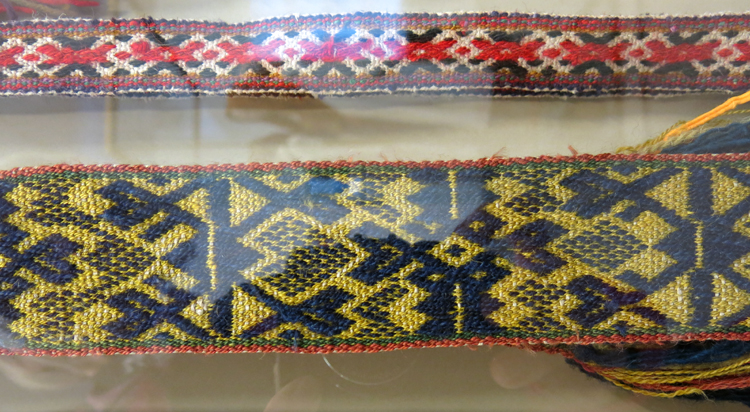
The museum had many old sashes and bands on display. I loved the range of colours used. Here is an unusual yellow and blue belt.


It is sometimes not easy to find books about weaving in other countries.

I found one lovely book which was published in 20010 by Inga Neniene. It is in Lithuanian but has a short summary of the contents in English.  With 431 pages it is quite a tome.

ISBN 978-9955-25-883-4
It is about Zanavykai weave traditions and textile heritage from the 19th century to the 21st century. It has many pages of weave patterns, both pattern drafts and actual photographs of textiles.  Here is an example.  Bedspreads using overshot patterns were very common.

an example of the many pattern drafts


some of the beautiful woven textiles
 There is also a section about band patterns. Unfortunately, I could not find the information about what colours would have been used for the patterns.
 A sample page of band patterns
However, in the English summary there is information about the use of sashes and the patterns. As in Sweden, sashes were sometimes sewn together to form a covering or even a carpet.
Mourning sashes were woven in white, black and unbleached linen. Sashes for souvenirs for special occasions were also woven with texts. Here are two examples. 


The author says that during her research she did not find any weaving women apart from one sash weaver. The last weavers had dismantled their looms in 2002 - 2003.  This lovely book is helping to preserve their tradition and also present their striking patterns to a wider audience. Even if, like me, you do not understand Lithuanian, the pictures and diagrams tell their own story.


However, if you are intrigued by Lithuanian weaving as I was, then do take a look at this book by Kati Reeder Meek published in 2000.

Reflections from a Flaxen Past:  For Love of Lithuanian Weaving.

ISBN 0 9700648-0-2

It is a treasure trove of images and patterns.  There is a useful introduction about Lithuanian history and then an awe inspiring collection of old black and white photographs of the process of turning flax into cloth from the M.K. Ciurlionis Museum.

  • There is a gallery of Lithuanians who love their countries textiles illustrated with many colour photographs.  Costumes and their details are intriguing. 
  • There is a comprehensive description of how to construct a simple sash loom and patterns of sashes to weave using it. 
  • Embroidery and patterned cloth weaving are also included. 

It is a glorious celebration of the delights of Lithuanian weaving and, of course, it is in English.

I asked Kati if I could reproduce a couple of pages of the book.  One page, page 71, celebrates the variety of ways of weaving. I have split the page into three sections so that you can see the looms detail.

 What an amazing collection of looms!

Types of looms used in Lithuania.


I have never seen a punch card system used on a small loom.  The circular variety is wonderful.

Does anyone know if this type of loom is still used or, even better, still available?


This page is typical of the detail that Kati provides about  Lithuanian spinning and weaving. There are further looms illustrated and described in the book.

Another page from her book.


She gives detailed instructions about weaving narrow bands on a home made loom.  Here is another page from her book, page 133.
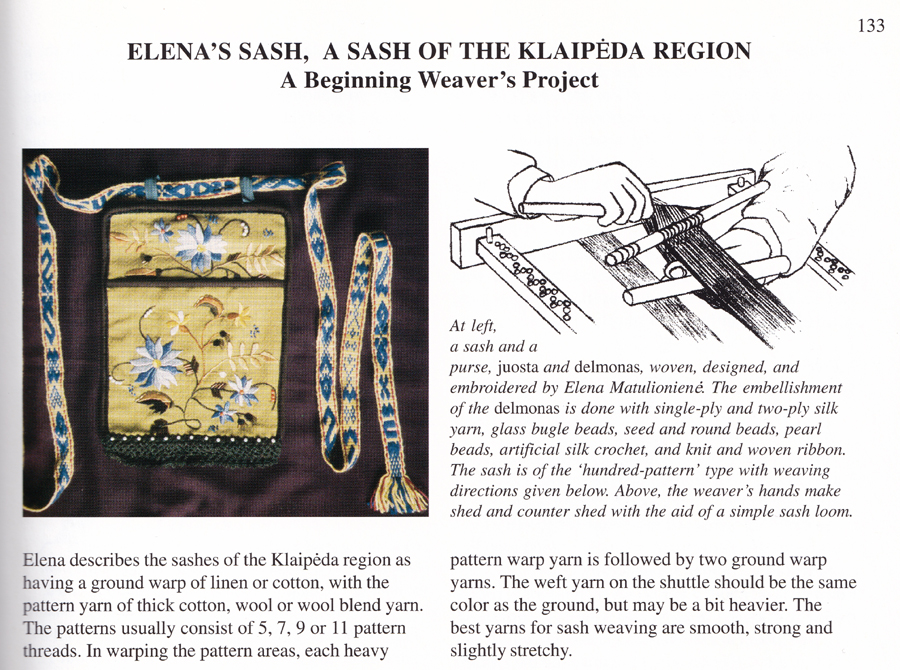


There are detailed instructions for using this type of simply equipment on the next few pages.  She calls it her 'desk drawer loom.'  It is a weaving hobby which can be stored in a shoe box - no bulky equipment required yet lovely patterned bands ca be made.

All in all this book is a treasure and is so obviously as a result of the deep love of Lithuanian spinning and weaving.

She has also published a second book which is for the specialist weaver. I have a large loom and to wind on a warp I require the help of my husband who, over the years, has become very familiar with the specialist terminology of weaving. Kati describes a method of winding on a warp which does not require a helper. I am intrigued by the method but I fear that my own weaving room is not large enough to be able to move my loom into a position where a trapeze like this could be used. Anything that makes the weavers task easier is wonderful and I am sure that there are loom owners who will find this method ideal.

ISBN 978-0-9700648-1-3

How to buy these books.

Both books are available from the USA from VavStuga.  http://www.vavstuga.com/

The book Warp with a Trapeze is available from Handweavers Studio in the UK. They have an amazing selection of books about weaving.  https://www.handweavers.co.uk/

I hoped you have enjoyed this celebration of Lithuanian weaving.  I loved the country when we visited it in 2017.  Do check out my previous blog for November 2017.
Here is the link.  https://durhamweaver64.blogspot.com/2017/11/

Happy Weaving

Susan J Foulkes  June 2019

Wednesday, 15 November 2017

Travels around the Baltic: Lithuania and Estonia

Lithuania 

I had been advised to visit the Open Air museum near Kaunas situated on the lakeside in Rumšiškės. It was established in 1966. Do check out the web site for information in English.  It has an extensive collection of traditional houses. http://www.llbm.lt/en/about-us/

The Open Air Museum near Kaunas

booklet about costume for children

The only booklet on sale was a small one for children but it had lovely colour illustrations of different costumes.

Sample page from booklet
Postcard of costumed doll


In the centre of the site is the town with a collection of beautiful buildings.


The village square


The bookshop
Surprisingly there was a second hand bookshop in the village square. This was a real find and the stock was extensive.  I found one old book about band weaving.  It does not have many colour illustrations but lots of black and white pictures of bands.

An old book about band weaving


Sample of inside page

We stayed in Kaunas for a few days. Kaunas became the temporary captital of Lithuania when Vilnius was taken over by Poland. This is a delightful small town with an old center with historical buildings. To my delight there were a few shops which had some bands for sale. You will recognise one of these bands from the Braid Society workshop notes for week three.

two bands in a local tourist shop


The capital Vilnius was a fascinating city to visit.  We used the local bus to travel to town and entered by a beautiful old gateway. On one day on our way home we found that there was a special service for a group of pilgrims at the church above the gateway.


The National Museum was a must-see and I was thrilled that there was a special exhibition of costumes from a theatre production of 1971.  They were beautiful and many had lovely woven belts.

close up of a belt from one costume
The small booklet about the exhibition had photographs and the original costume designers drawings.

The theatre was set up to celebrate Lithuanian history and culture from the 18th to the 20th century. the costumes were stunning.  This is the web site for the ethnic collection in the museum. http://www.lnm.lt/en/ethnic-culture/

I found a couple of craft shops but the only bands I saw for sale were tablet woven.  One shop had a beautiful patterned band in red and white but the pattern did not look like a traditional Lithuanian one. It was advertised as a Baltic region belt.

Tallin, Estonia.

We left Lithuania and travelled through Latvia on our way to Tallin.

Peter the Great's house museum in Tallin

We could walk to the centre from the camp site and this time visited house of Peter the Great which is now a sumptuous museum. http://linnamuuseum.ee/en/peetrimaja-eng/  This has been restored with great care and the exhibitions were fascinating.

In the grounds of the park there is the wonderful Kumo Museum of Modern Art.    https://kumu.ekm.ee/en/

Museum of Modern Art

This is an iconic building near the song festival grounds.I was most interested in an photographic exhibition which featured Tõnis Vint who helped make the film about the Lielvārde belt from Latvia. My Youtube video on how to weave complex motifs from this belt can be seen on https://youtu.be/t9Dekjt8uog

In Tallin I was disappointed to find that some of the tourist shops I visited on my previous trip no longer sold woven bands.  However, the Estonian Folk Art and Craft Union shop was still there and flourishing. The shop now two additional branches so there was a lot to see. If you visit Tallin, make sure you visit these outlets.

Check out their web site.   http://folkart.ee/en/ 


Deciding which bands to buy

One of the new outlets had an excellent collection of books including a lovely book of Lithuanian bands.
Twisting stairs to the basement 

To get to the shop involved clambering up and down steps to the basement.  It was worth the visit.

Wonderful books and textiles

Discussing which books to buy
Beautiful textiles and woven bookmarks for sale. 


In Helsinki on our next stop I saw this poster - unfortunately the performance was later in the year. the band is lovely.


It was a superb trip.

Handwoven belts in the Baltic and Scandinavian countries are an engrossing area to study. There are also other countries which have a handwoven tradition of narrow bands. Belarus and Ukraine also have a weaving tradition.  Here is a beautiful Ukrainian belt I have just bought from Elena who wove it.  it arrived a few days ago and I am still admiring the work that went into producing this lovely belt.

https://www.etsy.com/ru/shop/WovenSlavicBelts


It is a striking design and almost identical to the one I saw in Vilnius but this belt has a beautiful set of tassels to finish.

I hope you have enjoyed seeing some of the beautiful sites and textiles from these Baltic countries.  It was my first visit to Lithuania and will not be my last. The workshop gives examples of some of the wonderful woven bands from the area.

Do check out my Pinterest site as there are many examples of patterned bands from around the Baltic on the boards. https://www.pinterest.co.uk/DurhamWeaver/


Happy weaving

Susan J Foulkes November 2017