Friday, 1 May 2020

Workshop Week One: Band weaving with a rigid heddle


I am running an online workshop for the Braid Society on Braids & Bands group   https://groups.io/g/braidsandbands  This blog is part of the workshop for week one.
The Woolery in the USA, has published a post about the workshop  https://woolery.com/blog/   If you live in the USA, their online shop is open for equipment etc.


I love band weaving.  The back strap is such a practical way to weave and very portable. I also love weaving equipment, from the simple to the more highly decorated. I have quite a collection and very often have more than one is use.

My one regret is that I have not found a Sami heddle made from reindeer antler.  On my recent rip to Jokkmokk, I saw a lovely heddle in an exhibition in the Sami Douji Centre but it was bought as soon as the exhibition opened.  The person waited in the queue to get in, and immediately purchased it. Here is a picture of the heddle and the person who made it.  It was a work of art and takes a skill learned over a considerable period and many months to make.
Heddle and maker
Owning something is not really the point.  Owning something that has been made with considerable skill and that I can use, adds another dimension to weaving.  I love my large loom and find myself stroking the wood sometimes. It is the feel of the object.  Handmade heddles are such a joy to use. I feel that I am in touch with the maker as well as in touch with the skills that I need to weave. In Scandinavian countries a decorated rigid heddle was often given as a betrothal gift and there are some beautiful examples in museums.


Here are some of my standard rigid heddles.


Estonian Heddle and shuttle

Here are some of my standard heddles currently in use.  I bought a set of beautiful heddles in Boras, Sweden many years ago and they are simply lovely to hold. They still sell some of the designs.


The two heddles on the right are from vavkompaniet.

https://www.vavkompaniet.se/tools-for-textile-craft/heddles/
My first workshop online was a number of years ago. At the time, rigid heddles were not easy to find.  I tried making my own and shared the process.  Nowadays,heddles are widely available and  with the advent of 3D printing and an interest in making weaving tools, you do not have to acquire new skills to start weaving.

Here are the series of pictures I posted.  I am not a wood worker, so carpenters look away now! These heddles were not works of art but I enjoyed the process of working out how to make something within the severe limits of my skill.

Making a rigid heddle


1.  You will need: wooden coffee stirrers,   glue, fine sand paper, wire wool, a drill. And a length of wood, approx 24 mm in depth.  This should be flat one side but may be shaped on the other.
Choose coffee stirrers  that are straight and not warped.  Sand them to ensure that they are completely smooth. Mark the centre and drill a small hole in each stick.


2.  Sand them again and finish with wire wool.  Make sure that the sides of the sticks are smooth.  You will need more stirrers than you eventually use for the heddle.  Some will splinter or split.  In others,  you may find that your drilled hole is not central.


3.  Cut four 24 sticks the length of one coffee stirrer.  These will form the top and bottom of the heddle. Take two coffee stirrers and glue them to two of the wide sticks on the long edge.  Leave until the glue is dry.
Now spread glue on the wide sticks and place one coffee stirrer at each end. 


4.  Start to place the rest of the narrow sticks into place.  Adjust the gap between each stick.  Make the gaps as even as possible. 


5.  Glue the other two wide sticks.  Stick them on top of the narrow sticks. Place a weight on the completed heddle and leave the glue to dry.


6.  You will need to sand the top and bottom of the heddle. 
The heddle is now complete.   Usually, heddles have a handle on the bottom edge.  This helps to balance the heddle when weaving.  You can attach a small weight to the middle of the heddle on the bottom edge which should stop it twisting.


I made a number of heddles and gave them away, but I kept this one for myself. It is still in use.

Another home made standard heddle


I also tried to make my own band lock.

Making a Band Lock


You will need:
20 x 24mm wood no longer than 140mm
2 cup hooks
A thin strip of wood narrower than the first
A belt


I made a number of versions. This one uses a square section length of wood.


Another system is using a cotton reel and a ‘clip it’ with a cord to go around your waist.

Using a band lock


Band locks are not new. They have been found in Etruscan graves.  They were made of bronze.  Two identical strips with a hook on each end hold the warp ends in place.  The  back strap was tied around this band lock to clamp the warp ends tightly.  I tried to find a blacksmith to make me a copy but I was unsuccessful. 

This is from an illustration in an article by Margarita Gleba.  However, there is no indication that they used the band lock in this way.  They may have woven in the opposite direction.  If the tablets are near to the band lock, you can weave over the tablets and beat away from you.  This means that any overtwist in the warp ends can be easily undone by the weaver as the unwoven warp ends are wrapped around and through the band lock. 


This band lock uses a slightly rounded length of wood. 


When you tension the warp, the band locks into place.

Week One of the workshop for the Braid Society, gives examples of woven bands from northern Europe, South America and Japan. Remember you can use an inkle loom or a two shaft table or floor loom. You do not have to use a standard heddle.

A Striped Band 

Here is a band inspired by a patterned band from Peru.


This is another beautiful Swedish heddle.


Close up of band.


Warp Chart

Blue                     6                                               6
Dk green                  2
Medium green              2
Emerald  green                 2
Yellow                                  1
White                                       1
Light pink                                      2
Medium pink                                    2
Bright pink                                           2
Burgundy                                                 1

There are 27 warp ends in total.  I used 4 ply sock yarn and the band width is 15mm. I love the way that the colours glow against the dark blue edges.

Here is the drawdown with the nine colours.

Nine colour Peruvian band

I hope you enjoy trying this band.  It is a great way to use up small quantities of yarn.

I have been making some book marks with an adapted  pattern but this time using 16/2 cotton.

Using a different yarn will alter the width of the band. i will be showing you the bookmarks and the revised pattern on another blog.


Of course other equipment can be used. I am weaving a red and white band for a belt on my floor inkle loom.


I am using double knit cotton two colours  with a red weft.

Warp Chart

red        11        1     1      2    1     1     2     1      1      12
white            1      2     1     1     2    1      1     2      1


Here is the draw down.  There are 45 warp ends in total.  The width of the band on the loom is 3 cms  1.25 inches.


Here is another way of displaying the band pattern.  We will be looking at this in a later blog.


Next week there will more patterns for you to try

Weaving equipment can be bought online from Stoorstalka who ship world-wide. They are also publishing the booklets for the online weaving workshop. I want to encourage as many people as possible to get weaving!   Here is the link  https://shop.stoorstalka.com/en/products/workshop/

All the bands in the workshop can be woven using a standard rigid heddle with a band weaving shuttle.

Susan J Foulkes  May 1st 2020


Monday, 20 April 2020

Mexican Stripes - an inspiration

Last year I visited Mexico for the first time.  We spent a week in Mexico City and then had a short tour of the south.  We wanted to see the mural art in Mexico City. These huge murals are on the walls in various buildings so can only be seen in situ.

What is so stunning in Mexico is the use of colour.


 Our hotel was conveniently near the National Monument and we had a delightful walk to the Archaeology Museum which is in a huge park.  On Sundays. the main road up to the park is closed to traffic so everyone was out walking, running, strolling and generally socialising. The park was full of stalls, entertainment and families out for a social stroll.


These security straps were for parents. The crowds were so great that to have your small child attached to you by a strap was reassuring.

Even the place settings in one restaurant had beautiful stripes on the table runners.


Even place settings are colourful

This is a wonderful bag stall.  I bought a few to give to friends.  I love the way that the warp ends have been made into a handle.


Woven sashes in warp faced plain weave using one colour only.
This is a group of woven belts - all warp faced but in one colour only.  Together they make a lovely bright display.  So many colourful stripes everywhere.

Workshop

I am running an online workshop for the Braid Society on the Braids and Bands io group and these blogs are part of the workshop. The workshop will start on May 1st and will run for three weeks.

My blog for each week of the workshop will give more band patterns for you to try.  The first post will be on May 1st, the second on May 8th and the third on May 15th.

Do check out my YouTube video about weaving this type of band.

YouTube:  Five Ways of Weaving Narrow Bands.  


Stripes

The workshop starting on May 1st will be examining simple stripe patterns in warp-faced weave bands.  No pick up is involved so the bands are easy to weave on a variety of equipment.  We will be looking at some easy ways to design your own patterns, so look out for striped pictures for inspiration.
I have a board in Pinterest called Stripes.  I put any picture of stripes that I find on this board.  There are lots of similar boards devised by others.  Why not do some exploring yourself?  Find some striped patterns that you like. They will be sources of inspiration.

Books about simple band weaving

Here are some books which look at plain weave warp-faced bands .

The Braid Society has books for sale .  https://thebraidsociety.wildapricot.org/

Unfortunately, book sales are suspended due to the coronavirus but do check them out later.

Steve Kennett             https://www.sussexspinner.co.uk/  The book is available from his site.

Making Inkle Braids An introduction to weaving inkle braids

ISBN self published, Steve Kennett, 2017

The book starts with an introduction to inkle looms and basic instructions.  It then progresses to warping for patterns, then pick up and drop down for patterning with some ideas for use. He also looks at the pros and cons of using different types of yarn. The book is clearly illustrated with diagrams and photographs.


Annie MacHale has her book In Celebration of Plain Weave, for sale on her site.  https://www.etsy.com/listing/658320160/inkle-weaving-design-book-by-annie

It is also available as a PDF download.
https://www.etsy.com/listing/539998779/inkle-weaving-ebook-by-annie-machale-in

Here is her blog.  This month she is offering a tutorial about pick up patterns.  Its great - do check it out. http://aspinnerweaver.blogspot.com/

Annies enthusiasm for inkle weaving is infectious. The book has over 100 patterns in the  most glorious colour combinations for 39, 59 and 79 warp threads. I could hardly wait to try one of her patterns.  The layout of the book is very user friendly and the patterns are large and clear to read. 

Check out my review on my blog. 

Susan J Foulkes  The Art of Simple Band Weaving 

My self-published book The Art of Simple Band Weaving covers bands like the Sanada Himo bands.  It is available from blurb.com in print or a ebook version for the IPad.

http://www.blurb.co.uk/b/6375234-the-art-of-simple-band-weaving

Check out my blog at:  https://durhamweaver64.blogspot.co.uk/


Happy weaving and stay safe.

Susan J Foulkes  April 2020


Wednesday, 1 April 2020

Jokkmokk Marknad 6 8 Feb 2020


Jokkmokk Market 2020 was a wonderful event. If you followed my blog whilst I was there you will have seen such glorious images.

Jokkmokk is within the Arctic Circle.  We stopped to take photographs of the sign.

One of the Arctic Circle stopping points.

We arrived a few days before the Market opened as I knew that there was going to be so much to see and so many people to meet.

Practically next door to the hotel was the Sami Doudji Centre.

Sami Doudji Centre near the hotel

Here I met Juhan for the first time having only corresponded by email. He was very busy because two exhibitions were being assembled in the Centre.


Juhan and I in the Sami Doudji Centre
The Sami Doudji Centre was very busy for the whole week and had drafted in additional help.  There was a great selection of beautiful Sami handicraft for sale.

Just one corner of the room!
I was very excited to find that three books on Sami weaving, which had long been out of print, were now for sale.

A selection of the books on sale

Here are two of them. Stoorstalka might be selling them soon.  I mention them on my blog on the page about weaving books from Sweden.

Here are the three books  which are now back in print.


(2000) published by Sameslojdstiftelsen Sámi  Duodji ISBN 91-631-0498-9


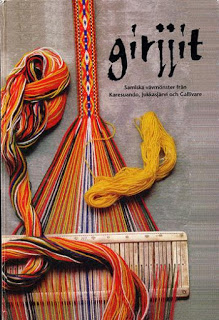
Girjjit Samisks vavmonster  Karesuando, Jukkasjarvi och Gallivare  (1999)  ISBN 91-630-9564-5
This book is excellent. The patterns are very clear and I understand that it was written by local weavers. 


Sjnjissjkot ja lahtat  Samiska band fran Arvidsjaur, Arjeplog och Mala  (2000) published by Sameslojdstiftelsen Sámi  Duodji ISBN 91-631-0499-7

There were a number of exhibitions in other venues both before and during the market.
The Old Pharmacy
The Old Pharmacy is on the central street and sells locally produced handicrafts.  There were several rooms and lots of interesting items for sale.

Inside the Old Pharmacy
The town was practically deserted for these few days, that is apart from the snow clearing and the officials marking out the spaces for the stalls.

I loved the ski baskets that people used when they were out shopping.


Laponia Adventures.  


We had booked the market portion of our holiday with Laponia Adventures.  https://www.laponiaadventures.com/

Mirja from Laponia Adventures in the hotel lobby.
Here is Mirja who was our guide for the adventure part of the holiday - dog sledging and snow mobile,  a trip to see moose and meeting a reindeer herder.  It was excellent, as was the hotel which was in the centre of town.

Here I am dressed for a dog sledging trip.  I have two coats, a sleeveless warm fleece,  shirt and thermal vest with a thermal buff and hat and two pairs of trousers and leggings! On top of that I was given a ski suit to wear and very warm boots.

Very cosy
 The dogs were amazing.   There were two sledges with 12 dogs each.  We were driven for 12 kilometres and then we stopped for coffee and a bite to eat in a tent. It was minus 27 degrees centigrade!  I really needed the extra layers.  Unfortunately I forgot that camera batteries cease to function in the cold so it was difficult to take pictures.

Setting off after our coffee break
I did not go with the group to find moose as I wanted to spend more time in the museum. Martin and the group found over 30 moose and were able to take pictures.

Three moose


The Jokkmokk Market


The Market opened on the Wednesday evening and the market was open from Thursday to Saturday.
Juhan was part of the opening ceremony.

Juhan trying out the microphone before the opening ceremony

Part of the opening ceremony

Once the market opened,  Jokkmokk became very crowded.

 A busy day on one of the market streets
 Everyday at noon there is a paraded of reindeer.

One of the reindeer in the parade.

This is eagerly anticipated and very colourful.

There were a number of exhibitions of Sami handicraft including many colourful textiles.

Part of the exhibition of the work of students at the Sami handcraft school
Well, there is so much to show that I think  will write another blog about some of the exhibitions I saw.

Do check my Facebook page for more pictures and videos. https://www.facebook.com/sue.foulkes.5
While I was in Jokkmokk I wrote a daily piece on Facebook.

Keep well and safe.

Braid Society Online Workshop


I am running a workshop for the Braid Society online starting in May.  The workshop is about weaving narrow warp-faced bands in stripes. It is free to join in. It will be hosted by the Braids and Bands groupsio site.

I hope to be able to make the workshop booklets more widely available. Check out my blog later this month for further details.

The equipment needed is the standard heddle.  The bands are simple warp-faced plain weave with no pick up. A pattern slot heddle like the Sunna heddle is not suitable.

Here is an outline of the sessions.

Week 1  An introduction to Sanada-Himo bands from Japan. Sanada-Himo are the traditional woven bands from Japan used to tie scrolls and boxes, and used in making samurai armour. Tamaki
Takagi wrote an interesting article about sanada-himo bands for her workshop in Tacoma., in 2016. It
was through her workshop that I became interested in these bands.
I will also introduce some other simple striped bands from around the world. The week will give you
a range of patterns to try if you want. The striped band seem to be used everywhere. These are the
ties that bind us all together in a community of handweavers.
You do not have to weave all of them. Just choose one that takes your fancy.

Week 2:  Simple ideas for designing your own stripe patterns.
This session and the next may be of interest to weavers, particularly those who like to weave plain
weave scarves.
In this session we will be looking at very easy ways of varying a striped pattern.

Week 3:  Further ideas for creative stripe designing
This session will give you ideas on how to design your own stripes from scratch. 

The equipment list has already been posted.  Anything will do from a standard heddle and backstrap, inkle loom, two shaft floor or table loom, tape loom, rigid heddle loom. As for materials, again cotton, wool, cottolin etc would be fine.  Why not reduce your stash!

I thought that it would be fun to share a workshop of easy-to-weave bands with some added exercises in making your own stripe patterns to weave.


Stockists

Stoorstalka 

Stoorstalka is open for mail order.They sell the Gepha shuttle and the standard heddle. The large white, the medium white and medium gold are suitable. The large white has 103 and the medium heddles have 63 slots and holes.  Most bands in the workshop have up to 60 warp ends but a few have more.  They can be woven on an inkle loom or a two shaft table or floor loom.    https://shop.stoorstalka.com/en/products/bandweaving-heddles/

Woolery, USA

The Woolery is open for mail order as is the Woolery.
Standard heddles .and the Gepha shuttle are stocked by The Woolery in the USA
go to  https://woolery.com/  They have a great selection of yarns for weaving and a variety of band weaving equipment which would also be suitable for the workshop including, band looms and inkle looms.

Happy weaving

Susan J Foulkes  April 2020

Thursday, 5 March 2020

Polish Asymmetrical Basket Weaving

I have always wanted to try basket weaving. Recently a friend  went on a one-day workshop and made a beautiful basket.  I decided to try as well so I enrolled for a one day workshop making a small  asymmetrical basket.  The workshop is held in a wonderful building just outside Durham City: Ushaw Historic House, Chapel and garden.   http://ushaw.org/

Ushaw was founded over 200 years ago to educate students for the Catholic priesthood, the vast estate contains buildings designed by Augustus Pugin and his followers, and is one of the most important examples of Victorian Gothic architecture in the North East. It is now a conference centre, bed and breakfast, offers workshops and beautiful gardens to enjoy.

Aerial view of Ushaw
The one day workshop is run by Jo from Abundant Earth.    The Polish asymmetrical basket is made with a solid wooden base, woven willow sides and a wooden handle.

Jo is a very experienced basket weaver.  They have a lovely Facebook page.
                          https://www.facebook.com/abundantearthdurhamuk/


 I arrived at 9:45 and waited with the other seven workshop participants in the entrance lobby.
The entrance hall to Ushaw College

There was a a lovely walk to the workshop room


The amazing corridors
This is the tutor's basket - she made it yesterday in three hours!  It is beautiful and so evenly woven.  It is made of willow which she cut herself and dried. Then it was soaked for one week for this workshop.


The asymmetrical Polish basket. 
The workshop was in the William Allen gallery and was designed by Edward Pugin.  It was originally the Natural History Museum of the College and now houses visiting exhibitions and is used as an art gallery.
the workshop was held in the William Allen gallery.


The art work was for sale. There was a display of work  from Jo our tutor.


Display of work by the tutor for sale


Here is my base for the basket.  I had to choose 27 willow rods.


My base
Jo demonstrated how to make the base of the basket. It always looks so easy when an expert is demonstrating.


Jo demonstrating how to begin

the first round

One round complete

Here is my finished base.  I have attached all the upright willow rods and I am about to start the weaving.


I finished the base

I wove about four inches and then it was time for lunch.  I used two colours of willow.

After the morning session

We had our lunch in the Parlour,. This room was originally for the professors so that they could dine away from the students.  It was designed by Edward Pugin.


The parlour - what an amazing place to have lunch.
This is the refectory which is open to the public. This room was designed by Edward Pugin and was the dining hall for the students.  The dinners were eaten in silence. It is now Divines Tearoom and is very popular.

This is the refectory next door
Another view of our dining room.  I have never dined at such a large table with these  amazing candlesticks.
Another view of our lunch room


Back to work in the afternoon.
Weaving one side

Weaving the second side
By four o'clock we had all finished our baskets.  Mine is a bit wonky - but it is supposed to be asymmetrical.
my finished basket 
I had a wonderful day.  It was so absorbing although my fingers are quite sore. Bending willow rods is hard work.

It was really lovely to try a new craft. I have always wanted to try basket weaving.

Saturday, 1 February 2020

book reprint


STOP PRESS!      Reprint


This lovely book by Barbro Wallin was first published in 2012. It has been unavailable for some time.   Barbro informed me that it has just been reprinted!

Here is a description of the beautifully illustrated book. It is in Swedish but the diagrams make it easy to understand.

This beautifully illustrated book is published by the Zorn Museum in Mora, Sweden. It is in Swedish but the band patterns are clearly set out. Barbro has carefully recorded the bands that she has woven over many years.  The bands are woven on a Swedish band loom using coloured heddles to choose the pattern threads.  The bands use a threading which has three background threads in between each pattern thread.

When I visited Sweden a number of years ago, I met Barbro.  She is a lovely lady, and a very skilled weaver and teacher.  She let me try her loom - although I was not very successful!  Her band records are filed neatly and are so meticulous. It puts me to shame.

She was generous with her time and took me to see some of the nearby sights as well as a guided tour of the museum.

Here are some of the samples that she kindly gave to me.  It is a real privilege to have some of her own woven bands.


Two samples given to me by Barbro


Here is her Facebook page about this type of weaving.

https://www.facebook.com/pages/category/Product-Service/Moraband-Barbro-Wallin-581287432018528/.                          

Do check out my Facebook page for pictures of the Sami winter Market in Jokkmokk. The market is open for three days but earlier in the week there are a number of handcraft exhibitions which open on Monday. 

Happy Weaving for 2020.

Susan J Foulkes  February 2020