Friday, 15 September 2017

Fashionable Woven Belts 2

Sash Belts

I saw a fashion article earlier this year with an illustration of a lovely sash belt.

Close up of sash belt

Here is another sash I saw in a shop window.


I remembered that I had bought a Peruvian sash belt many years ago.

Peruvian sash in warp faced plain weave. 

It is  163 cm  in length and 7.5 cm( 3 inches) in width.
Here is a close up of the material.  It is in warp faced plain weave and uses very fine cotton.

Close up of sash belt from Peru

Of course, sash belts are part of the folk costume in many countries. They are made using many different techniques; finger weaving, tablet weaving, sprang as well as patterned band weaving.
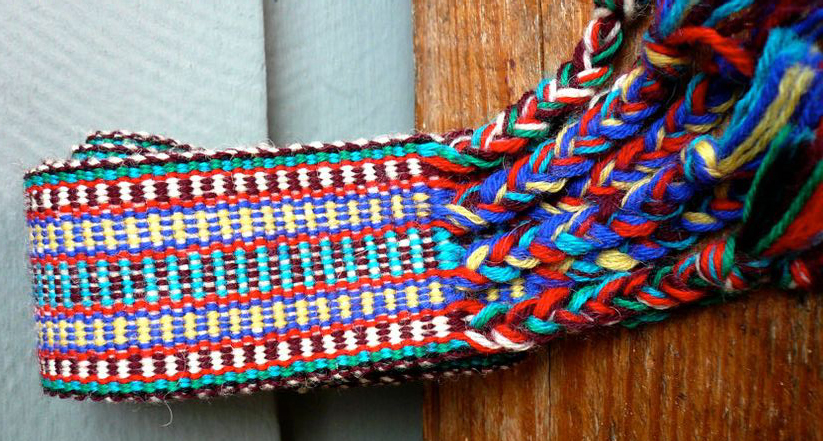
Norwegian belts


Russian belt


Sash from Guatalmala.


Assumption sash, Canada.


Here is another traditional Ukrainian Belt, called krajka, handmade using the old traditional weaving loom in Western Ukraine. There are some lovely designs shown in the Etsy shop WovenSlavicBelts.


Ukrainian woven sash


Weaving a warp faced plain weave sash.


Sash belts are easy to weave and wear.  I thought that I would try to weave my own sash as I love stripes and warp faced plain weave is such an easy structure. I was not sure of the sett for 16/2 Swedish cotton.  I decided to use a high sett and weave a short sample.

I used three colours of red, white and blue, with a darker blue for the border.  I used a 14 dent reed with 6 ends per dent.  Weft is white 16/2 cotton.

Sett at 84 per inch

width 3.75 inches / 9.5 cm     =       324   ends

Dark Blue 30
Mid Blue              1       25               1
White            41                       18
Red                          25        1                 Centre  40 red  then reverse the colour order.


Belt on the loom

It was easier to weave than I thought it would be. The Swedish cotton is good quality and strong.

close up on loom showing dotted edging to the solid colour areas
I tried using a dark navy weft so that the edges of the band would be a solid colour. This made the white stripe darker so I switched to using a white weft.  This was better and did not show up in the red and blue striped areas.  It makes a white dotted edge to the belt which echos the dotted edges of red and blue.

Here is the finished belt. It is 9.5 cm in width which I feel is slightly too wide. The feel of the woven material is smooth and flexible.  The cotton has a slight sheen.  The colour is more natural than on the close up on the loom. Artificial lighting alters colour values.


This is the finished belt. 

I am not sure I will wear this as a belt.  The material is lovely to handle and I thought that I could make a small bag with it.

It was a good learning exercise.  I now know the sett for weaving warp faced wider bands and the type of material that 16/2 cotton produces.

Happy weaving

Susan J Foulkes  September 2017


Friday, 1 September 2017

Traditional handtowels Cat Track and Snail Trail

The first book that I bought when I started to learn to weave was A Handweavers Pattern Book by Marguerite P Davison.  It was first published in 1944.  It is a treasure - lovely to browse and full of traditional patterns with wonderful names such as Gothic Cross, Queen's Delight, Batchelor's Fancy, Wall of Troy, and Saterglantan.  The last name felt very exotic and it was many years before I discovered that Saterglantan is a weaving college in Sweden.

I decided to weave one of the patterns - Cat track and Snail trail which I saw in an Interweave Press booklet.  In Marguerite Davison's book it is known as Wandering Vine.


 This is a design that can be played with and new combinations discovered.

Another variation for cat track and snail trail.


Here is another version. The cat track is more distinct and the snail trail is narrower. Remember that there needs to be a plain weave tabby in between the pattern weft.


A variation of the pattern


I decided to adapt the pattern to make four shorter cat tracks surrounded by the 'snail trail'. Perhaps it should be christened kitten track and snail trail

weave chart for cat track and snail trail


The hand towel warp is 16/2 cotton and the weft is 16/2 cotton and the pattern weft is 16/2 linen doubled.
The sett is 24 epi for the 16/2 cotton stripes.
The ppi is approx. 40 because of the tabby overshot.

The warp is in stripes 40 ends in white and 40 ends in colour. I used five stripes of white alternating with six stripes of green.

Here is the weave chart with the tabby weft included. It does seem a little more complex but it is easy to weave.

Weave draft with tabby weft highlighted in blue.
The draft may seem a bit confusing but it is easy to get into the swing of using two shuttles. One shuttle has the plain weave weft of 16/2 cotton.  The other shuttle has a doubled 16/2 linen yarn.


Adapted cat track and snail trail.
The handtowel is very sturdy and absorbent. On the loom, the cloth will seem very stiff and rather hard.  Do not worry. Once it is washed it becomes soft.  This cloth is very absorbent.

I decided weave another version using blue and white stripes.

Weaving on the loom
Of course, the design can be varied by using a blue or white tabby yarn and a blue or white linen pattern yarn. Once threaded the pattern can be woven with either two small footprints or four smaller ones.

I  made a long warp for four towels. This warp had been lying around for some time so I used it for the online workshop with the Online Guild for Weavers, Spinners and Dyers for January 2017.  the first workshop of the year is always UFO  (Unfinished Objects)  This is a chance to look through your projects half finished or as in my case not even started and make a good effort to complete them.
I really like this workshop and each year I have managed to find the extra effort to complete long abandoned projects.  It is such a good way to start the year.  Even owning up to what you would like to do is an added incentive to really achieve your goal.  I am so pleased that I finished this before the end of January.  i really found it difficult to get up the enthusiasm needed but once started and with encouragement form other Guild members, I was away.

In between each towel I used a few picks of yellow cottolin. This is where I cut the long fabric after weaving. At the beginning and end of each towel, I wove 10 - 12 picks using 16/2 cotton in plain weave.  This is to make the hem less bulky.  The white cotton is folded underneath and will not show when the handtowel is hemmed.


Here you can see the difference when using a blue linen pattern yarn with either a white tabby weft of a blue tabby weft.

For the pattern yarn of a doubled 16/2 linen I use my large shuttle which can take two spools of yarn.

A two spool boat shuttle. 
Whenever I need to use a double yarn, I always use this shuttle.  I have tried winding two threads together but I find that there is always some slack in one yarn.

Once the fabric is off the loom, cut it into the towel lengths.  I iron the top and bottom of each towel to press the material for the hem.  I tack the hems and add the hanging tags and press again.  Then I sew the hems using a zig zag stitch.  The towels are washed in a normal machine wash.


Hanging tag.


I wove a hanging tag for the towels.  There are 35 warp ends in two colours.  i used 16/2 cotton doubled for the warp ends.  The weft is blue cottolin.


I like the effect of the dotted pattern and the horizontal stripe in the centre.

Here are two finished towels.

Two handtowels one with a two footprint cat track and the other with a smaller four footprint track.
Measurements of the two towels before and after washing.

Two track pattern

Width before washing: 45 cm                    After washing:  41.5 cm
Length before washing: 64 cm                   After washing: 61.5

Four track pattern

Width before washing:    45 cm                After washing:  41.5 cm
Length before washing:  64.5 cm              After washing:  62 cm

The towels look really lovely and are very absorbent.

Happy weaving

Susan J Foulkes May 2017

Tuesday, 15 August 2017

Exploring colour and band weaving (2)

In my book, The Art of band Weaving, I described a way of designing colour stripes for bands.


Using a colour strip from the photograph.


I enjoy experimenting with colour. I thought that I would use my own method to design a stripe pattern for a woven band from this picture.


View across Framwellgate Bridge near my home.

I isolated a strip from the photograph.  This can be done at any angle. The resulting colour strip I took is here.

colour strip from photograph
The colours of the restaurant and the greenery with the autumn leaves combined with the grey stonework of the bridge are striking.


The range of cottons to match the colours in the strip.


1.  Here is my first attempt to combine these colours into a band design


There are  61 warp ends using 16/2 cotton.


Here is the woven band. This is the first design.


2.  I decided to vary the design by omitting one of the yellow stripes in the centre. I think that the second design is more dramatic. There are 56 warp ends in this band.


3.  For the third design I removed the brown stripes and made the yellow stripe in the centre smaller. There are 54 warp ends in this band.


4. I thought that I would look at an asymmetrical design. Here is the drawdown with 37 warp ends.


Which design do you prefer?

This was a very informative exercise.  I love designing bands as I can play with colour and make combinations easily.

Happy Weaving.  Enjoy exploring colour and designing your own bands.

Susan J Foulkes  August 2017

Tuesday, 1 August 2017

Exploring Colour and band weaving (1)


Exploring Colour Combinations.


I completed a very interesting course called the Power of Colour with FutureLearn.   I learned how to use some digital tools for analysing colour in an image.  There are two free tools which you can use. I took a picture of a view near where I live.  I uploaded it into the two programmes to see the range of colours:  ColorExplorer, and  TinEye Labs   You can try these programmes for yourself.

You need to make sure that the image is of a small number of pixels for the programmes to work.


Here is my photograph.

Photograph across Framwellgate Bridge Durham City, UK

ColorExplorer.

The first analysis is from ColorExplorer at  http://www.colorexplorer.com/

I uploaded my photograph and this is the colour analysis.


TinEye Labs.


The second analysis is from TinEye Labs. at http://labs.tineye.com/


It is interesting to compare the two types of analysis from the same photograph.  Why not try it for yourself.

As a tool for interior design I can see that it would be very useful.

The four colours from Pitaculous matched to 16/2 Swedish cotton.

First Idea.

I used the four colours to design my first band. There are 61 warp ends. i used 16/2 Swedish cotton used double to make a wider band.  the weft is 6/2 cotton in grey which is nearly the same colour as the grey 16/2 cotton at the edges of the band.

My first idea

The woven band


Second Idea.


After weaving, I decided that I did not like the single red stripe. I left the single green stripe.  There are 58 warp ends.


The woven band


Third Idea.


For band 3 I thought that I would leave the colours in stripes minimising the overlap of colours.

graph for asymmetrical band


Four colour band 3.  I like this version.


So three variations using just four colours.

I would probably not have chosen this particular combination of colours from my photograph but it has been fascinating to see what could be done with them.

I feel that these colour analysis tools would be of more use to interior designers.  It was fun to play with them. I feel that I would probably have found these colours anyway by my own method of taking a strip across the photograph.  I will show you how to do this in my next blog.


Happy weaving

Susan J Foulkes  August 2017


Saturday, 1 July 2017

Chinese Whispers and Beamish Open Air Museum.


After being inspired by The Quilters Guild project of the same name a few years ago, Durham Guild decided to produce work for this exhibition beginning in December 2015 when 12 members of the guild signed up to produce 12 images using fibres and/or yarn.

The task was simple enough…..”A completed textile of 30 x 30 cm to fit a frame of 50 x 50 cm, based on a photograph of the preceding piece within 6 weeks –  sending a photograph on to the next volunteer in line” The really hard part was not talking about the work for over one year!  The unveiling of all the entries was a very moving occasion. No-one had any idea of what to expect. The links between one picture and the next are shown in the captions to each of the items.  This challenge was so inspiring.

The results are stunning and the exhibition is a great testimony to the skills of the Guild members.

Do go to the Guild site at
 https://dgswd.wordpress.com/2017/05/02/fabulous-exhibition-chinese-whispers/   where you can see close ups of all of the items and a full description written by the members who produced them. The year long creative journey is very moving.

The Heritage Centre is near Durham Cathedral and is a busy tourist centre.


Durham Guild also has a Facebook site here:  https://www.facebook.com/Durhamguild/

Durham Guild at Beamish Open Air Museum.

The display moved on to Beamish Museum for the three days the Guild was demonstrating traditional skills.The Durham Guild of Spinners Weaver and Dyers had volunteered to dress up and demonstrate at Beamish Open Air Museum in County Durham.  I had never done anything like this before and it was so much fun!.
We were given the Band Hall  for the exhibition and demonstrating.


Here is a sample of the wonderful response to the Chinese Whispers challenge but do visit the wordpress site for a full viewing.

Part of the Chinese Whispers display.  The miners banner on the wall shows the Big Meeting.

Just to give you a background to the museum here is the web link.  http://www.beamish.org.uk/

The Band Hall was hung with banners from the mining villages. These banners are still treasured by the villages in Durham and are proudly displayed in the amazing processions for the Durham Miners Gala held every year in July. The next Gala, the 133rd,  is on July 8th.  The bands start playing in the processions and as one of the routes is very close to where I live we can hear them in the house.  I love going to the Gala Field later in the day. http://www.durhamminers.org/gala


I had not visited Beamish for a number of years and I was amazed at the variety of activities on offer.
http://www.beamish.org.uk/whats-on/traditional-experiences/

Our role for three days was to demonstrate the traditional skills of weaving and spinning.  I took along my little box loom to do some patterned band weaving. We all had to dress in costumes issued by the costume department of the museum.  It was great fun dressing up!

Dressed in costume at Beamish Open Air Museum

The day was punctuated by rumbling and clattering from the road outside the hall. There is a trolley bus for people to ride around the museum.  A horse drawn cart and steam engine also went past at regular intervals.

The steam engine

The traditional horse drawn cart


We settled in for the day. 


Some of our spinners
I was amazed at the number of visitors from abroad.  This is not so surprising really as I always visit this type of museum when on holiday.

The first wave of visitors
One table was set up with small peg looms so that children and adults could have a go.  This was very popular.  Crafts can be taught even if there is no common language.


My small band loom with a Sami band.
I took several warped heddles and managed to use weave two complete warps during the day.  The picture here is from my third warp.  It is a Sami band pattern from Kautokeino in Norway from the end of the 19th century. The pattern is from a small booklet printed, I think, in 1946 which contains patterns for 8 bands. All of the patterns are from original bands woven in the second half of the nineteenth century. This was very kindly sent to me by a Guild member who knows how much I love Sami band weaving.  Thank you.

.
Happy weaving

Susan J Foulkes